

addition, the net decrease in world coal consumption in 2015 came from the USA and China,
declining by 12.7% and 1.5% respectively.
5.1.2 Opportunities in Coal Demand
(1) Huge potential in clean coal power generation and combined heat and power
Strong demand for power and great prospects for
clean coal power generation. Clean coal power
generation is the safest, most cost-effective and
environmentally friendly way to use coal. Electricity will be the fastest-growing energy source in
the next two decades, in China and in other countries. China’s annual demand for power is forecast
to grow by 4.9% and 2.3% respectively in 2010–20
and 2020–30. In 2013, China’s power demand per
capita (3,936 kWh/person) was higher than the
world average (3,293 kWh/person). A year later it
had risen to 4,047 kWh/person. By 2020, China’s
power demand per capita and household power
demand per capita will reach 6,200 Wh/person and
1,400 kWh/person respectively. Compared with
gas-fired power generation, nuclear and wind,
coal-fired power generation is safer and more
cost-effective. Thanks to continuous technological
innovation in recent years, near-zero emissions
from coal-fired power generation are possible in
China. Coal therefore has great prospects as
China’s dominant energy source in clean coal
power generation.
Development of combined heat and power
(CHP) will be accelerated in order to increase
the share of centralised coal burning in total
coal consumption Currently, China’s centralised
coal burning accounts for 48% of total coal
consumption. The extremely large number of
coal-fired facilities that are not equipped with
pollution control technologies is a key contributor to air pollution. Industry experts have forecast
that by substituting electricity for coal, PM2.5
emissions in east and central China will decrease
by about 12%, 20% and 28% respectively in
2015, 2017 and 2020, compared to 2010. In
contrast, 99% of coal consumption in the USA is
used to generate power, which makes centralised
pollution control of coal burning possible. In the
future, China needs to take several measures to
significantly increase centralised coal burning,
thus reducing emissions from coal burning.
(2) Modern coal chemicals will be a breakthrough in future coal consumption
Modern coal chemical technologies include
coal-to-oil, coal-to-olefin and aromatics,
coal-to-ethylene glycol, and coal-to-gas. Compared with traditional coal chemicals, modern
coal chemical processes are more scientific and
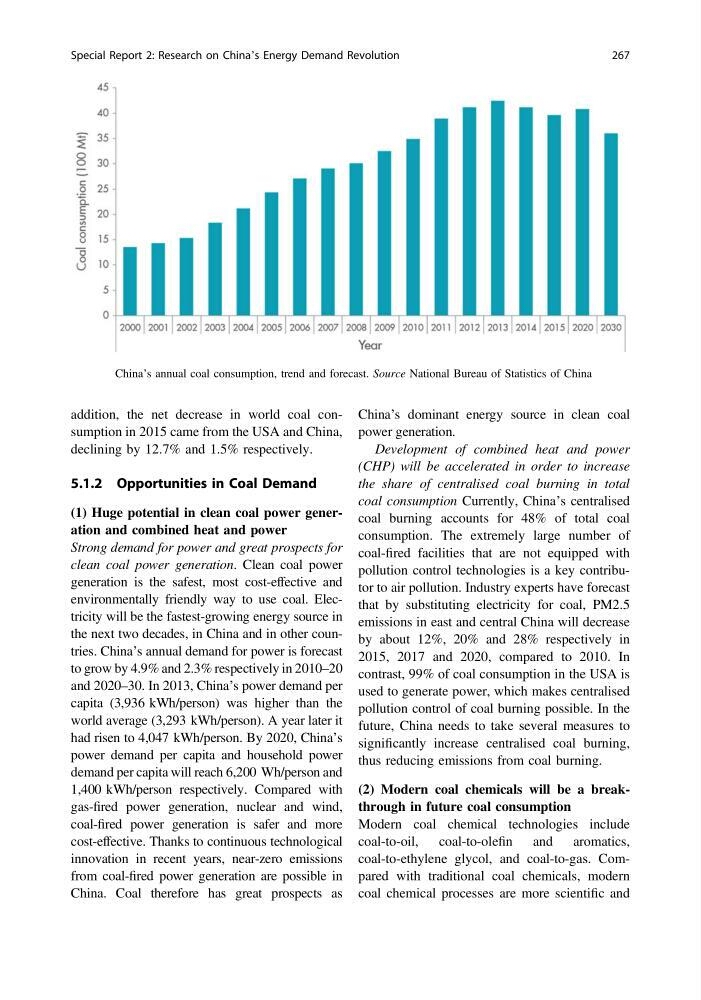
Fig. 45 China’s annual coal consumption, trend and forecast. Source National Bureau of Statistics of China
Special Report 2: Research on China’s Energy Demand Revolution
267
declining by 12.7% and 1.5% respectively.
5.1.2 Opportunities in Coal Demand
(1) Huge potential in clean coal power generation and combined heat and power
Strong demand for power and great prospects for
clean coal power generation. Clean coal power
generation is the safest, most cost-effective and
environmentally friendly way to use coal. Electricity will be the fastest-growing energy source in
the next two decades, in China and in other countries. China’s annual demand for power is forecast
to grow by 4.9% and 2.3% respectively in 2010–20
and 2020–30. In 2013, China’s power demand per
capita (3,936 kWh/person) was higher than the
world average (3,293 kWh/person). A year later it
had risen to 4,047 kWh/person. By 2020, China’s
power demand per capita and household power
demand per capita will reach 6,200 Wh/person and
1,400 kWh/person respectively. Compared with
gas-fired power generation, nuclear and wind,
coal-fired power generation is safer and more
cost-effective. Thanks to continuous technological
innovation in recent years, near-zero emissions
from coal-fired power generation are possible in
China. Coal therefore has great prospects as
China’s dominant energy source in clean coal
power generation.
Development of combined heat and power
(CHP) will be accelerated in order to increase
the share of centralised coal burning in total
coal consumption Currently, China’s centralised
coal burning accounts for 48% of total coal
consumption. The extremely large number of
coal-fired facilities that are not equipped with
pollution control technologies is a key contributor to air pollution. Industry experts have forecast
that by substituting electricity for coal, PM2.5
emissions in east and central China will decrease
by about 12%, 20% and 28% respectively in
2015, 2017 and 2020, compared to 2010. In
contrast, 99% of coal consumption in the USA is
used to generate power, which makes centralised
pollution control of coal burning possible. In the
future, China needs to take several measures to
significantly increase centralised coal burning,
thus reducing emissions from coal burning.
(2) Modern coal chemicals will be a breakthrough in future coal consumption
Modern coal chemical technologies include
coal-to-oil, coal-to-olefin and aromatics,
coal-to-ethylene glycol, and coal-to-gas. Compared with traditional coal chemicals, modern
coal chemical processes are more scientific and
Fig. 45 China’s annual coal consumption, trend and forecast. Source National Bureau of Statistics of China
Special Report 2: Research on China’s Energy Demand Revolution
267