

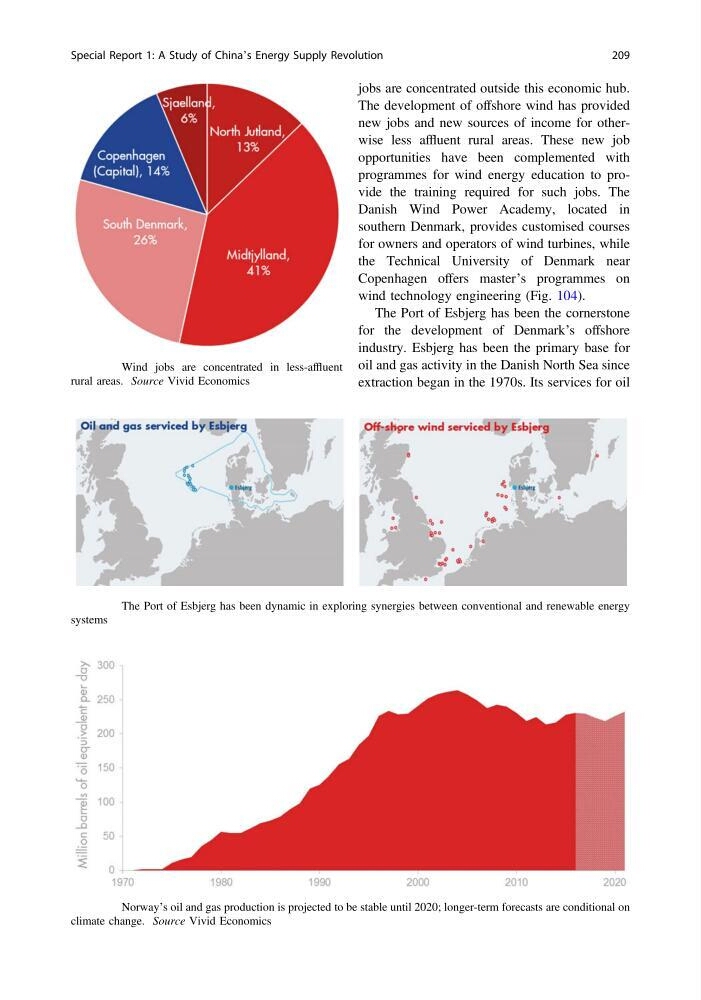
jobs are concentrated outside this economic hub.
The development of offshore wind has provided
new jobs and new sources of income for otherwise less affluent rural areas. These new job
opportunities have been complemented with
programmes for wind energy education to provide the training required for such jobs. The
Danish Wind Power Academy, located in
southern Denmark, provides customised courses
for owners and operators of wind turbines, while
the Technical University of Denmark near
Copenhagen offers master’s programmes on
wind technology engineering (Fig. 104).
The Port of Esbjerg has been the cornerstone
for the development of Denmark’s offshore
industry. Esbjerg has been the primary base for
oil and gas activity in the Danish North Sea since
extraction began in the 1970s. Its services for oil
Fig. 103 Wind jobs are concentrated in less-affluent
rural areas. Source Vivid Economics
Fig. 105 Norway’s oil and gas production is projected to be stable until 2020; longer-term forecasts are conditional on
climate change. Source Vivid Economics
Fig. 104 The Port of Esbjerg has been dynamic in exploring synergies between conventional and renewable energy
systems
Special Report 1: A Study of China’s Energy Supply Revolution
209
The development of offshore wind has provided
new jobs and new sources of income for otherwise less affluent rural areas. These new job
opportunities have been complemented with
programmes for wind energy education to provide the training required for such jobs. The
Danish Wind Power Academy, located in
southern Denmark, provides customised courses
for owners and operators of wind turbines, while
the Technical University of Denmark near
Copenhagen offers master’s programmes on
wind technology engineering (Fig. 104).
The Port of Esbjerg has been the cornerstone
for the development of Denmark’s offshore
industry. Esbjerg has been the primary base for
oil and gas activity in the Danish North Sea since
extraction began in the 1970s. Its services for oil
Fig. 103 Wind jobs are concentrated in less-affluent
rural areas. Source Vivid Economics
Fig. 105 Norway’s oil and gas production is projected to be stable until 2020; longer-term forecasts are conditional on
climate change. Source Vivid Economics
Fig. 104 The Port of Esbjerg has been dynamic in exploring synergies between conventional and renewable energy
systems
Special Report 1: A Study of China’s Energy Supply Revolution
209