

production, reducing the need to raise taxes and
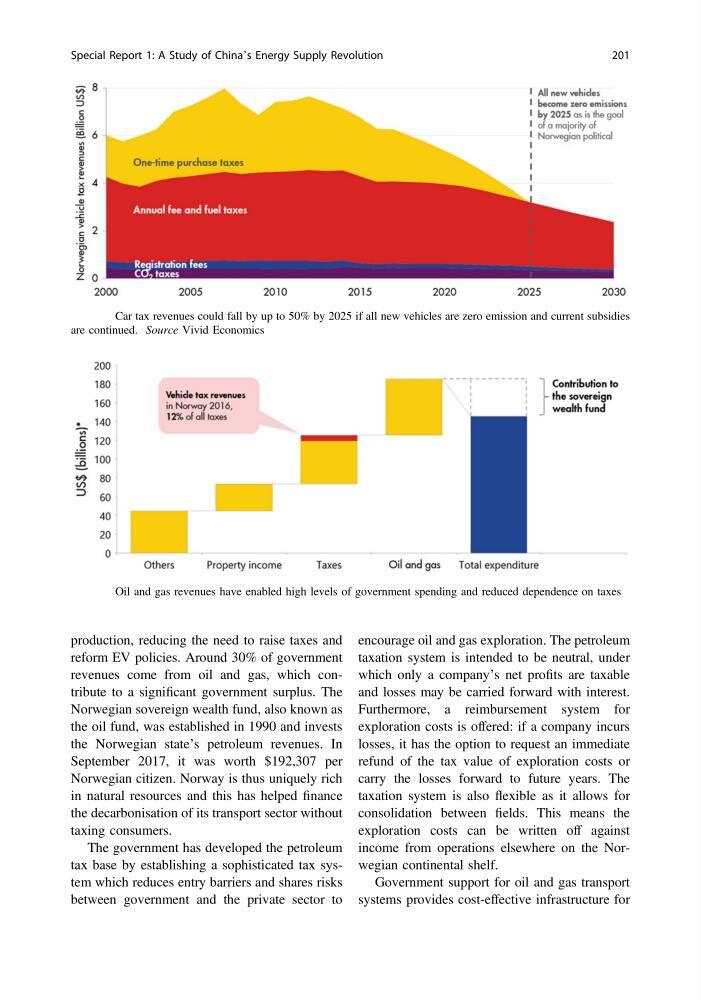
reform EV policies. Around 30% of government
revenues come from oil and gas, which contribute to a significant government surplus. The
Norwegian sovereign wealth fund, also known as
the oil fund, was established in 1990 and invests
the Norwegian state’s petroleum revenues. In
September 2017, it was worth $192,307 per
Norwegian citizen. Norway is thus uniquely rich
in natural resources and this has helped finance
the decarbonisation of its transport sector without
taxing consumers.
The government has developed the petroleum
tax base by establishing a sophisticated tax system which reduces entry barriers and shares risks
between government and the private sector to
encourage oil and gas exploration. The petroleum
taxation system is intended to be neutral, under
which only a company’s net profits are taxable
and losses may be carried forward with interest.
Furthermore, a reimbursement system for
exploration costs is offered: if a company incurs
losses, it has the option to request an immediate
refund of the tax value of exploration costs or
carry the losses forward to future years. The
taxation system is also flexible as it allows for
consolidation between fields. This means the
exploration costs can be written off against
income from operations elsewhere on the Norwegian continental shelf.
Government support for oil and gas transport
systems provides cost-effective infrastructure for
Fig. 91 Oil and gas revenues have enabled high levels of government spending and reduced dependence on taxes
Fig. 90 Car tax revenues could fall by up to 50% by 2025 if all new vehicles are zero emission and current subsidies
are continued. Source Vivid Economics
Special Report 1: A Study of China’s Energy Supply Revolution
201
reform EV policies. Around 30% of government
revenues come from oil and gas, which contribute to a significant government surplus. The
Norwegian sovereign wealth fund, also known as
the oil fund, was established in 1990 and invests
the Norwegian state’s petroleum revenues. In
September 2017, it was worth $192,307 per
Norwegian citizen. Norway is thus uniquely rich
in natural resources and this has helped finance
the decarbonisation of its transport sector without
taxing consumers.
The government has developed the petroleum
tax base by establishing a sophisticated tax system which reduces entry barriers and shares risks
between government and the private sector to
encourage oil and gas exploration. The petroleum
taxation system is intended to be neutral, under
which only a company’s net profits are taxable
and losses may be carried forward with interest.
Furthermore, a reimbursement system for
exploration costs is offered: if a company incurs
losses, it has the option to request an immediate
refund of the tax value of exploration costs or
carry the losses forward to future years. The
taxation system is also flexible as it allows for
consolidation between fields. This means the
exploration costs can be written off against
income from operations elsewhere on the Norwegian continental shelf.
Government support for oil and gas transport
systems provides cost-effective infrastructure for
Fig. 91 Oil and gas revenues have enabled high levels of government spending and reduced dependence on taxes
Fig. 90 Car tax revenues could fall by up to 50% by 2025 if all new vehicles are zero emission and current subsidies
are continued. Source Vivid Economics
Special Report 1: A Study of China’s Energy Supply Revolution
201