

can educate the workers required for the
energy transition. The case of Denmark
illustrates how workers can be reskilled and
transferred from oil and gas production to the
renewables industry through targeted educational programmes. A specific example is the
Port of Esbjerg, which used to be the primary
base for servicing Danish oil and gas production in the North Sea but is increasingly
becoming a base for offshore wind operations
and maintenance. This demonstrates how
workers can be transferred from developing
hydrocarbons to renewable energy resources.
2. Overview of supply revolutions
(1) Norway
Norway has paradoxically emerged as a world
leader in climate action, despite being one of the
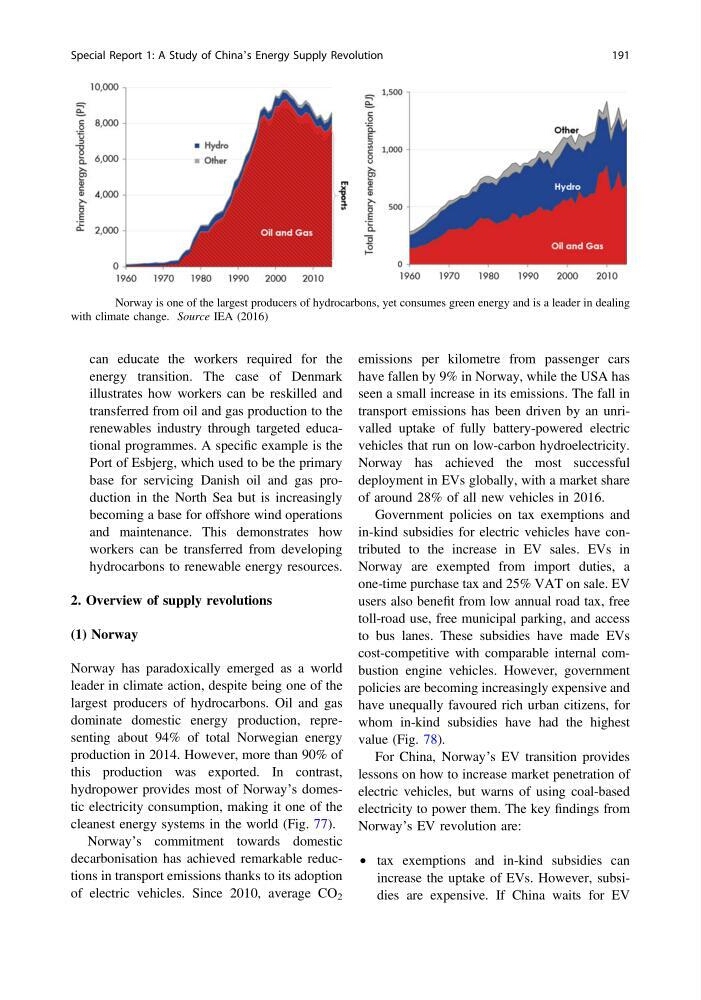
largest producers of hydrocarbons. Oil and gas
dominate domestic energy production, representing about 94% of total Norwegian energy
production in 2014. However, more than 90% of
this production was exported. In contrast,
hydropower provides most of Norway’s domestic electricity consumption, making it one of the
cleanest energy systems in the world (Fig. 77).
Norway’s commitment towards domestic
decarbonisation has achieved remarkable reductions in transport emissions thanks to its adoption
of electric vehicles. Since 2010, average CO 2
emissions per kilometre from passenger cars
have fallen by 9% in Norway, while the USA has
seen a small increase in its emissions. The fall in
transport emissions has been driven by an unrivalled uptake of fully battery-powered electric
vehicles that run on low-carbon hydroelectricity.
Norway has achieved the most successful
deployment in EVs globally, with a market share
of around 28% of all new vehicles in 2016.
Government policies on tax exemptions and
in-kind subsidies for electric vehicles have contributed to the increase in EV sales. EVs in
Norway are exempted from import duties, a
one-time purchase tax and 25% VAT on sale. EV
users also benefit from low annual road tax, free
toll-road use, free municipal parking, and access
to bus lanes. These subsidies have made EVs
cost-competitive with comparable internal combustion engine vehicles. However, government
policies are becoming increasingly expensive and
have unequally favoured rich urban citizens, for
whom in-kind subsidies have had the highest
value (Fig. 78).
For China, Norway’s EV transition provides
lessons on how to increase market penetration of
electric vehicles, but warns of using coal-based
electricity to power them. The key findings from
Norway’s EV revolution are:
• tax exemptions and in-kind subsidies can
increase the uptake of EVs. However, subsidies are expensive. If China waits for EV
Fig. 77 Norway is one of the largest producers of hydrocarbons, yet consumes green energy and is a leader in dealing
with climate change. Source IEA (2016)
Special Report 1: A Study of China’s Energy Supply Revolution
191
energy transition. The case of Denmark
illustrates how workers can be reskilled and
transferred from oil and gas production to the
renewables industry through targeted educational programmes. A specific example is the
Port of Esbjerg, which used to be the primary
base for servicing Danish oil and gas production in the North Sea but is increasingly
becoming a base for offshore wind operations
and maintenance. This demonstrates how
workers can be transferred from developing
hydrocarbons to renewable energy resources.
2. Overview of supply revolutions
(1) Norway
Norway has paradoxically emerged as a world
leader in climate action, despite being one of the
largest producers of hydrocarbons. Oil and gas
dominate domestic energy production, representing about 94% of total Norwegian energy
production in 2014. However, more than 90% of
this production was exported. In contrast,
hydropower provides most of Norway’s domestic electricity consumption, making it one of the
cleanest energy systems in the world (Fig. 77).
Norway’s commitment towards domestic
decarbonisation has achieved remarkable reductions in transport emissions thanks to its adoption
of electric vehicles. Since 2010, average CO 2
emissions per kilometre from passenger cars
have fallen by 9% in Norway, while the USA has
seen a small increase in its emissions. The fall in
transport emissions has been driven by an unrivalled uptake of fully battery-powered electric
vehicles that run on low-carbon hydroelectricity.
Norway has achieved the most successful
deployment in EVs globally, with a market share
of around 28% of all new vehicles in 2016.
Government policies on tax exemptions and
in-kind subsidies for electric vehicles have contributed to the increase in EV sales. EVs in
Norway are exempted from import duties, a
one-time purchase tax and 25% VAT on sale. EV
users also benefit from low annual road tax, free
toll-road use, free municipal parking, and access
to bus lanes. These subsidies have made EVs
cost-competitive with comparable internal combustion engine vehicles. However, government
policies are becoming increasingly expensive and
have unequally favoured rich urban citizens, for
whom in-kind subsidies have had the highest
value (Fig. 78).
For China, Norway’s EV transition provides
lessons on how to increase market penetration of
electric vehicles, but warns of using coal-based
electricity to power them. The key findings from
Norway’s EV revolution are:
• tax exemptions and in-kind subsidies can
increase the uptake of EVs. However, subsidies are expensive. If China waits for EV
Fig. 77 Norway is one of the largest producers of hydrocarbons, yet consumes green energy and is a leader in dealing
with climate change. Source IEA (2016)
Special Report 1: A Study of China’s Energy Supply Revolution
191