

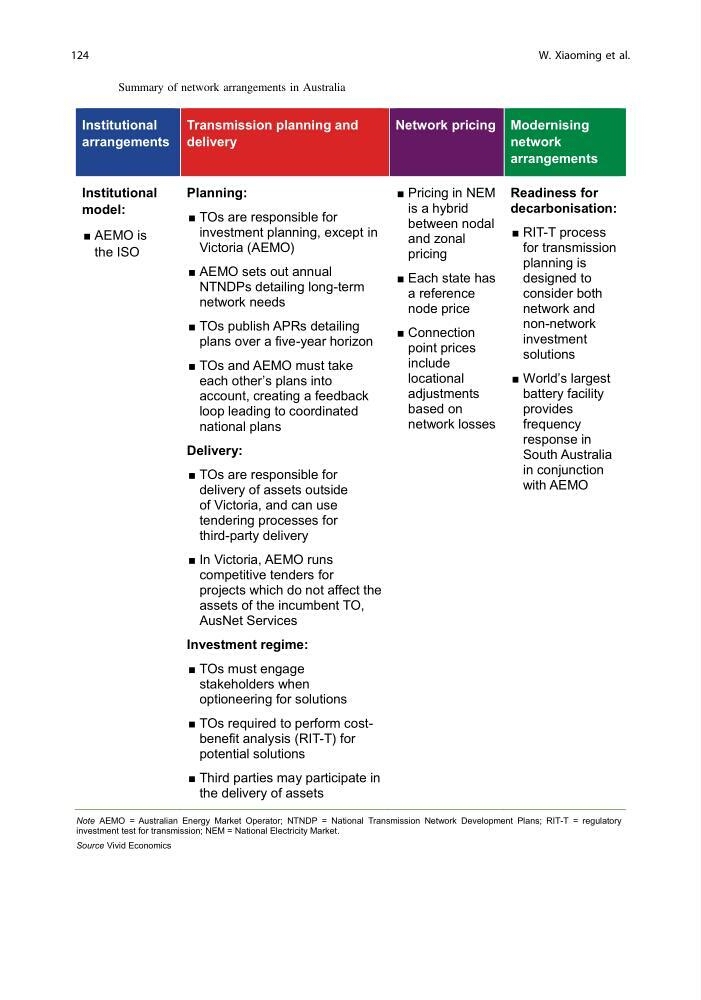
Table 8 Summary of network arrangements in Australia
Institutional
arrangements
Transmission planning and
delivery
Network pricing Modernising
network
arrangements
Institutional
model:
AEMO is
the ISO
Planning:
TOs are responsible for
investment planning, except in
Victoria (AEMO)
AEMO sets out annual
NTNDPs detailing long-term
network needs
TOs publish APRs detailing
plans over a five-year horizon
TOs and AEMO must take
each other’s plans into
account, creating a feedback
loop leading to coordinated
national plans
Delivery:
TOs are responsible for
delivery of assets outside
of Victoria, and can use
tendering processes for
third-party delivery
In Victoria, AEMO runs
competitive tenders for
projects which do not affect the
assets of the incumbent TO,
AusNet Services
Investment regime:
TOs must engage
stakeholders when
optioneering for solutions
TOs required to perform costbenefit analysis (RIT-T) for
potential solutions
Third parties may participate in
the delivery of assets
Pricing in NEM
is a hybrid
between nodal
and zonal
pricing
Each state has
a reference
node price
Connection
point prices
include
locational
adjustments
based on
network losses
Readiness for
decarbonisation:
RIT-T process
for transmission
planning is
designed to
consider both
network and
non-network
investment
solutions
World’s largest
battery facility
provides
frequency
response in
South Australia
in conjunction
with AEMO
Note AEMO = Australian Energy Market Operator; NTNDP = National Transmission Network Development Plans; RIT-T = regulatory
investment test for transmission; NEM = National Electricity Market.
Source Vivid Economics
124
W. Xiaoming et al.
Institutional
arrangements
Transmission planning and
delivery
Network pricing Modernising
network
arrangements
Institutional
model:
AEMO is
the ISO
Planning:
TOs are responsible for
investment planning, except in
Victoria (AEMO)
AEMO sets out annual
NTNDPs detailing long-term
network needs
TOs publish APRs detailing
plans over a five-year horizon
TOs and AEMO must take
each other’s plans into
account, creating a feedback
loop leading to coordinated
national plans
Delivery:
TOs are responsible for
delivery of assets outside
of Victoria, and can use
tendering processes for
third-party delivery
In Victoria, AEMO runs
competitive tenders for
projects which do not affect the
assets of the incumbent TO,
AusNet Services
Investment regime:
TOs must engage
stakeholders when
optioneering for solutions
TOs required to perform costbenefit analysis (RIT-T) for
potential solutions
Third parties may participate in
the delivery of assets
Pricing in NEM
is a hybrid
between nodal
and zonal
pricing
Each state has
a reference
node price
Connection
point prices
include
locational
adjustments
based on
network losses
Readiness for
decarbonisation:
RIT-T process
for transmission
planning is
designed to
consider both
network and
non-network
investment
solutions
World’s largest
battery facility
provides
frequency
response in
South Australia
in conjunction
with AEMO
Note AEMO = Australian Energy Market Operator; NTNDP = National Transmission Network Development Plans; RIT-T = regulatory
investment test for transmission; NEM = National Electricity Market.
Source Vivid Economics
124
W. Xiaoming et al.