

to mandate its standard market design and pursued a voluntary regional approach.
FERC’s push for a competitive electricity
sector and standard market design were received
differently by the regional transmission networks.
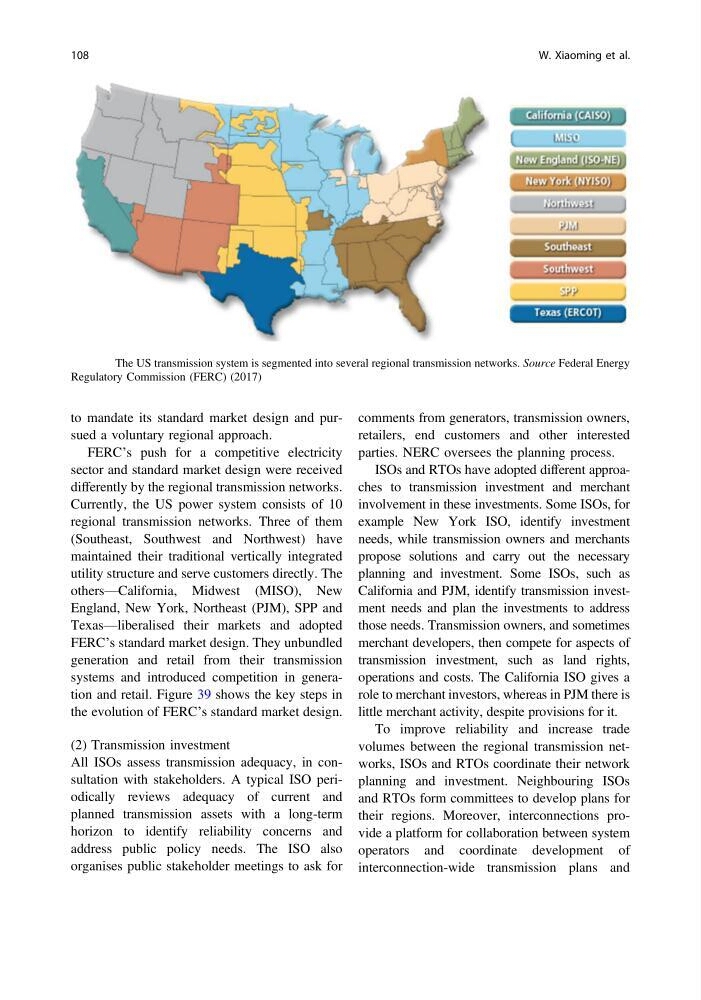
Currently, the US power system consists of 10
regional transmission networks. Three of them
(Southeast, Southwest and Northwest) have
maintained their traditional vertically integrated
utility structure and serve customers directly. The
others—California, Midwest (MISO), New
England, New York, Northeast (PJM), SPP and
Texas—liberalised their markets and adopted
FERC’s standard market design. They unbundled
generation and retail from their transmission
systems and introduced competition in generation and retail. Figure 39 shows the key steps in
the evolution of FERC’s standard market design.
(2) Transmission investment
All ISOs assess transmission adequacy, in consultation with stakeholders. A typical ISO periodically reviews adequacy of current and
planned transmission assets with a long-term
horizon to identify reliability concerns and
address public policy needs. The ISO also
organises public stakeholder meetings to ask for
comments from generators, transmission owners,
retailers, end customers and other interested
parties. NERC oversees the planning process.
ISOs and RTOs have adopted different approaches to transmission investment and merchant
involvement in these investments. Some ISOs, for
example New York ISO, identify investment
needs, while transmission owners and merchants
propose solutions and carry out the necessary
planning and investment. Some ISOs, such as
California and PJM, identify transmission investment needs and plan the investments to address
those needs. Transmission owners, and sometimes
merchant developers, then compete for aspects of
transmission investment, such as land rights,
operations and costs. The California ISO gives a
role to merchant investors, whereas in PJM there is
little merchant activity, despite provisions for it.
To improve reliability and increase trade
volumes between the regional transmission networks, ISOs and RTOs coordinate their network
planning and investment. Neighbouring ISOs
and RTOs form committees to develop plans for
their regions. Moreover, interconnections provide a platform for collaboration between system
operators and coordinate development of
interconnection-wide transmission plans and
Fig. 38 The US transmission system is segmented into several regional transmission networks. Source Federal Energy
Regulatory Commission (FERC) (2017)
108
W. Xiaoming et al.
FERC’s push for a competitive electricity
sector and standard market design were received
differently by the regional transmission networks.
Currently, the US power system consists of 10
regional transmission networks. Three of them
(Southeast, Southwest and Northwest) have
maintained their traditional vertically integrated
utility structure and serve customers directly. The
others—California, Midwest (MISO), New
England, New York, Northeast (PJM), SPP and
Texas—liberalised their markets and adopted
FERC’s standard market design. They unbundled
generation and retail from their transmission
systems and introduced competition in generation and retail. Figure 39 shows the key steps in
the evolution of FERC’s standard market design.
(2) Transmission investment
All ISOs assess transmission adequacy, in consultation with stakeholders. A typical ISO periodically reviews adequacy of current and
planned transmission assets with a long-term
horizon to identify reliability concerns and
address public policy needs. The ISO also
organises public stakeholder meetings to ask for
comments from generators, transmission owners,
retailers, end customers and other interested
parties. NERC oversees the planning process.
ISOs and RTOs have adopted different approaches to transmission investment and merchant
involvement in these investments. Some ISOs, for
example New York ISO, identify investment
needs, while transmission owners and merchants
propose solutions and carry out the necessary
planning and investment. Some ISOs, such as
California and PJM, identify transmission investment needs and plan the investments to address
those needs. Transmission owners, and sometimes
merchant developers, then compete for aspects of
transmission investment, such as land rights,
operations and costs. The California ISO gives a
role to merchant investors, whereas in PJM there is
little merchant activity, despite provisions for it.
To improve reliability and increase trade
volumes between the regional transmission networks, ISOs and RTOs coordinate their network
planning and investment. Neighbouring ISOs
and RTOs form committees to develop plans for
their regions. Moreover, interconnections provide a platform for collaboration between system
operators and coordinate development of
interconnection-wide transmission plans and
Fig. 38 The US transmission system is segmented into several regional transmission networks. Source Federal Energy
Regulatory Commission (FERC) (2017)
108
W. Xiaoming et al.