

like a virtual power plant to coordinate trading
with the wider electricity system. This aggregation can be accomplished by a central controller,
or potentially by peer-to-peer communication of
individual microgrid resources, without a central
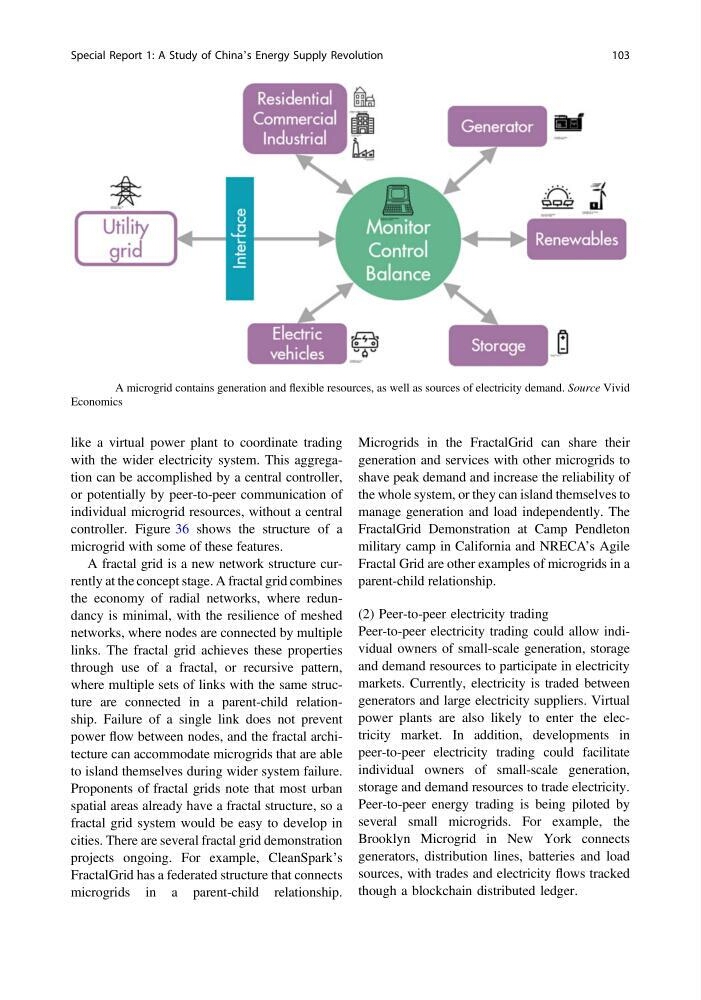
controller. Figure 36 shows the structure of a
microgrid with some of these features.
A fractal grid is a new network structure currently at the concept stage. A fractal grid combines
the economy of radial networks, where redundancy is minimal, with the resilience of meshed
networks, where nodes are connected by multiple
links. The fractal grid achieves these properties
through use of a fractal, or recursive pattern,
where multiple sets of links with the same structure are connected in a parent-child relationship. Failure of a single link does not prevent
power flow between nodes, and the fractal architecture can accommodate microgrids that are able
to island themselves during wider system failure.
Proponents of fractal grids note that most urban
spatial areas already have a fractal structure, so a
fractal grid system would be easy to develop in
cities. There are several fractal grid demonstration
projects ongoing. For example, CleanSpark’s
FractalGrid has a federated structure that connects
microgrids in a parent-child relationship.
Microgrids in the FractalGrid can share their
generation and services with other microgrids to
shave peak demand and increase the reliability of
the whole system, or they can island themselves to
manage generation and load independently. The
FractalGrid Demonstration at Camp Pendleton
military camp in California and NRECA’s Agile
Fractal Grid are other examples of microgrids in a
parent-child relationship.
(2) Peer-to-peer electricity trading
Peer-to-peer electricity trading could allow individual owners of small-scale generation, storage
and demand resources to participate in electricity
markets. Currently, electricity is traded between
generators and large electricity suppliers. Virtual
power plants are also likely to enter the electricity market. In addition, developments in
peer-to-peer electricity trading could facilitate
individual owners of small-scale generation,
storage and demand resources to trade electricity.
Peer-to-peer energy trading is being piloted by
several small microgrids. For example, the
Brooklyn Microgrid in New York connects
generators, distribution lines, batteries and load
sources, with trades and electricity flows tracked
though a blockchain distributed ledger.
Fig. 36 A microgrid contains generation and flexible resources, as well as sources of electricity demand. Source Vivid
Economics
Special Report 1: A Study of China’s Energy Supply Revolution
103
with the wider electricity system. This aggregation can be accomplished by a central controller,
or potentially by peer-to-peer communication of
individual microgrid resources, without a central
controller. Figure 36 shows the structure of a
microgrid with some of these features.
A fractal grid is a new network structure currently at the concept stage. A fractal grid combines
the economy of radial networks, where redundancy is minimal, with the resilience of meshed
networks, where nodes are connected by multiple
links. The fractal grid achieves these properties
through use of a fractal, or recursive pattern,
where multiple sets of links with the same structure are connected in a parent-child relationship. Failure of a single link does not prevent
power flow between nodes, and the fractal architecture can accommodate microgrids that are able
to island themselves during wider system failure.
Proponents of fractal grids note that most urban
spatial areas already have a fractal structure, so a
fractal grid system would be easy to develop in
cities. There are several fractal grid demonstration
projects ongoing. For example, CleanSpark’s
FractalGrid has a federated structure that connects
microgrids in a parent-child relationship.
Microgrids in the FractalGrid can share their
generation and services with other microgrids to
shave peak demand and increase the reliability of
the whole system, or they can island themselves to
manage generation and load independently. The
FractalGrid Demonstration at Camp Pendleton
military camp in California and NRECA’s Agile
Fractal Grid are other examples of microgrids in a
parent-child relationship.
(2) Peer-to-peer electricity trading
Peer-to-peer electricity trading could allow individual owners of small-scale generation, storage
and demand resources to participate in electricity
markets. Currently, electricity is traded between
generators and large electricity suppliers. Virtual
power plants are also likely to enter the electricity market. In addition, developments in
peer-to-peer electricity trading could facilitate
individual owners of small-scale generation,
storage and demand resources to trade electricity.
Peer-to-peer energy trading is being piloted by
several small microgrids. For example, the
Brooklyn Microgrid in New York connects
generators, distribution lines, batteries and load
sources, with trades and electricity flows tracked
though a blockchain distributed ledger.
Fig. 36 A microgrid contains generation and flexible resources, as well as sources of electricity demand. Source Vivid
Economics
Special Report 1: A Study of China’s Energy Supply Revolution
103