

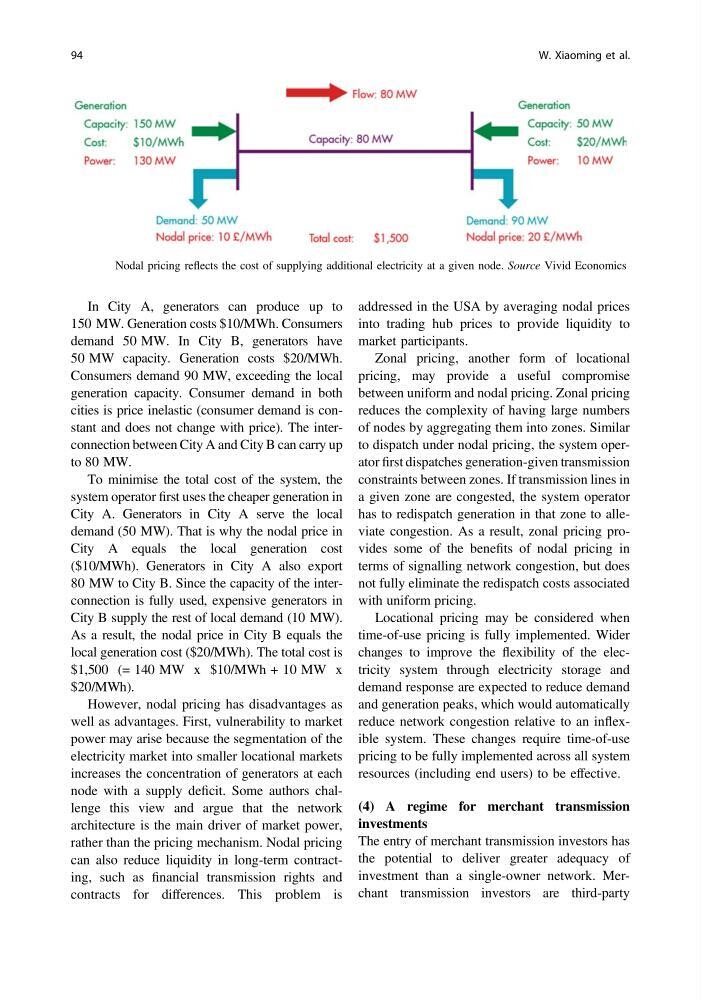
In City A, generators can produce up to
150 MW. Generation costs $10/MWh. Consumers
demand 50 MW. In City B, generators have
50 MW capacity. Generation costs $20/MWh.
Consumers demand 90 MW, exceeding the local
generation capacity. Consumer demand in both
cities is price inelastic (consumer demand is constant and does not change with price). The interconnection between City A and City B can carry up
to 80 MW.
To minimise the total cost of the system, the
system operator first uses the cheaper generation in
City A. Generators in City A serve the local
demand (50 MW). That is why the nodal price in
City A equals the local generation cost
($10/MWh). Generators in City A also export
80 MW to City B. Since the capacity of the interconnection is fully used, expensive generators in
City B supply the rest of local demand (10 MW).
As a result, the nodal price in City B equals the
local generation cost ($20/MWh). The total cost is
$1,500 (= 140 MW x $10/MWh + 10 MW x
$20/MWh).
However, nodal pricing has disadvantages as
well as advantages. First, vulnerability to market
power may arise because the segmentation of the
electricity market into smaller locational markets
increases the concentration of generators at each
node with a supply deficit. Some authors challenge this view and argue that the network
architecture is the main driver of market power,
rather than the pricing mechanism. Nodal pricing
can also reduce liquidity in long-term contracting, such as financial transmission rights and
contracts for differences. This problem is
addressed in the USA by averaging nodal prices
into trading hub prices to provide liquidity to
market participants.
Zonal pricing, another form of locational
pricing, may provide a useful compromise
between uniform and nodal pricing. Zonal pricing
reduces the complexity of having large numbers
of nodes by aggregating them into zones. Similar
to dispatch under nodal pricing, the system operator first dispatches generation-given transmission
constraints between zones. If transmission lines in
a given zone are congested, the system operator
has to redispatch generation in that zone to alleviate congestion. As a result, zonal pricing provides some of the benefits of nodal pricing in
terms of signalling network congestion, but does
not fully eliminate the redispatch costs associated
with uniform pricing.
Locational pricing may be considered when
time-of-use pricing is fully implemented. Wider
changes to improve the flexibility of the electricity system through electricity storage and
demand response are expected to reduce demand
and generation peaks, which would automatically
reduce network congestion relative to an inflexible system. These changes require time-of-use
pricing to be fully implemented across all system
resources (including end users) to be effective.
(4) A regime for merchant transmission
investments
The entry of merchant transmission investors has
the potential to deliver greater adequacy of
investment than a single-owner network. Merchant transmission investors are third-party
Fig. 32 Nodal pricing reflects the cost of supplying additional electricity at a given node. Source Vivid Economics
94
W. Xiaoming et al.
150 MW. Generation costs $10/MWh. Consumers
demand 50 MW. In City B, generators have
50 MW capacity. Generation costs $20/MWh.
Consumers demand 90 MW, exceeding the local
generation capacity. Consumer demand in both
cities is price inelastic (consumer demand is constant and does not change with price). The interconnection between City A and City B can carry up
to 80 MW.
To minimise the total cost of the system, the
system operator first uses the cheaper generation in
City A. Generators in City A serve the local
demand (50 MW). That is why the nodal price in
City A equals the local generation cost
($10/MWh). Generators in City A also export
80 MW to City B. Since the capacity of the interconnection is fully used, expensive generators in
City B supply the rest of local demand (10 MW).
As a result, the nodal price in City B equals the
local generation cost ($20/MWh). The total cost is
$1,500 (= 140 MW x $10/MWh + 10 MW x
$20/MWh).
However, nodal pricing has disadvantages as
well as advantages. First, vulnerability to market
power may arise because the segmentation of the
electricity market into smaller locational markets
increases the concentration of generators at each
node with a supply deficit. Some authors challenge this view and argue that the network
architecture is the main driver of market power,
rather than the pricing mechanism. Nodal pricing
can also reduce liquidity in long-term contracting, such as financial transmission rights and
contracts for differences. This problem is
addressed in the USA by averaging nodal prices
into trading hub prices to provide liquidity to
market participants.
Zonal pricing, another form of locational
pricing, may provide a useful compromise
between uniform and nodal pricing. Zonal pricing
reduces the complexity of having large numbers
of nodes by aggregating them into zones. Similar
to dispatch under nodal pricing, the system operator first dispatches generation-given transmission
constraints between zones. If transmission lines in
a given zone are congested, the system operator
has to redispatch generation in that zone to alleviate congestion. As a result, zonal pricing provides some of the benefits of nodal pricing in
terms of signalling network congestion, but does
not fully eliminate the redispatch costs associated
with uniform pricing.
Locational pricing may be considered when
time-of-use pricing is fully implemented. Wider
changes to improve the flexibility of the electricity system through electricity storage and
demand response are expected to reduce demand
and generation peaks, which would automatically
reduce network congestion relative to an inflexible system. These changes require time-of-use
pricing to be fully implemented across all system
resources (including end users) to be effective.
(4) A regime for merchant transmission
investments
The entry of merchant transmission investors has
the potential to deliver greater adequacy of
investment than a single-owner network. Merchant transmission investors are third-party
Fig. 32 Nodal pricing reflects the cost of supplying additional electricity at a given node. Source Vivid Economics
94
W. Xiaoming et al.