

independent system operator (ISO). International experience of the regulated TSO or ISO
model is yet to reveal the best performer of
the two, so it matters more to adopt a good
quality institutional model early than to
choose between the options.
• Select a model of control for decentralised
resources. Initially, when the number of
resources is small, the TSO may be able to
control them directly. However, as the number of resources increases, and as temporal
and locational pricing become more sophisticated, the computational, commercial and
contractual capacity of a single operator
model may be exceeded, and new models of
control may be needed.
2.2.4 An Introduction to Electricity
Networks
Electricity networks transport electricity from
generators to consumers through a combination
of high voltage transmission networks and low
voltage distribution networks. The system operator balances supply and demand on the network
at all times, within the constraints of available
network capacity.
Liberalisation of electricity markets can lead
to more efficient electricity systems by replacing
government control over markets with competition. However, government intervention remains
necessary to correct market failures. Electricity
networks are a natural monopoly and may be
subject to regulation to ensure efficient investment and operational decisions and pricing.
(1) Basic concepts
Networks are used to transport electricity and
keep costs down. First, power generators often
operate under economies of scale—it is cheaper
to build a small number of large power plants
than a large number of small plants to serve a
population. Second, generation may be located
remotely, far from sources of demand (for
example, due to environmental constraints).
Third, networks can reduce redundancy in generation investment, where patterns of generation
and demand vary geographically.
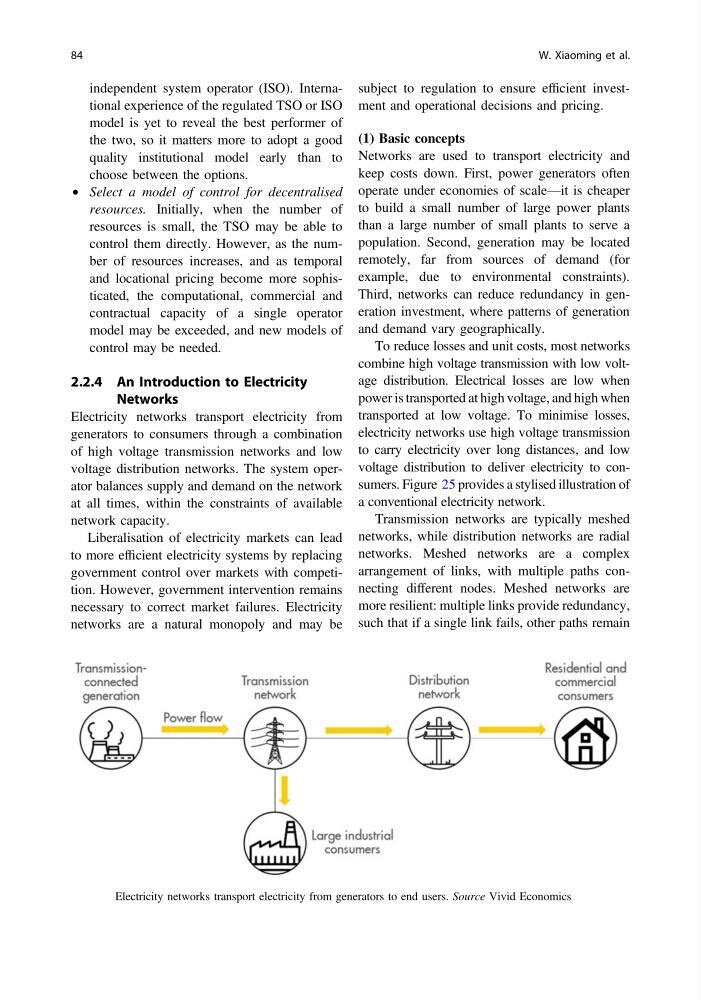
To reduce losses and unit costs, most networks
combine high voltage transmission with low voltage distribution. Electrical losses are low when
power is transported at high voltage, and high when
transported at low voltage. To minimise losses,
electricity networks use high voltage transmission
to carry electricity over long distances, and low
voltage distribution to deliver electricity to consumers. Figure 25 provides a stylised illustration of
a conventional electricity network.
Transmission networks are typically meshed
networks, while distribution networks are radial
networks. Meshed networks are a complex
arrangement of links, with multiple paths connecting different nodes. Meshed networks are
more resilient: multiple links provide redundancy,
such that if a single link fails, other paths remain
Fig. 25 Electricity networks transport electricity from generators to end users. Source Vivid Economics
84
W. Xiaoming et al.
model is yet to reveal the best performer of
the two, so it matters more to adopt a good
quality institutional model early than to
choose between the options.
• Select a model of control for decentralised
resources. Initially, when the number of
resources is small, the TSO may be able to
control them directly. However, as the number of resources increases, and as temporal
and locational pricing become more sophisticated, the computational, commercial and
contractual capacity of a single operator
model may be exceeded, and new models of
control may be needed.
2.2.4 An Introduction to Electricity
Networks
Electricity networks transport electricity from
generators to consumers through a combination
of high voltage transmission networks and low
voltage distribution networks. The system operator balances supply and demand on the network
at all times, within the constraints of available
network capacity.
Liberalisation of electricity markets can lead
to more efficient electricity systems by replacing
government control over markets with competition. However, government intervention remains
necessary to correct market failures. Electricity
networks are a natural monopoly and may be
subject to regulation to ensure efficient investment and operational decisions and pricing.
(1) Basic concepts
Networks are used to transport electricity and
keep costs down. First, power generators often
operate under economies of scale—it is cheaper
to build a small number of large power plants
than a large number of small plants to serve a
population. Second, generation may be located
remotely, far from sources of demand (for
example, due to environmental constraints).
Third, networks can reduce redundancy in generation investment, where patterns of generation
and demand vary geographically.
To reduce losses and unit costs, most networks
combine high voltage transmission with low voltage distribution. Electrical losses are low when
power is transported at high voltage, and high when
transported at low voltage. To minimise losses,
electricity networks use high voltage transmission
to carry electricity over long distances, and low
voltage distribution to deliver electricity to consumers. Figure 25 provides a stylised illustration of
a conventional electricity network.
Transmission networks are typically meshed
networks, while distribution networks are radial
networks. Meshed networks are a complex
arrangement of links, with multiple paths connecting different nodes. Meshed networks are
more resilient: multiple links provide redundancy,
such that if a single link fails, other paths remain
Fig. 25 Electricity networks transport electricity from generators to end users. Source Vivid Economics
84
W. Xiaoming et al.