

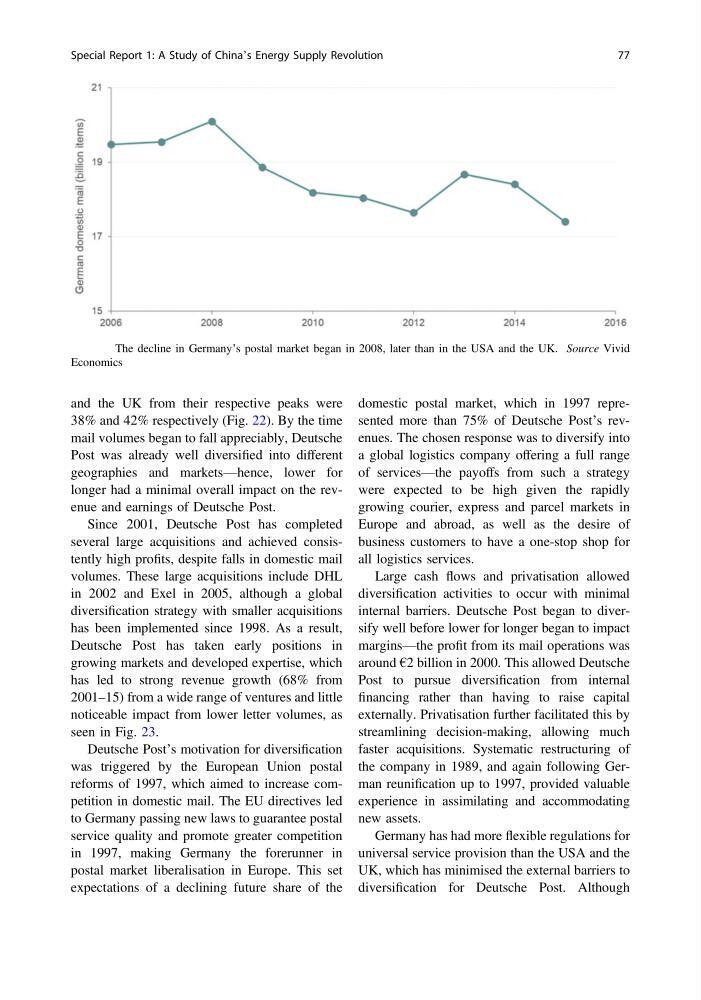
and the UK from their respective peaks were
38% and 42% respectively (Fig. 22). By the time
mail volumes began to fall appreciably, Deutsche
Post was already well diversified into different
geographies and markets—hence, lower for
longer had a minimal overall impact on the revenue and earnings of Deutsche Post.
Since 2001, Deutsche Post has completed
several large acquisitions and achieved consistently high profits, despite falls in domestic mail
volumes. These large acquisitions include DHL
in 2002 and Exel in 2005, although a global
diversification strategy with smaller acquisitions
has been implemented since 1998. As a result,
Deutsche Post has taken early positions in
growing markets and developed expertise, which
has led to strong revenue growth (68% from
2001–15) from a wide range of ventures and little
noticeable impact from lower letter volumes, as
seen in Fig. 23.
Deutsche Post’s motivation for diversification
was triggered by the European Union postal
reforms of 1997, which aimed to increase competition in domestic mail. The EU directives led
to Germany passing new laws to guarantee postal
service quality and promote greater competition
in 1997, making Germany the forerunner in
postal market liberalisation in Europe. This set
expectations of a declining future share of the
domestic postal market, which in 1997 represented more than 75% of Deutsche Post’s revenues. The chosen response was to diversify into
a global logistics company offering a full range
of services—the payoffs from such a strategy
were expected to be high given the rapidly
growing courier, express and parcel markets in
Europe and abroad, as well as the desire of
business customers to have a one-stop shop for
all logistics services.
Large cash flows and privatisation allowed
diversification activities to occur with minimal
internal barriers. Deutsche Post began to diversify well before lower for longer began to impact
margins—the profit from its mail operations was
around €2 billion in 2000. This allowed Deutsche
Post to pursue diversification from internal
financing rather than having to raise capital
externally. Privatisation further facilitated this by
streamlining decision-making, allowing much
faster acquisitions. Systematic restructuring of
the company in 1989, and again following German reunification up to 1997, provided valuable
experience in assimilating and accommodating
new assets.
Germany has had more flexible regulations for
universal service provision than the USA and the
UK, which has minimised the external barriers to
diversification for Deutsche Post. Although
Fig. 22 The decline in Germany’s postal market began in 2008, later than in the USA and the UK. Source Vivid
Economics
Special Report 1: A Study of China’s Energy Supply Revolution
77
38% and 42% respectively (Fig. 22). By the time
mail volumes began to fall appreciably, Deutsche
Post was already well diversified into different
geographies and markets—hence, lower for
longer had a minimal overall impact on the revenue and earnings of Deutsche Post.
Since 2001, Deutsche Post has completed
several large acquisitions and achieved consistently high profits, despite falls in domestic mail
volumes. These large acquisitions include DHL
in 2002 and Exel in 2005, although a global
diversification strategy with smaller acquisitions
has been implemented since 1998. As a result,
Deutsche Post has taken early positions in
growing markets and developed expertise, which
has led to strong revenue growth (68% from
2001–15) from a wide range of ventures and little
noticeable impact from lower letter volumes, as
seen in Fig. 23.
Deutsche Post’s motivation for diversification
was triggered by the European Union postal
reforms of 1997, which aimed to increase competition in domestic mail. The EU directives led
to Germany passing new laws to guarantee postal
service quality and promote greater competition
in 1997, making Germany the forerunner in
postal market liberalisation in Europe. This set
expectations of a declining future share of the
domestic postal market, which in 1997 represented more than 75% of Deutsche Post’s revenues. The chosen response was to diversify into
a global logistics company offering a full range
of services—the payoffs from such a strategy
were expected to be high given the rapidly
growing courier, express and parcel markets in
Europe and abroad, as well as the desire of
business customers to have a one-stop shop for
all logistics services.
Large cash flows and privatisation allowed
diversification activities to occur with minimal
internal barriers. Deutsche Post began to diversify well before lower for longer began to impact
margins—the profit from its mail operations was
around €2 billion in 2000. This allowed Deutsche
Post to pursue diversification from internal
financing rather than having to raise capital
externally. Privatisation further facilitated this by
streamlining decision-making, allowing much
faster acquisitions. Systematic restructuring of
the company in 1989, and again following German reunification up to 1997, provided valuable
experience in assimilating and accommodating
new assets.
Germany has had more flexible regulations for
universal service provision than the USA and the
UK, which has minimised the external barriers to
diversification for Deutsche Post. Although
Fig. 22 The decline in Germany’s postal market began in 2008, later than in the USA and the UK. Source Vivid
Economics
Special Report 1: A Study of China’s Energy Supply Revolution
77