

modernisation measures that have significantly
improved its recent financial performance.
Deutsche Post, privatised in 2000, has taken
similar steps as Royal Mail, but has gone faster
and further, diversifying from its former core
business, both geographically and in product
offering, and growing substantially as a result.
The parallels with the oil and gas industry,
both in terms of the lower for longer trend faced
and the scale of the companies themselves, make
the postal sector a good case study for oil and
gas. Both have two core products with different
outlooks: one that is facing challenges because of
long-term falling demand (oil/letters) and another
that is experiencing rising demand (gas/parcels).
In addition, both industries have faced, or are
facing, large regulatory change: deregulation and
competition in the case of post and increasing
climate change policy in oil and gas.
The large postal companies were similar to oil
and gas companies: they were often nationalised,
delivered an essential service and had huge revenues. The high capital and large economies of
scale in both sectors mean that small falls in
volumes can make large impacts on profitability.
These similarities make the postal sector a good
learning case for oil and gas companies.
USPS: An example of inaction
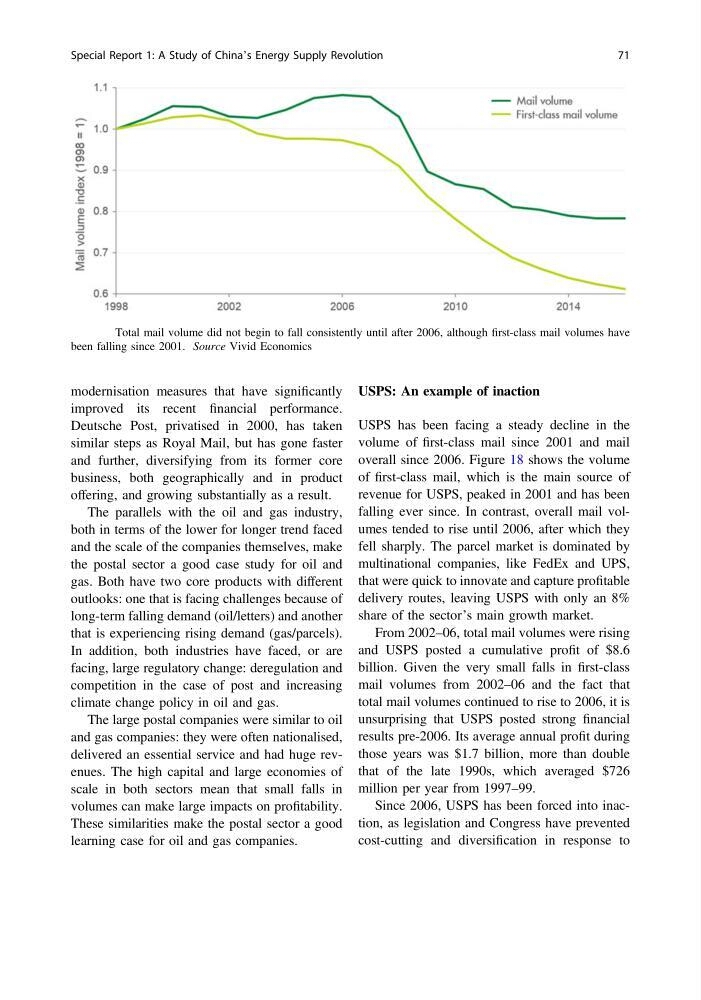
USPS has been facing a steady decline in the
volume of first-class mail since 2001 and mail
overall since 2006. Figure 18 shows the volume
of first-class mail, which is the main source of
revenue for USPS, peaked in 2001 and has been
falling ever since. In contrast, overall mail volumes tended to rise until 2006, after which they
fell sharply. The parcel market is dominated by
multinational companies, like FedEx and UPS,
that were quick to innovate and capture profitable
delivery routes, leaving USPS with only an 8%
share of the sector’s main growth market.
From 2002–06, total mail volumes were rising
and USPS posted a cumulative profit of $8.6
billion. Given the very small falls in first-class
mail volumes from 2002–06 and the fact that
total mail volumes continued to rise to 2006, it is
unsurprising that USPS posted strong financial
results pre-2006. Its average annual profit during
those years was $1.7 billion, more than double
that of the late 1990s, which averaged $726
million per year from 1997–99.
Since 2006, USPS has been forced into inaction, as legislation and Congress have prevented
cost-cutting and diversification in response to
Fig. 18 Total mail volume did not begin to fall consistently until after 2006, although first-class mail volumes have
been falling since 2001. Source Vivid Economics
Special Report 1: A Study of China’s Energy Supply Revolution
71
improved its recent financial performance.
Deutsche Post, privatised in 2000, has taken
similar steps as Royal Mail, but has gone faster
and further, diversifying from its former core
business, both geographically and in product
offering, and growing substantially as a result.
The parallels with the oil and gas industry,
both in terms of the lower for longer trend faced
and the scale of the companies themselves, make
the postal sector a good case study for oil and
gas. Both have two core products with different
outlooks: one that is facing challenges because of
long-term falling demand (oil/letters) and another
that is experiencing rising demand (gas/parcels).
In addition, both industries have faced, or are
facing, large regulatory change: deregulation and
competition in the case of post and increasing
climate change policy in oil and gas.
The large postal companies were similar to oil
and gas companies: they were often nationalised,
delivered an essential service and had huge revenues. The high capital and large economies of
scale in both sectors mean that small falls in
volumes can make large impacts on profitability.
These similarities make the postal sector a good
learning case for oil and gas companies.
USPS: An example of inaction
USPS has been facing a steady decline in the
volume of first-class mail since 2001 and mail
overall since 2006. Figure 18 shows the volume
of first-class mail, which is the main source of
revenue for USPS, peaked in 2001 and has been
falling ever since. In contrast, overall mail volumes tended to rise until 2006, after which they
fell sharply. The parcel market is dominated by
multinational companies, like FedEx and UPS,
that were quick to innovate and capture profitable
delivery routes, leaving USPS with only an 8%
share of the sector’s main growth market.
From 2002–06, total mail volumes were rising
and USPS posted a cumulative profit of $8.6
billion. Given the very small falls in first-class
mail volumes from 2002–06 and the fact that
total mail volumes continued to rise to 2006, it is
unsurprising that USPS posted strong financial
results pre-2006. Its average annual profit during
those years was $1.7 billion, more than double
that of the late 1990s, which averaged $726
million per year from 1997–99.
Since 2006, USPS has been forced into inaction, as legislation and Congress have prevented
cost-cutting and diversification in response to
Fig. 18 Total mail volume did not begin to fall consistently until after 2006, although first-class mail volumes have
been falling since 2001. Source Vivid Economics
Special Report 1: A Study of China’s Energy Supply Revolution
71