

core business from oil and gas to offshore wind.
It was incentivised by consistent wind subsidies
and implemented divisional autonomy for its
offshore wind division to insulate it from competition from other divisions within the company,
setting growth rather than profit targets until it
reached maturity.
(2) Options for adjustment
Governments can play a role in shaping the future
responses of companies by adjusting the motives
and context through policy setting. Although
strategy and organisational response choices are
decentralised and made at the corporate level, there
is potential for governments to intervene and guide
the direction of future responses by setting the
conditions that influence those responses. This can
be done by setting different targets for
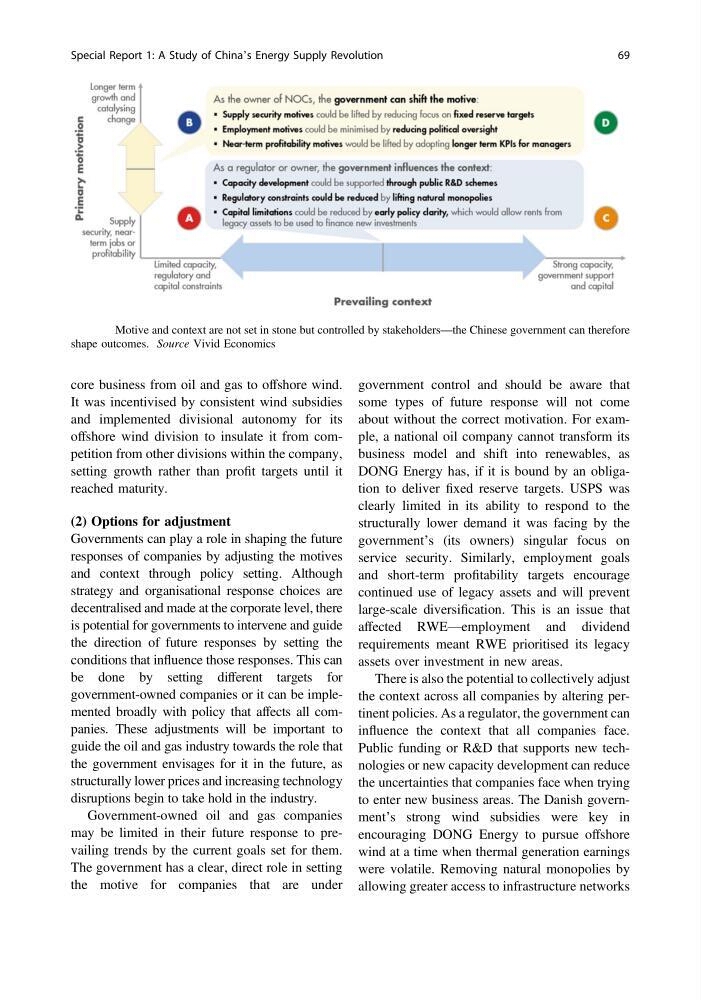
government-owned companies or it can be implemented broadly with policy that affects all companies. These adjustments will be important to
guide the oil and gas industry towards the role that
the government envisages for it in the future, as
structurally lower prices and increasing technology
disruptions begin to take hold in the industry.
Government-owned oil and gas companies
may be limited in their future response to prevailing trends by the current goals set for them.
The government has a clear, direct role in setting
the motive for companies that are under
government control and should be aware that
some types of future response will not come
about without the correct motivation. For example, a national oil company cannot transform its
business model and shift into renewables, as
DONG Energy has, if it is bound by an obligation to deliver fixed reserve targets. USPS was
clearly limited in its ability to respond to the
structurally lower demand it was facing by the
government’s (its owners) singular focus on
service security. Similarly, employment goals
and short-term profitability targets encourage
continued use of legacy assets and will prevent
large-scale diversification. This is an issue that
affected RWE—employment and dividend
requirements meant RWE prioritised its legacy
assets over investment in new areas.
There is also the potential to collectively adjust
the context across all companies by altering pertinent policies. As a regulator, the government can
influence the context that all companies face.
Public funding or R&D that supports new technologies or new capacity development can reduce
the uncertainties that companies face when trying
to enter new business areas. The Danish government’s strong wind subsidies were key in
encouraging DONG Energy to pursue offshore
wind at a time when thermal generation earnings
were volatile. Removing natural monopolies by
allowing greater access to infrastructure networks
Fig. 17 Motive and context are not set in stone but controlled by stakeholders—the Chinese government can therefore
shape outcomes. Source Vivid Economics
Special Report 1: A Study of China’s Energy Supply Revolution
69
It was incentivised by consistent wind subsidies
and implemented divisional autonomy for its
offshore wind division to insulate it from competition from other divisions within the company,
setting growth rather than profit targets until it
reached maturity.
(2) Options for adjustment
Governments can play a role in shaping the future
responses of companies by adjusting the motives
and context through policy setting. Although
strategy and organisational response choices are
decentralised and made at the corporate level, there
is potential for governments to intervene and guide
the direction of future responses by setting the
conditions that influence those responses. This can
be done by setting different targets for
government-owned companies or it can be implemented broadly with policy that affects all companies. These adjustments will be important to
guide the oil and gas industry towards the role that
the government envisages for it in the future, as
structurally lower prices and increasing technology
disruptions begin to take hold in the industry.
Government-owned oil and gas companies
may be limited in their future response to prevailing trends by the current goals set for them.
The government has a clear, direct role in setting
the motive for companies that are under
government control and should be aware that
some types of future response will not come
about without the correct motivation. For example, a national oil company cannot transform its
business model and shift into renewables, as
DONG Energy has, if it is bound by an obligation to deliver fixed reserve targets. USPS was
clearly limited in its ability to respond to the
structurally lower demand it was facing by the
government’s (its owners) singular focus on
service security. Similarly, employment goals
and short-term profitability targets encourage
continued use of legacy assets and will prevent
large-scale diversification. This is an issue that
affected RWE—employment and dividend
requirements meant RWE prioritised its legacy
assets over investment in new areas.
There is also the potential to collectively adjust
the context across all companies by altering pertinent policies. As a regulator, the government can
influence the context that all companies face.
Public funding or R&D that supports new technologies or new capacity development can reduce
the uncertainties that companies face when trying
to enter new business areas. The Danish government’s strong wind subsidies were key in
encouraging DONG Energy to pursue offshore
wind at a time when thermal generation earnings
were volatile. Removing natural monopolies by
allowing greater access to infrastructure networks
Fig. 17 Motive and context are not set in stone but controlled by stakeholders—the Chinese government can therefore
shape outcomes. Source Vivid Economics
Special Report 1: A Study of China’s Energy Supply Revolution
69