

280
M. F. Makhtar et al.
25.1 Introduction
The history of friction stir welding (FSW) began in the 1990s. It was invented by
Wayne Thomas and patented by The Welding Institute Ltd (TWI) in December 1991
in England [1–3]. FSW is an environmentally friendly welding process and it could
be classified as green technology welding technique due to no additional material
required, no fumes, gases and low-energy input required to join the plate compared
to the fusion welding technique [4–6]. The philosophy of FSW is quite simple when
the third body tool produces heat and mixes the materials to produce high-quality
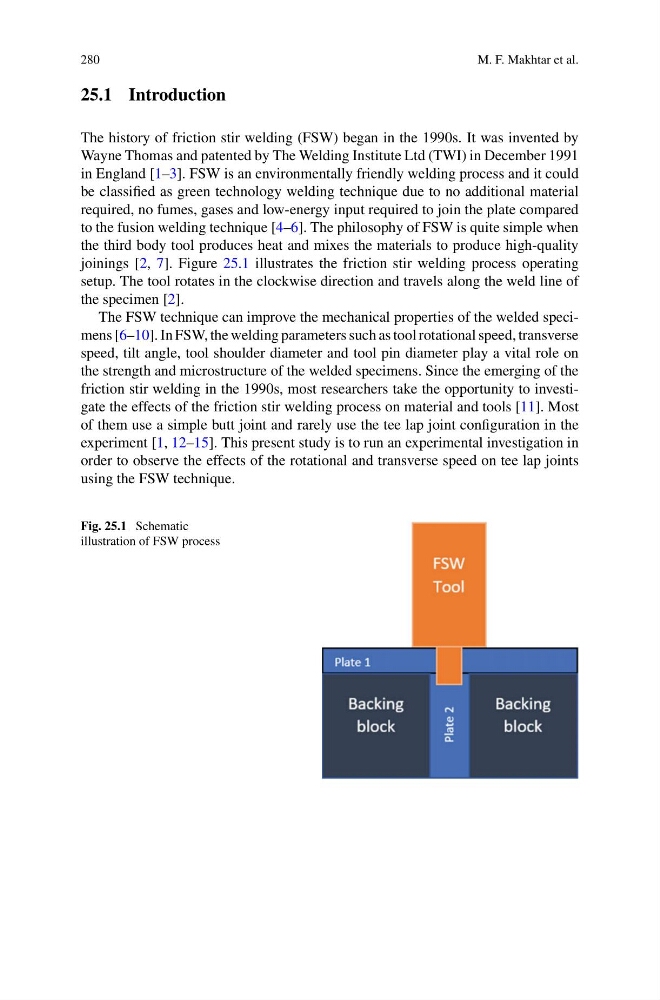
joinings [2, 7]. Figure 25.1 illustrates the friction stir welding process operating
setup. The tool rotates in the clockwise direction and travels along the weld line of
the specimen [2].
The FSW technique can improve the mechanical properties of the welded specimens [6–10]. In FSW, the welding parameters such as tool rotational speed, transverse
speed, tilt angle, tool shoulder diameter and tool pin diameter play a vital role on
the strength and microstructure of the welded specimens. Since the emerging of the
friction stir welding in the 1990s, most researchers take the opportunity to investigate the effects of the friction stir welding process on material and tools [11]. Most
of them use a simple butt joint and rarely use the tee lap joint configuration in the
experiment [1, 12–15]. This present study is to run an experimental investigation in
order to observe the effects of the rotational and transverse speed on tee lap joints
using the FSW technique.
Fig. 25.1 Schematic
illustration of FSW process
M. F. Makhtar et al.
25.1 Introduction
The history of friction stir welding (FSW) began in the 1990s. It was invented by
Wayne Thomas and patented by The Welding Institute Ltd (TWI) in December 1991
in England [1–3]. FSW is an environmentally friendly welding process and it could
be classified as green technology welding technique due to no additional material
required, no fumes, gases and low-energy input required to join the plate compared
to the fusion welding technique [4–6]. The philosophy of FSW is quite simple when
the third body tool produces heat and mixes the materials to produce high-quality
joinings [2, 7]. Figure 25.1 illustrates the friction stir welding process operating
setup. The tool rotates in the clockwise direction and travels along the weld line of
the specimen [2].
The FSW technique can improve the mechanical properties of the welded specimens [6–10]. In FSW, the welding parameters such as tool rotational speed, transverse
speed, tilt angle, tool shoulder diameter and tool pin diameter play a vital role on
the strength and microstructure of the welded specimens. Since the emerging of the
friction stir welding in the 1990s, most researchers take the opportunity to investigate the effects of the friction stir welding process on material and tools [11]. Most
of them use a simple butt joint and rarely use the tee lap joint configuration in the
experiment [1, 12–15]. This present study is to run an experimental investigation in
order to observe the effects of the rotational and transverse speed on tee lap joints
using the FSW technique.
Fig. 25.1 Schematic
illustration of FSW process