

17 Underwater Noise Study Toward Propeller Rotation
185
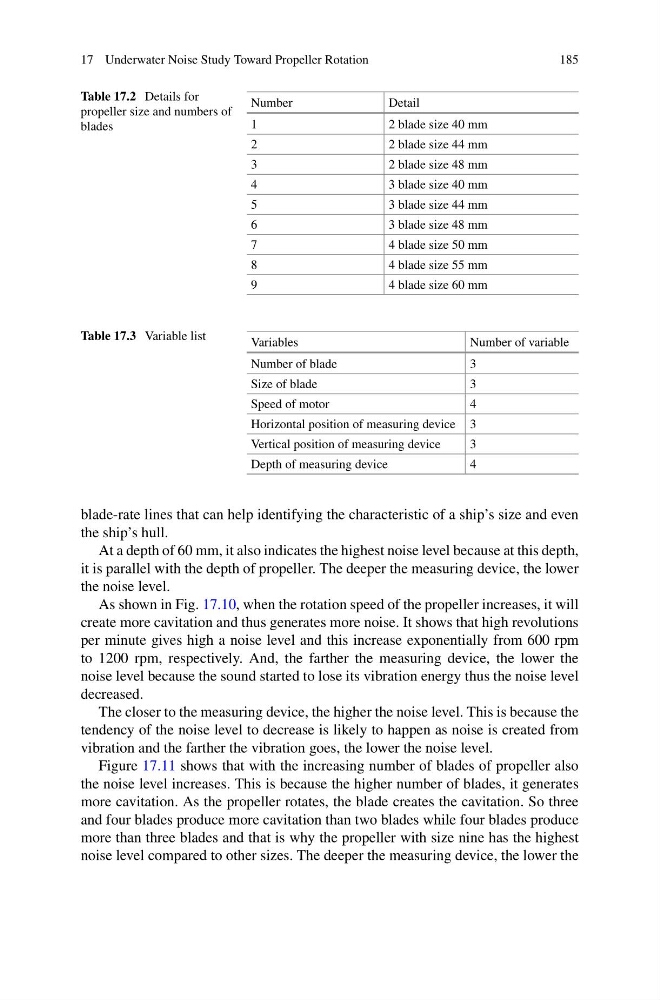
Table 17.2 Details for
propeller size and numbers of
blades
Number
Detail
1
2 blade size 40 mm
2
2 blade size 44 mm
3
2 blade size 48 mm
4
3 blade size 40 mm
5
3 blade size 44 mm
6
3 blade size 48 mm
7
4 blade size 50 mm
8
4 blade size 55 mm
9
4 blade size 60 mm
Table 17.3 Variable list
Variables
Number of variable
Number of blade
3
Size of blade
3
Speed of motor
4
Horizontal position of measuring device 3
Vertical position of measuring device
3
Depth of measuring device
4
blade-rate lines that can help identifying the characteristic of a ship’s size and even
the ship’s hull.
At a depth of 60 mm, it also indicates the highest noise level because at this depth,
it is parallel with the depth of propeller. The deeper the measuring device, the lower
the noise level.
As shown in Fig. 17.10, when the rotation speed of the propeller increases, it will
create more cavitation and thus generates more noise. It shows that high revolutions
per minute gives high a noise level and this increase exponentially from 600 rpm
to 1200 rpm, respectively. And, the farther the measuring device, the lower the
noise level because the sound started to lose its vibration energy thus the noise level
decreased.
The closer to the measuring device, the higher the noise level. This is because the
tendency of the noise level to decrease is likely to happen as noise is created from
vibration and the farther the vibration goes, the lower the noise level.
Figure 17.11 shows that with the increasing number of blades of propeller also
the noise level increases. This is because the higher number of blades, it generates
more cavitation. As the propeller rotates, the blade creates the cavitation. So three
and four blades produce more cavitation than two blades while four blades produce
more than three blades and that is why the propeller with size nine has the highest
noise level compared to other sizes. The deeper the measuring device, the lower the
185
Table 17.2 Details for
propeller size and numbers of
blades
Number
Detail
1
2 blade size 40 mm
2
2 blade size 44 mm
3
2 blade size 48 mm
4
3 blade size 40 mm
5
3 blade size 44 mm
6
3 blade size 48 mm
7
4 blade size 50 mm
8
4 blade size 55 mm
9
4 blade size 60 mm
Table 17.3 Variable list
Variables
Number of variable
Number of blade
3
Size of blade
3
Speed of motor
4
Horizontal position of measuring device 3
Vertical position of measuring device
3
Depth of measuring device
4
blade-rate lines that can help identifying the characteristic of a ship’s size and even
the ship’s hull.
At a depth of 60 mm, it also indicates the highest noise level because at this depth,
it is parallel with the depth of propeller. The deeper the measuring device, the lower
the noise level.
As shown in Fig. 17.10, when the rotation speed of the propeller increases, it will
create more cavitation and thus generates more noise. It shows that high revolutions
per minute gives high a noise level and this increase exponentially from 600 rpm
to 1200 rpm, respectively. And, the farther the measuring device, the lower the
noise level because the sound started to lose its vibration energy thus the noise level
decreased.
The closer to the measuring device, the higher the noise level. This is because the
tendency of the noise level to decrease is likely to happen as noise is created from
vibration and the farther the vibration goes, the lower the noise level.
Figure 17.11 shows that with the increasing number of blades of propeller also
the noise level increases. This is because the higher number of blades, it generates
more cavitation. As the propeller rotates, the blade creates the cavitation. So three
and four blades produce more cavitation than two blades while four blades produce
more than three blades and that is why the propeller with size nine has the highest
noise level compared to other sizes. The deeper the measuring device, the lower the