

17 Underwater Noise Study Toward Propeller Rotation
183
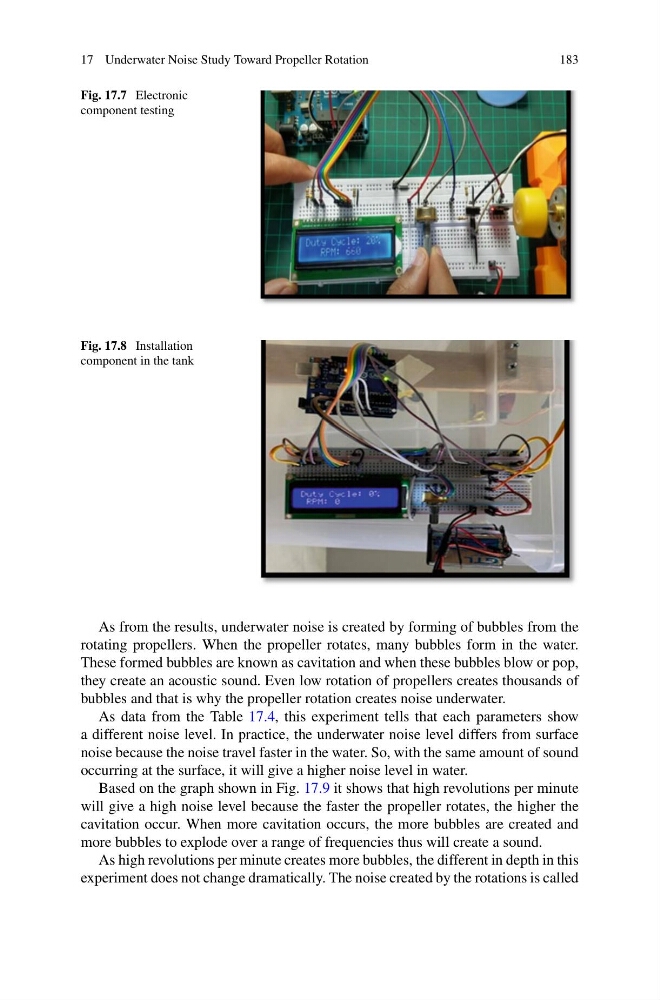
Fig. 17.7 Electronic
component testing
Fig. 17.8 Installation
component in the tank
As from the results, underwater noise is created by forming of bubbles from the
rotating propellers. When the propeller rotates, many bubbles form in the water.
These formed bubbles are known as cavitation and when these bubbles blow or pop,
they create an acoustic sound. Even low rotation of propellers creates thousands of
bubbles and that is why the propeller rotation creates noise underwater.
As data from the Table 17.4, this experiment tells that each parameters show
a different noise level. In practice, the underwater noise level differs from surface
noise because the noise travel faster in the water. So, with the same amount of sound
occurring at the surface, it will give a higher noise level in water.
Based on the graph shown in Fig. 17.9 it shows that high revolutions per minute
will give a high noise level because the faster the propeller rotates, the higher the
cavitation occur. When more cavitation occurs, the more bubbles are created and
more bubbles to explode over a range of frequencies thus will create a sound.
As high revolutions per minute creates more bubbles, the different in depth in this
experiment does not change dramatically. The noise created by the rotations is called
183
Fig. 17.7 Electronic
component testing
Fig. 17.8 Installation
component in the tank
As from the results, underwater noise is created by forming of bubbles from the
rotating propellers. When the propeller rotates, many bubbles form in the water.
These formed bubbles are known as cavitation and when these bubbles blow or pop,
they create an acoustic sound. Even low rotation of propellers creates thousands of
bubbles and that is why the propeller rotation creates noise underwater.
As data from the Table 17.4, this experiment tells that each parameters show
a different noise level. In practice, the underwater noise level differs from surface
noise because the noise travel faster in the water. So, with the same amount of sound
occurring at the surface, it will give a higher noise level in water.
Based on the graph shown in Fig. 17.9 it shows that high revolutions per minute
will give a high noise level because the faster the propeller rotates, the higher the
cavitation occur. When more cavitation occurs, the more bubbles are created and
more bubbles to explode over a range of frequencies thus will create a sound.
As high revolutions per minute creates more bubbles, the different in depth in this
experiment does not change dramatically. The noise created by the rotations is called