

Photoluminescent Printed Fabrics: Design and Development …
95
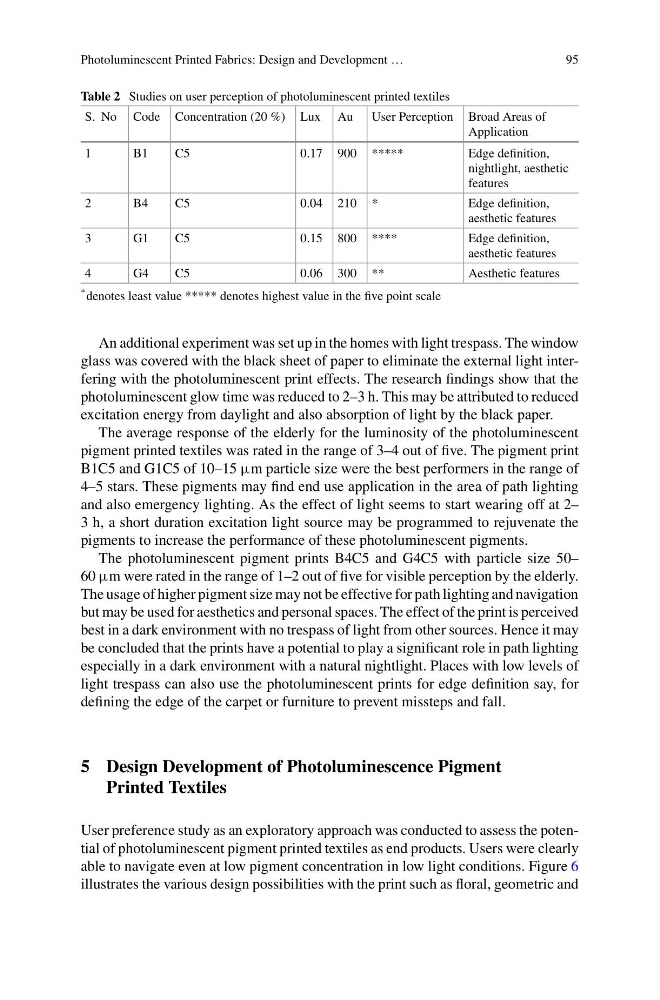
Table 2 Studies on user perception of photoluminescent printed textiles
S. No Code Concentration (20 %) Lux Au User Perception Broad Areas of
Application
1
B1
C5
0.17 900 *****
Edge definition,
nightlight, aesthetic
features
2
B4
C5
0.04 210 *
Edge definition,
aesthetic features
3
G1
C5
0.15 800 ****
Edge definition,
aesthetic features
4
G4
C5
0.06 300 **
Aesthetic features
* denotes least value ***** denotes highest value in the five point scale
An additional experiment was set up in the homes with light trespass. The window
glass was covered with the black sheet of paper to eliminate the external light interfering with the photoluminescent print effects. The research findings show that the
photoluminescent glow time was reduced to 2–3 h. This may be attributed to reduced
excitation energy from daylight and also absorption of light by the black paper.
The average response of the elderly for the luminosity of the photoluminescent
pigment printed textiles was rated in the range of 3–4 out of five. The pigment print
B1C5 and G1C5 of 10–15 μm particle size were the best performers in the range of
4–5 stars. These pigments may find end use application in the area of path lighting
and also emergency lighting. As the effect of light seems to start wearing off at 2–
3 h, a short duration excitation light source may be programmed to rejuvenate the
pigments to increase the performance of these photoluminescent pigments.
The photoluminescent pigment prints B4C5 and G4C5 with particle size 50–
60 μm were rated in the range of 1–2 out of five for visible perception by the elderly.
The usage of higher pigment size may not be effective for path lighting and navigation
but may be used for aesthetics and personal spaces. The effect of the print is perceived
best in a dark environment with no trespass of light from other sources. Hence it may
be concluded that the prints have a potential to play a significant role in path lighting
especially in a dark environment with a natural nightlight. Places with low levels of
light trespass can also use the photoluminescent prints for edge definition say, for
defining the edge of the carpet or furniture to prevent missteps and fall.
5 Design Development of Photoluminescence Pigment
Printed Textiles
User preference study as an exploratory approach was conducted to assess the potential of photoluminescent pigment printed textiles as end products. Users were clearly
able to navigate even at low pigment concentration in low light conditions. Figure 6
illustrates the various design possibilities with the print such as floral, geometric and
95
Table 2 Studies on user perception of photoluminescent printed textiles
S. No Code Concentration (20 %) Lux Au User Perception Broad Areas of
Application
1
B1
C5
0.17 900 *****
Edge definition,
nightlight, aesthetic
features
2
B4
C5
0.04 210 *
Edge definition,
aesthetic features
3
G1
C5
0.15 800 ****
Edge definition,
aesthetic features
4
G4
C5
0.06 300 **
Aesthetic features
* denotes least value ***** denotes highest value in the five point scale
An additional experiment was set up in the homes with light trespass. The window
glass was covered with the black sheet of paper to eliminate the external light interfering with the photoluminescent print effects. The research findings show that the
photoluminescent glow time was reduced to 2–3 h. This may be attributed to reduced
excitation energy from daylight and also absorption of light by the black paper.
The average response of the elderly for the luminosity of the photoluminescent
pigment printed textiles was rated in the range of 3–4 out of five. The pigment print
B1C5 and G1C5 of 10–15 μm particle size were the best performers in the range of
4–5 stars. These pigments may find end use application in the area of path lighting
and also emergency lighting. As the effect of light seems to start wearing off at 2–
3 h, a short duration excitation light source may be programmed to rejuvenate the
pigments to increase the performance of these photoluminescent pigments.
The photoluminescent pigment prints B4C5 and G4C5 with particle size 50–
60 μm were rated in the range of 1–2 out of five for visible perception by the elderly.
The usage of higher pigment size may not be effective for path lighting and navigation
but may be used for aesthetics and personal spaces. The effect of the print is perceived
best in a dark environment with no trespass of light from other sources. Hence it may
be concluded that the prints have a potential to play a significant role in path lighting
especially in a dark environment with a natural nightlight. Places with low levels of
light trespass can also use the photoluminescent prints for edge definition say, for
defining the edge of the carpet or furniture to prevent missteps and fall.
5 Design Development of Photoluminescence Pigment
Printed Textiles
User preference study as an exploratory approach was conducted to assess the potential of photoluminescent pigment printed textiles as end products. Users were clearly
able to navigate even at low pigment concentration in low light conditions. Figure 6
illustrates the various design possibilities with the print such as floral, geometric and