

78
N. Bairagi and S. K. Bhuyan
before ideation of proposed concepts. The design criteria developed has been
presented in Table 1.
3.7 Development of Design Concepts of Adaptive Sportswear
for Wheelchair-Bound Tennis Players
Based on the above findings, eight tested design concepts for the sportswear upper
body garment and lower body garment are presented in this section. The details of
the conceptualised designs have been presented in this section. The designs were
user-tested through wearer trial to study the ease of movement during the match,
ease of donning and doffing and ease of use of assistive devices.
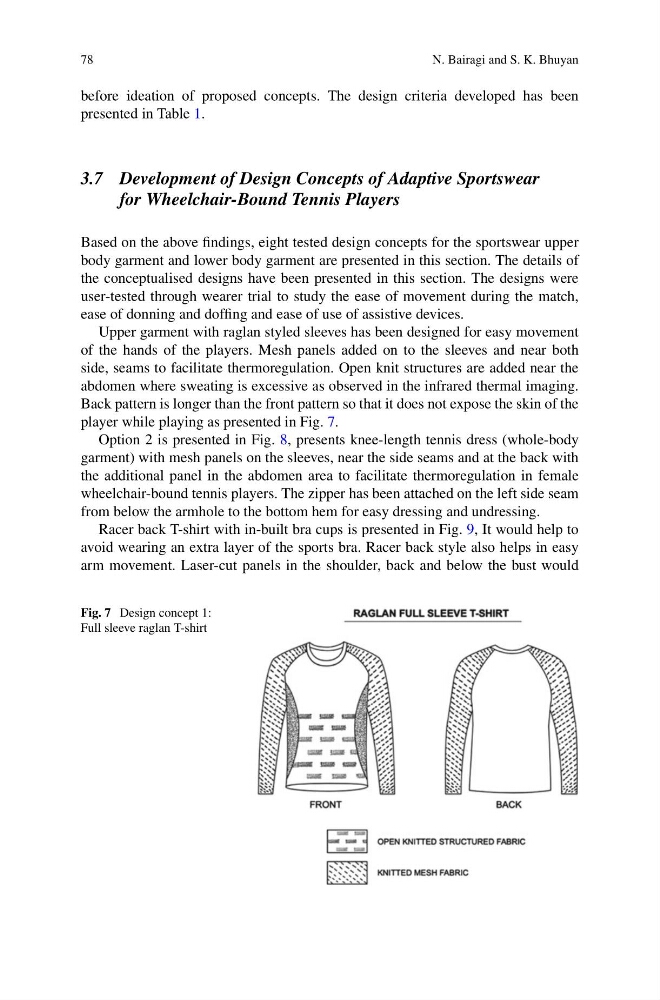
Upper garment with raglan styled sleeves has been designed for easy movement
of the hands of the players. Mesh panels added on to the sleeves and near both
side, seams to facilitate thermoregulation. Open knit structures are added near the
abdomen where sweating is excessive as observed in the infrared thermal imaging.
Back pattern is longer than the front pattern so that it does not expose the skin of the
player while playing as presented in Fig. 7.
Option 2 is presented in Fig. 8, presents knee-length tennis dress (whole-body
garment) with mesh panels on the sleeves, near the side seams and at the back with
the additional panel in the abdomen area to facilitate thermoregulation in female
wheelchair-bound tennis players. The zipper has been attached on the left side seam
from below the armhole to the bottom hem for easy dressing and undressing.
Racer back T-shirt with in-built bra cups is presented in Fig. 9, It would help to
avoid wearing an extra layer of the sports bra. Racer back style also helps in easy
arm movement. Laser-cut panels in the shoulder, back and below the bust would
Fig. 7 Design concept 1:
Full sleeve raglan T-shirt
N. Bairagi and S. K. Bhuyan
before ideation of proposed concepts. The design criteria developed has been
presented in Table 1.
3.7 Development of Design Concepts of Adaptive Sportswear
for Wheelchair-Bound Tennis Players
Based on the above findings, eight tested design concepts for the sportswear upper
body garment and lower body garment are presented in this section. The details of
the conceptualised designs have been presented in this section. The designs were
user-tested through wearer trial to study the ease of movement during the match,
ease of donning and doffing and ease of use of assistive devices.
Upper garment with raglan styled sleeves has been designed for easy movement
of the hands of the players. Mesh panels added on to the sleeves and near both
side, seams to facilitate thermoregulation. Open knit structures are added near the
abdomen where sweating is excessive as observed in the infrared thermal imaging.
Back pattern is longer than the front pattern so that it does not expose the skin of the
player while playing as presented in Fig. 7.
Option 2 is presented in Fig. 8, presents knee-length tennis dress (whole-body
garment) with mesh panels on the sleeves, near the side seams and at the back with
the additional panel in the abdomen area to facilitate thermoregulation in female
wheelchair-bound tennis players. The zipper has been attached on the left side seam
from below the armhole to the bottom hem for easy dressing and undressing.
Racer back T-shirt with in-built bra cups is presented in Fig. 9, It would help to
avoid wearing an extra layer of the sports bra. Racer back style also helps in easy
arm movement. Laser-cut panels in the shoulder, back and below the bust would
Fig. 7 Design concept 1:
Full sleeve raglan T-shirt