

70
N. Bairagi and S. K. Bhuyan
female athlete is 8 months. Till January 2020, the male athlete has played National
and International level tournaments while the female athlete has played state-level
tournaments. Both the athletes are associated with Karnataka State Lawn Tennis
Association (KSLTA), India, and undergo training regularly. These players have
been trained by national and international coaches in Bengaluru. Every weekend the
athletes get together at KSLTA for wheelchair tennis matches. Informed consent was
taken prior to the study.
2.2 Data Collection
The qualitative and quantitative data have been collected initially through observations, the structured questionnaire with users and stakeholders (coaches, doctors,
physiotherapists, sportswear experts, etc.) using Lamb and Kallal’s (1992) functional,
expressive and aesthetic (FEA) consumer needs model. During the interview, the
researcher tried to find out the problems the players faced while playing wheelchair
tennis especially with players affected by poliomyelitis. The interview questions were
divided into the following groups: (a) difficulties with the present sportswear (b) FEA
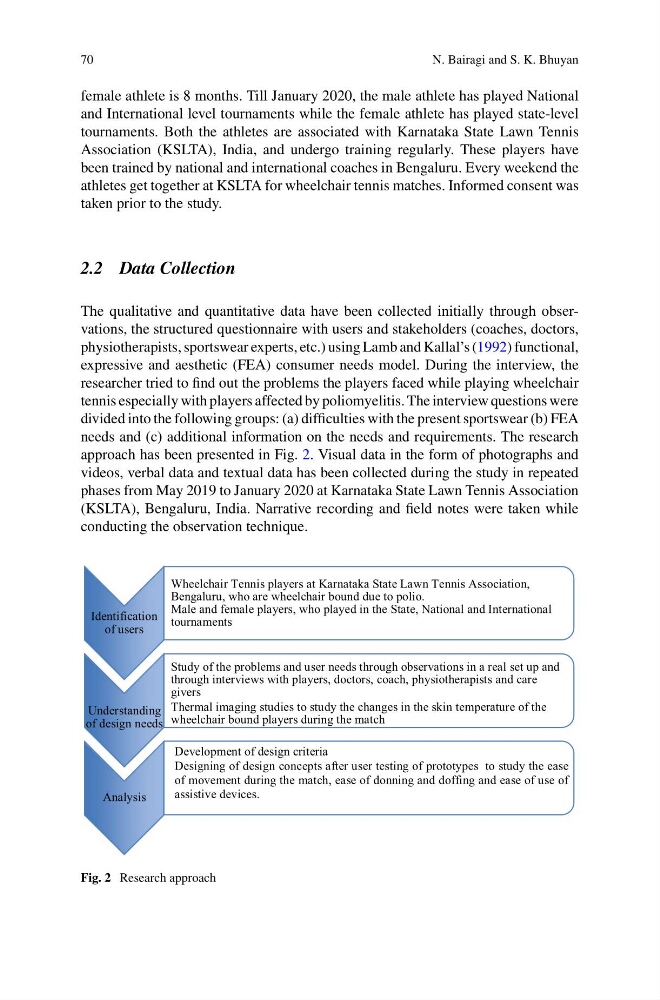
needs and (c) additional information on the needs and requirements. The research
approach has been presented in Fig. 2. Visual data in the form of photographs and
videos, verbal data and textual data has been collected during the study in repeated
phases from May 2019 to January 2020 at Karnataka State Lawn Tennis Association
(KSLTA), Bengaluru, India. Narrative recording and field notes were taken while
conducting the observation technique.
Identification
of users
Wheelchair Tennis players at Karnataka State Lawn Tennis Association,
Bengaluru, who are wheelchair bound due to polio.
Male and female players, who played in the State, National and International
tournaments
Understanding
of design needs
Study of the problems and user needs through observations in a real set up and
through interviews with players, doctors, coach, physiotherapists and care
givers
Thermal imaging studies to study the changes in the skin temperature of the
wheelchair bound players during the match
Analysis
Development of design criteria
Designing of design concepts after user testing of prototypes to study the ease
of movement during the match, ease of donning and doffing and ease of use of
assistive devices.
Fig. 2 Research approach
N. Bairagi and S. K. Bhuyan
female athlete is 8 months. Till January 2020, the male athlete has played National
and International level tournaments while the female athlete has played state-level
tournaments. Both the athletes are associated with Karnataka State Lawn Tennis
Association (KSLTA), India, and undergo training regularly. These players have
been trained by national and international coaches in Bengaluru. Every weekend the
athletes get together at KSLTA for wheelchair tennis matches. Informed consent was
taken prior to the study.
2.2 Data Collection
The qualitative and quantitative data have been collected initially through observations, the structured questionnaire with users and stakeholders (coaches, doctors,
physiotherapists, sportswear experts, etc.) using Lamb and Kallal’s (1992) functional,
expressive and aesthetic (FEA) consumer needs model. During the interview, the
researcher tried to find out the problems the players faced while playing wheelchair
tennis especially with players affected by poliomyelitis. The interview questions were
divided into the following groups: (a) difficulties with the present sportswear (b) FEA
needs and (c) additional information on the needs and requirements. The research
approach has been presented in Fig. 2. Visual data in the form of photographs and
videos, verbal data and textual data has been collected during the study in repeated
phases from May 2019 to January 2020 at Karnataka State Lawn Tennis Association
(KSLTA), Bengaluru, India. Narrative recording and field notes were taken while
conducting the observation technique.
Identification
of users
Wheelchair Tennis players at Karnataka State Lawn Tennis Association,
Bengaluru, who are wheelchair bound due to polio.
Male and female players, who played in the State, National and International
tournaments
Understanding
of design needs
Study of the problems and user needs through observations in a real set up and
through interviews with players, doctors, coach, physiotherapists and care
givers
Thermal imaging studies to study the changes in the skin temperature of the
wheelchair bound players during the match
Analysis
Development of design criteria
Designing of design concepts after user testing of prototypes to study the ease
of movement during the match, ease of donning and doffing and ease of use of
assistive devices.
Fig. 2 Research approach