

Development of a Unique Stab and Impact Resistant Material …
63
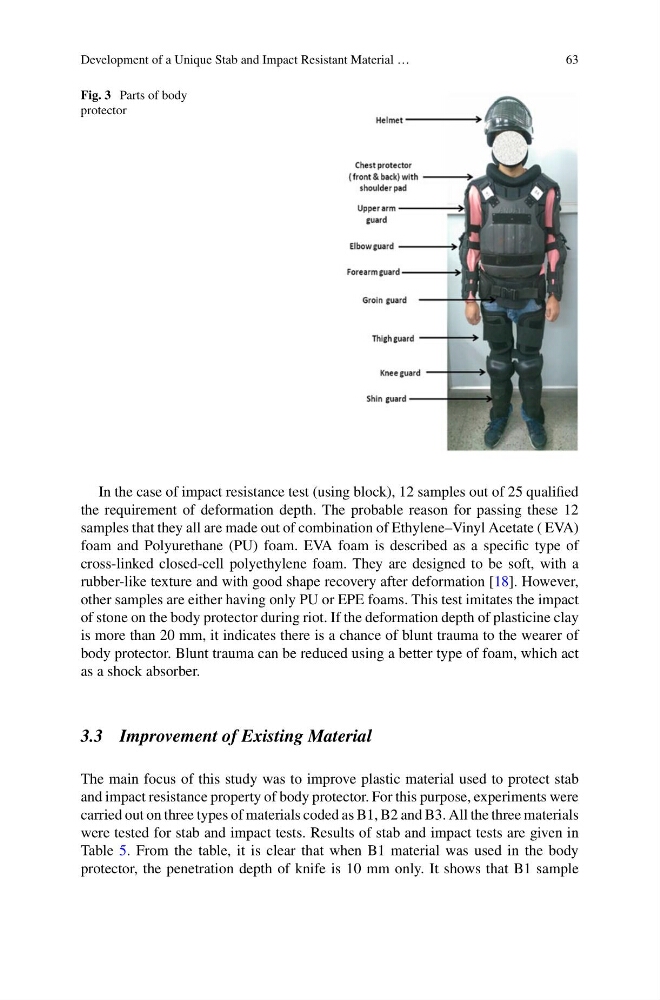
Fig. 3 Parts of body
protector
In the case of impact resistance test (using block), 12 samples out of 25 qualified
the requirement of deformation depth. The probable reason for passing these 12
samples that they all are made out of combination of Ethylene–Vinyl Acetate ( EVA)
foam and Polyurethane (PU) foam. EVA foam is described as a specific type of
cross-linked closed-cell polyethylene foam. They are designed to be soft, with a
rubber-like texture and with good shape recovery after deformation [18]. However,
other samples are either having only PU or EPE foams. This test imitates the impact
of stone on the body protector during riot. If the deformation depth of plasticine clay
is more than 20 mm, it indicates there is a chance of blunt trauma to the wearer of
body protector. Blunt trauma can be reduced using a better type of foam, which act
as a shock absorber.
3.3 Improvement of Existing Material
The main focus of this study was to improve plastic material used to protect stab
and impact resistance property of body protector. For this purpose, experiments were
carried out on three types of materials coded as B1, B2 and B3. All the three materials
were tested for stab and impact tests. Results of stab and impact tests are given in
Table 5. From the table, it is clear that when B1 material was used in the body
protector, the penetration depth of knife is 10 mm only. It shows that B1 sample
63
Fig. 3 Parts of body
protector
In the case of impact resistance test (using block), 12 samples out of 25 qualified
the requirement of deformation depth. The probable reason for passing these 12
samples that they all are made out of combination of Ethylene–Vinyl Acetate ( EVA)
foam and Polyurethane (PU) foam. EVA foam is described as a specific type of
cross-linked closed-cell polyethylene foam. They are designed to be soft, with a
rubber-like texture and with good shape recovery after deformation [18]. However,
other samples are either having only PU or EPE foams. This test imitates the impact
of stone on the body protector during riot. If the deformation depth of plasticine clay
is more than 20 mm, it indicates there is a chance of blunt trauma to the wearer of
body protector. Blunt trauma can be reduced using a better type of foam, which act
as a shock absorber.
3.3 Improvement of Existing Material
The main focus of this study was to improve plastic material used to protect stab
and impact resistance property of body protector. For this purpose, experiments were
carried out on three types of materials coded as B1, B2 and B3. All the three materials
were tested for stab and impact tests. Results of stab and impact tests are given in
Table 5. From the table, it is clear that when B1 material was used in the body
protector, the penetration depth of knife is 10 mm only. It shows that B1 sample