

210
K. Gahletia
1. Layer for data collection, which use RFID technology and sensors,
2. Layer for transmission process which use stable and mobile networks,
3. Layer for service, and.
4. Layer for interface.
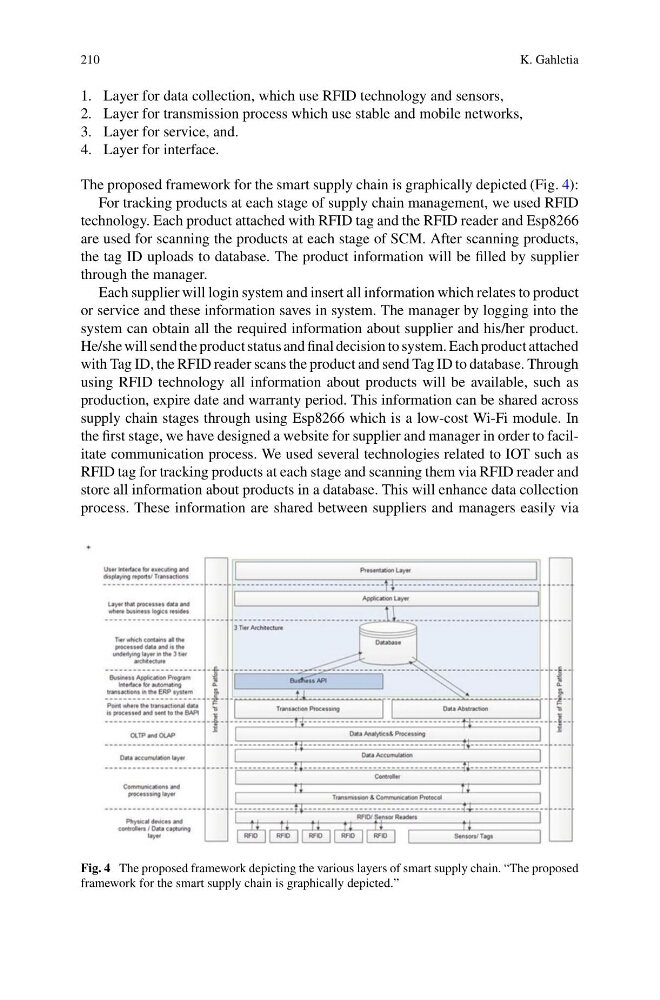
The proposed framework for the smart supply chain is graphically depicted (Fig. 4):
For tracking products at each stage of supply chain management, we used RFID
technology. Each product attached with RFID tag and the RFID reader and Esp8266
are used for scanning the products at each stage of SCM. After scanning products,
the tag ID uploads to database. The product information will be filled by supplier
through the manager.
Each supplier will login system and insert all information which relates to product
or service and these information saves in system. The manager by logging into the
system can obtain all the required information about supplier and his/her product.
He/she will send the product status and final decision to system. Each product attached
with Tag ID, the RFID reader scans the product and send Tag ID to database. Through
using RFID technology all information about products will be available, such as
production, expire date and warranty period. This information can be shared across
supply chain stages through using Esp8266 which is a low-cost Wi-Fi module. In
the first stage, we have designed a website for supplier and manager in order to facilitate communication process. We used several technologies related to IOT such as
RFID tag for tracking products at each stage and scanning them via RFID reader and
store all information about products in a database. This will enhance data collection
process. These information are shared between suppliers and managers easily via
Fig. 4 The proposed framework depicting the various layers of smart supply chain. “The proposed
framework for the smart supply chain is graphically depicted.”
K. Gahletia
1. Layer for data collection, which use RFID technology and sensors,
2. Layer for transmission process which use stable and mobile networks,
3. Layer for service, and.
4. Layer for interface.
The proposed framework for the smart supply chain is graphically depicted (Fig. 4):
For tracking products at each stage of supply chain management, we used RFID
technology. Each product attached with RFID tag and the RFID reader and Esp8266
are used for scanning the products at each stage of SCM. After scanning products,
the tag ID uploads to database. The product information will be filled by supplier
through the manager.
Each supplier will login system and insert all information which relates to product
or service and these information saves in system. The manager by logging into the
system can obtain all the required information about supplier and his/her product.
He/she will send the product status and final decision to system. Each product attached
with Tag ID, the RFID reader scans the product and send Tag ID to database. Through
using RFID technology all information about products will be available, such as
production, expire date and warranty period. This information can be shared across
supply chain stages through using Esp8266 which is a low-cost Wi-Fi module. In
the first stage, we have designed a website for supplier and manager in order to facilitate communication process. We used several technologies related to IOT such as
RFID tag for tracking products at each stage and scanning them via RFID reader and
store all information about products in a database. This will enhance data collection
process. These information are shared between suppliers and managers easily via
Fig. 4 The proposed framework depicting the various layers of smart supply chain. “The proposed
framework for the smart supply chain is graphically depicted.”