

206
K. Gahletia
match fast-moving supply and demand [2, 3]. This decoupling has occurred because,
in effect, omnichannel retailing blurs boundaries between the channels—in stark
contrast to the more conventional multichannel approach followed by most retailers
over the last decade.
So far, the omnichannel strategy for most retailers has hinged on developing a
presence on social networks (Facebook, Instagram, etc.) and then devising ways for
customers to shop on their smartphones. However, retailers are now beginning to
deploy IoT devices and a new generation of software tools (World Economic Forum
2017).
In this competitive business world, most of the supply chains are struggling to
sustain competitively in the global supply chain due to its increasing complexity
in each phase of the supply chain operations. Companies have to be smarter by
incorporating the necessary technologies to be more competitive and sustain in the
global supply chain such that the processes can be better managed and automated
where necessary [4]. Most companies fail due to poor integrations of technology in
their supply chain. It is vital for companies to adopt to the changing nature of the
digital supply chains and embrace Industry 4.0, leveraging internet of things (IoT)—a
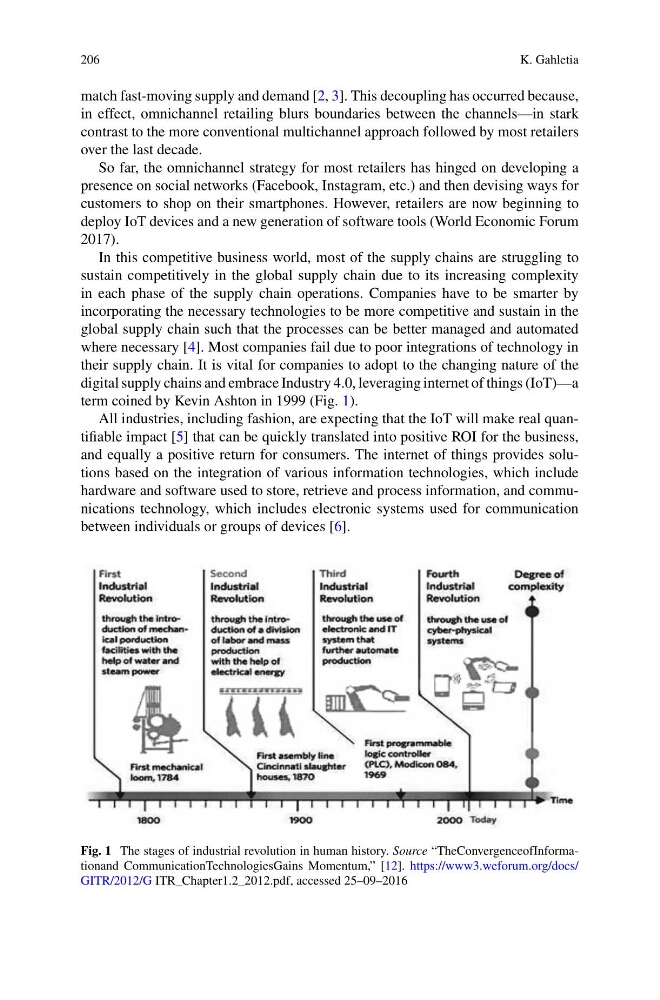
term coined by Kevin Ashton in 1999 (Fig. 1).
All industries, including fashion, are expecting that the IoT will make real quantifiable impact [5] that can be quickly translated into positive ROI for the business,
and equally a positive return for consumers. The internet of things provides solutions based on the integration of various information technologies, which include
hardware and software used to store, retrieve and process information, and communications technology, which includes electronic systems used for communication
between individuals or groups of devices [6].
Fig. 1 The stages of industrial revolution in human history. Source “TheConvergenceofInformationand CommunicationTechnologiesGains Momentum,” [12]. https://www3.weforum.org/docs/
GITR/2012/G ITR_Chapter1.2_2012.pdf, accessed 25–09–2016
K. Gahletia
match fast-moving supply and demand [2, 3]. This decoupling has occurred because,
in effect, omnichannel retailing blurs boundaries between the channels—in stark
contrast to the more conventional multichannel approach followed by most retailers
over the last decade.
So far, the omnichannel strategy for most retailers has hinged on developing a
presence on social networks (Facebook, Instagram, etc.) and then devising ways for
customers to shop on their smartphones. However, retailers are now beginning to
deploy IoT devices and a new generation of software tools (World Economic Forum
2017).
In this competitive business world, most of the supply chains are struggling to
sustain competitively in the global supply chain due to its increasing complexity
in each phase of the supply chain operations. Companies have to be smarter by
incorporating the necessary technologies to be more competitive and sustain in the
global supply chain such that the processes can be better managed and automated
where necessary [4]. Most companies fail due to poor integrations of technology in
their supply chain. It is vital for companies to adopt to the changing nature of the
digital supply chains and embrace Industry 4.0, leveraging internet of things (IoT)—a
term coined by Kevin Ashton in 1999 (Fig. 1).
All industries, including fashion, are expecting that the IoT will make real quantifiable impact [5] that can be quickly translated into positive ROI for the business,
and equally a positive return for consumers. The internet of things provides solutions based on the integration of various information technologies, which include
hardware and software used to store, retrieve and process information, and communications technology, which includes electronic systems used for communication
between individuals or groups of devices [6].
Fig. 1 The stages of industrial revolution in human history. Source “TheConvergenceofInformationand CommunicationTechnologiesGains Momentum,” [12]. https://www3.weforum.org/docs/
GITR/2012/G ITR_Chapter1.2_2012.pdf, accessed 25–09–2016