

Developing Organic Fabric from Aquatic Cellulosic Waste
185
Table 6 Twist tpi/tpm of
lotus yarn
Yarn sample Twist per inch
(tpi)
Twist per
meter (tpm)
Twist direction
Lotus yarn
1.66
65.6
S
Table 7 Tensile strength of lotus yarn
Yarn Sample
Maximum load (gf) Extension at maximum,
mm
Stress, g/den Strain (%)
Lotus (handspun) 288
1.7
2.66
1.7
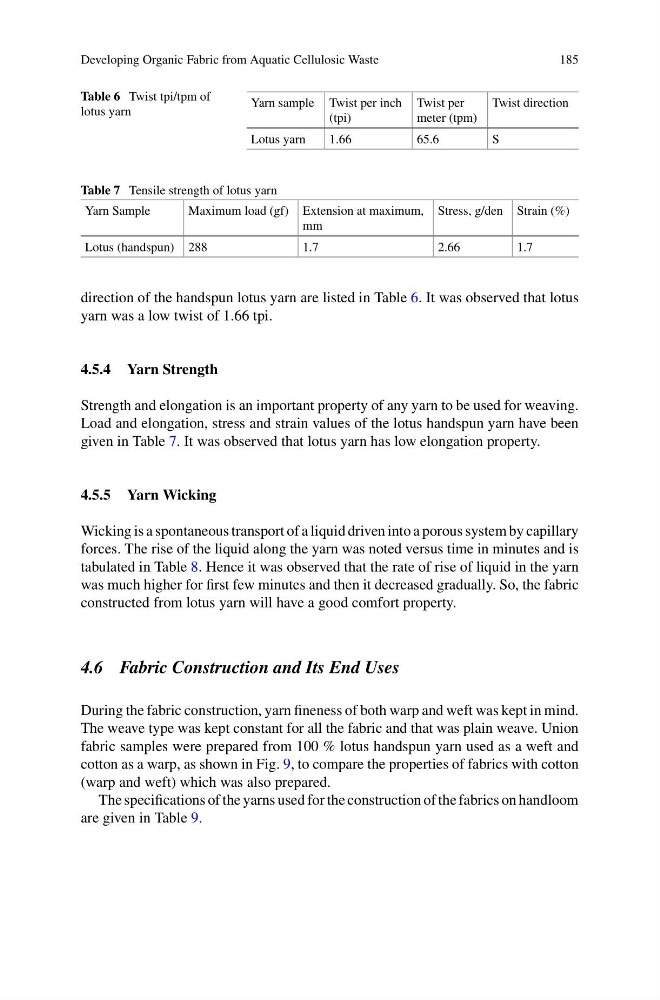
direction of the handspun lotus yarn are listed in Table 6. It was observed that lotus
yarn was a low twist of 1.66 tpi.
4.5.4 Yarn Strength
Strength and elongation is an important property of any yarn to be used for weaving.
Load and elongation, stress and strain values of the lotus handspun yarn have been
given in Table 7. It was observed that lotus yarn has low elongation property.
4.5.5 Yarn Wicking
Wicking is a spontaneous transport of a liquid driven into a porous system by capillary
forces. The rise of the liquid along the yarn was noted versus time in minutes and is
tabulated in Table 8. Hence it was observed that the rate of rise of liquid in the yarn
was much higher for first few minutes and then it decreased gradually. So, the fabric
constructed from lotus yarn will have a good comfort property.
4.6 Fabric Construction and Its End Uses
During the fabric construction, yarn fineness of both warp and weft was kept in mind.
The weave type was kept constant for all the fabric and that was plain weave. Union
fabric samples were prepared from 100 % lotus handspun yarn used as a weft and
cotton as a warp, as shown in Fig. 9, to compare the properties of fabrics with cotton
(warp and weft) which was also prepared.
The specifications of the yarns used for the construction of the fabrics on handloom
are given in Table 9.
185
Table 6 Twist tpi/tpm of
lotus yarn
Yarn sample Twist per inch
(tpi)
Twist per
meter (tpm)
Twist direction
Lotus yarn
1.66
65.6
S
Table 7 Tensile strength of lotus yarn
Yarn Sample
Maximum load (gf) Extension at maximum,
mm
Stress, g/den Strain (%)
Lotus (handspun) 288
1.7
2.66
1.7
direction of the handspun lotus yarn are listed in Table 6. It was observed that lotus
yarn was a low twist of 1.66 tpi.
4.5.4 Yarn Strength
Strength and elongation is an important property of any yarn to be used for weaving.
Load and elongation, stress and strain values of the lotus handspun yarn have been
given in Table 7. It was observed that lotus yarn has low elongation property.
4.5.5 Yarn Wicking
Wicking is a spontaneous transport of a liquid driven into a porous system by capillary
forces. The rise of the liquid along the yarn was noted versus time in minutes and is
tabulated in Table 8. Hence it was observed that the rate of rise of liquid in the yarn
was much higher for first few minutes and then it decreased gradually. So, the fabric
constructed from lotus yarn will have a good comfort property.
4.6 Fabric Construction and Its End Uses
During the fabric construction, yarn fineness of both warp and weft was kept in mind.
The weave type was kept constant for all the fabric and that was plain weave. Union
fabric samples were prepared from 100 % lotus handspun yarn used as a weft and
cotton as a warp, as shown in Fig. 9, to compare the properties of fabrics with cotton
(warp and weft) which was also prepared.
The specifications of the yarns used for the construction of the fabrics on handloom
are given in Table 9.