

Developing Organic Fabric from Aquatic Cellulosic Waste
177
The transport of liquids in a porous media is driven by capillary forces that arise
from the wetting of yarns. The rise of liquid along the specimen was recorded on the
basis of the height shown against the scale. At the same time, a stop watch was also
started in order to record the time it took the moisture to travel from mark to mark.
This was done in order to compare length traveled by liquid versus time. The rise
in length was recorded at different intervals of time. For testing of yarn, a length of
180 mm was clamped at the top ensuring immersion of 30 mm in the liquid [13].
2.6 Construction of Fabric
Union fabric sample was constructed using 100 % lotus handspun yarn as a weft
and cotton as a warp. To compare the properties, fabric with cotton (warp and weft)
and silk (warp and weft) were also prepared. Weaving was done in treadle loom at
Bhujodi, Kutch.
2.7 Evaluation of the Properties of Constructed Fabric
2.7.1 Determination of Fabric Count
Fabric count (the number of yarns/inch) helped to describe the closeness of the
weave. Following the ASTM-D 3775-98 [14] standard fabric count was determined
by counting the number of threads in 1 in. in warp and weft direction using pick
glass.
2.7.2 Determination of Fabric Thickness
Following the ASTM-D 1777-96 [15] standard fabric thickness was measured using
universal thickness tester.
2.7.3 Determination of Fabric Weight Per Unit Area:
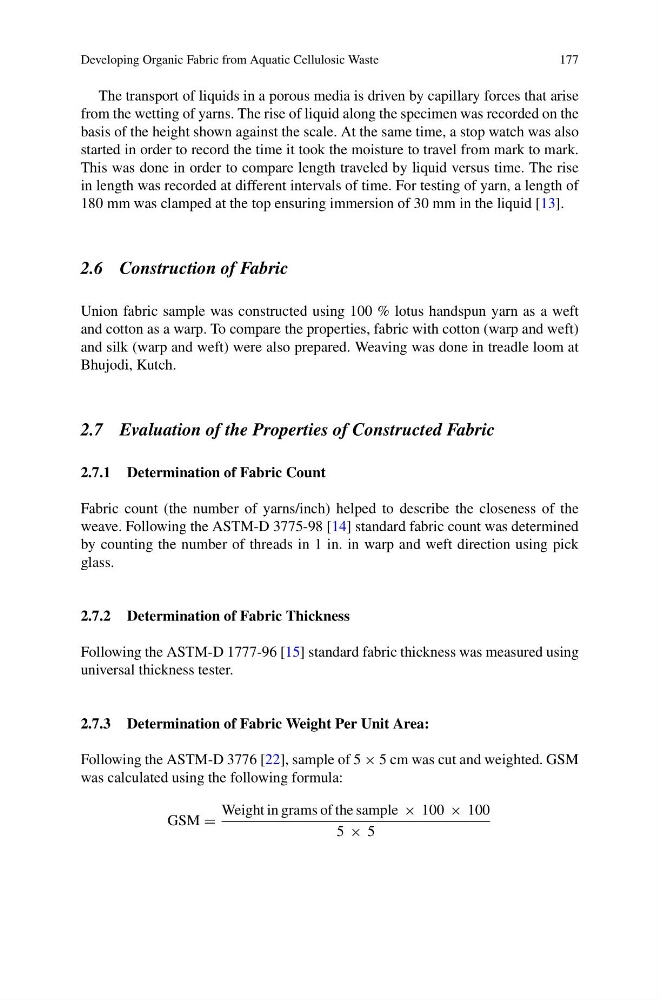
Following the ASTM-D 3776 [22], sample of 5 × 5 cm was cut and weighted. GSM
was calculated using the following formula:
GSM =
Weight in grams of the sample × 100 × 100
5 × 5
177
The transport of liquids in a porous media is driven by capillary forces that arise
from the wetting of yarns. The rise of liquid along the specimen was recorded on the
basis of the height shown against the scale. At the same time, a stop watch was also
started in order to record the time it took the moisture to travel from mark to mark.
This was done in order to compare length traveled by liquid versus time. The rise
in length was recorded at different intervals of time. For testing of yarn, a length of
180 mm was clamped at the top ensuring immersion of 30 mm in the liquid [13].
2.6 Construction of Fabric
Union fabric sample was constructed using 100 % lotus handspun yarn as a weft
and cotton as a warp. To compare the properties, fabric with cotton (warp and weft)
and silk (warp and weft) were also prepared. Weaving was done in treadle loom at
Bhujodi, Kutch.
2.7 Evaluation of the Properties of Constructed Fabric
2.7.1 Determination of Fabric Count
Fabric count (the number of yarns/inch) helped to describe the closeness of the
weave. Following the ASTM-D 3775-98 [14] standard fabric count was determined
by counting the number of threads in 1 in. in warp and weft direction using pick
glass.
2.7.2 Determination of Fabric Thickness
Following the ASTM-D 1777-96 [15] standard fabric thickness was measured using
universal thickness tester.
2.7.3 Determination of Fabric Weight Per Unit Area:
Following the ASTM-D 3776 [22], sample of 5 × 5 cm was cut and weighted. GSM
was calculated using the following formula:
GSM =
Weight in grams of the sample × 100 × 100
5 × 5