

134
K. Mishra and E. Dedhia
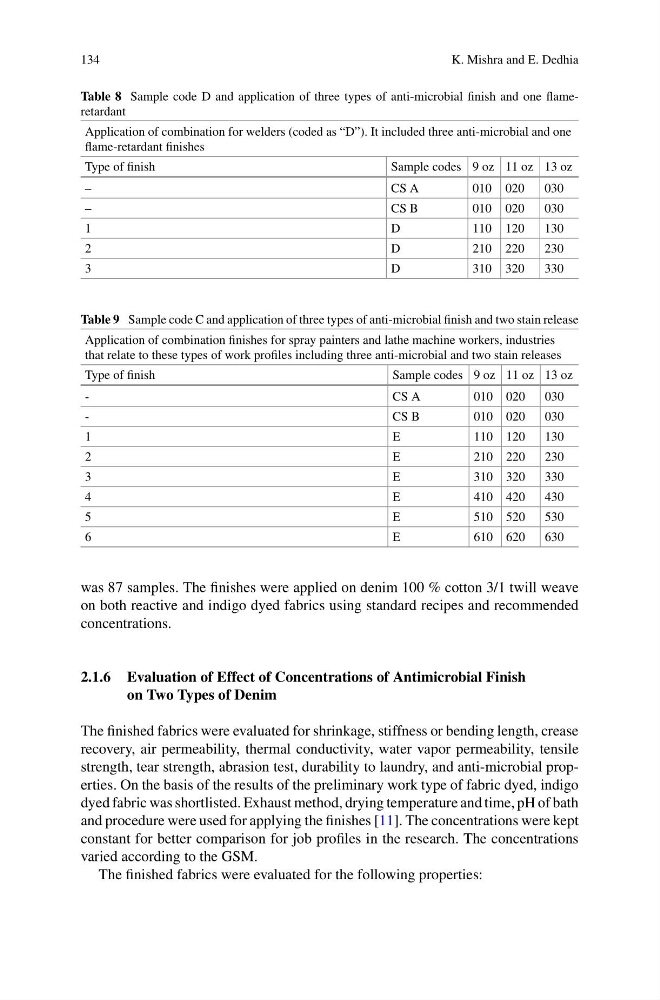
Table 8 Sample code D and application of three types of anti-microbial finish and one flameretardant
Application of combination for welders (coded as “D”). It included three anti-microbial and one
flame-retardant finishes
Type of finish
Sample codes 9 oz 11 oz 13 oz
–
CS A
010 020
030
–
CS B
010 020
030
1
D
110 120
130
2
D
210 220
230
3
D
310 320
330
Table 9 Sample code C and application of three types of anti-microbial finish and two stain release
Application of combination finishes for spray painters and lathe machine workers, industries
that relate to these types of work profiles including three anti-microbial and two stain releases
Type of finish
Sample codes 9 oz 11 oz 13 oz
-
CS A
010 020
030
-
CS B
010 020
030
1
E
110 120
130
2
E
210 220
230
3
E
310 320
330
4
E
410 420
430
5
E
510 520
530
6
E
610 620
630
was 87 samples. The finishes were applied on denim 100 % cotton 3/1 twill weave
on both reactive and indigo dyed fabrics using standard recipes and recommended
concentrations.
2.1.6 Evaluation of Effect of Concentrations of Antimicrobial Finish
on Two Types of Denim
The finished fabrics were evaluated for shrinkage, stiffness or bending length, crease
recovery, air permeability, thermal conductivity, water vapor permeability, tensile
strength, tear strength, abrasion test, durability to laundry, and anti-microbial properties. On the basis of the results of the preliminary work type of fabric dyed, indigo
dyed fabric was shortlisted. Exhaust method, drying temperature and time, pH of bath
and procedure were used for applying the finishes [11]. The concentrations were kept
constant for better comparison for job profiles in the research. The concentrations
varied according to the GSM.
The finished fabrics were evaluated for the following properties:
K. Mishra and E. Dedhia
Table 8 Sample code D and application of three types of anti-microbial finish and one flameretardant
Application of combination for welders (coded as “D”). It included three anti-microbial and one
flame-retardant finishes
Type of finish
Sample codes 9 oz 11 oz 13 oz
–
CS A
010 020
030
–
CS B
010 020
030
1
D
110 120
130
2
D
210 220
230
3
D
310 320
330
Table 9 Sample code C and application of three types of anti-microbial finish and two stain release
Application of combination finishes for spray painters and lathe machine workers, industries
that relate to these types of work profiles including three anti-microbial and two stain releases
Type of finish
Sample codes 9 oz 11 oz 13 oz
-
CS A
010 020
030
-
CS B
010 020
030
1
E
110 120
130
2
E
210 220
230
3
E
310 320
330
4
E
410 420
430
5
E
510 520
530
6
E
610 620
630
was 87 samples. The finishes were applied on denim 100 % cotton 3/1 twill weave
on both reactive and indigo dyed fabrics using standard recipes and recommended
concentrations.
2.1.6 Evaluation of Effect of Concentrations of Antimicrobial Finish
on Two Types of Denim
The finished fabrics were evaluated for shrinkage, stiffness or bending length, crease
recovery, air permeability, thermal conductivity, water vapor permeability, tensile
strength, tear strength, abrasion test, durability to laundry, and anti-microbial properties. On the basis of the results of the preliminary work type of fabric dyed, indigo
dyed fabric was shortlisted. Exhaust method, drying temperature and time, pH of bath
and procedure were used for applying the finishes [11]. The concentrations were kept
constant for better comparison for job profiles in the research. The concentrations
varied according to the GSM.
The finished fabrics were evaluated for the following properties: