

Objective Assessment of the Cooling Function of Textile Products …
5
Tab 1 Materials and characteristic parameter
Sample
Composition*
Mass per unit
(g/m 2 )
Thickness
(mm)
Construction
M01
PES
(100)
120
0.5
Knitted, mesh
M02
PES
(100)
95
2.4
Spacer fabric
M03
PA/PES/El/Lycra (54/32/14) 245
0.85
Knitted,
two layers
M04
PA/PES/El/Lycra (58/26/16) 240
0.93
Knitted, two layers
M05
PA/PES/El/Lycra (58/29/13) 250
0.88
Knitted, two layers
M06
PES/Carbon
(98/2)
120
0.43
Knitted
M07
PES/PES Coolmax (50/50)
120
0.75
Knitted,
two layers
M08
PES/EL/Lycra (67/33)
220
0.76
Knitted
M09
PES
(100)
119
120
0.69
RR double knit
M10
PES
(100)
119
113
0.67
RR double knit
Fabric 1 PES (100)
**
**
Knitted
Fabric 2 PES (100)
**
**
Knitted
Fabric 3 PES (100)
**
**
Knitted
* Composition of fabric from manufacturer information; PA = polyamide, PES = polyester, EL =
elastane, **fabric 1,2 and 3 show the same mass per unit and the same construction
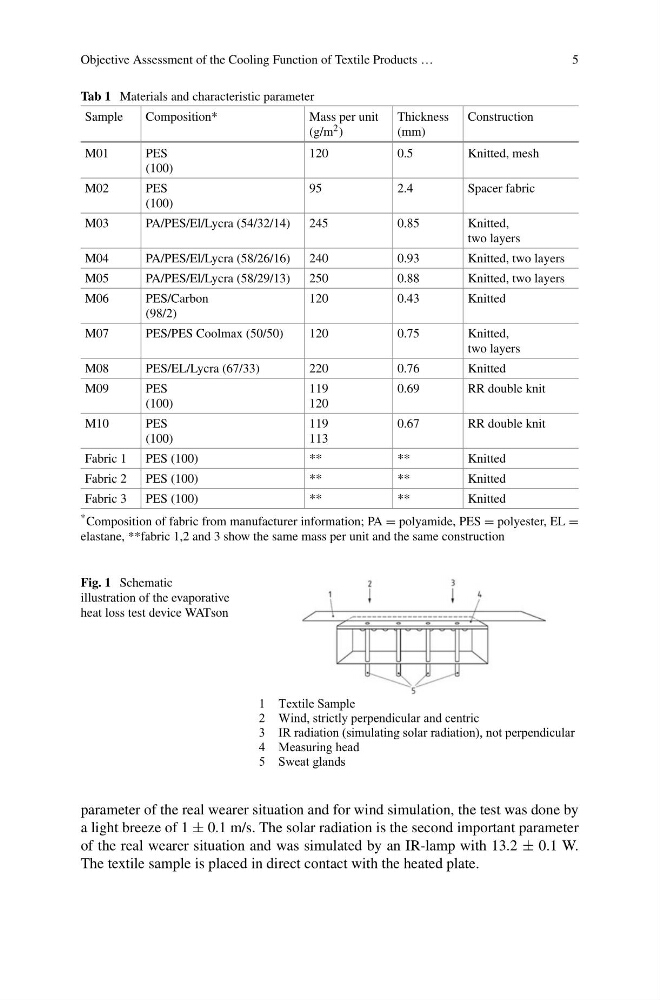
Fig. 1 Schematic
illustration of the evaporative
heat loss test device WATson
1 Textile Sample
2 Wind, strictly perpendicular and centric
3 IR radiation (simulating solar radiation), not perpendicular
4 Measuring head
5 Sweat glands
parameter of the real wearer situation and for wind simulation, the test was done by
a light breeze of 1 ± 0.1 m/s. The solar radiation is the second important parameter
of the real wearer situation and was simulated by an IR-lamp with 13.2 ± 0.1 W.
The textile sample is placed in direct contact with the heated plate.
5
Tab 1 Materials and characteristic parameter
Sample
Composition*
Mass per unit
(g/m 2 )
Thickness
(mm)
Construction
M01
PES
(100)
120
0.5
Knitted, mesh
M02
PES
(100)
95
2.4
Spacer fabric
M03
PA/PES/El/Lycra (54/32/14) 245
0.85
Knitted,
two layers
M04
PA/PES/El/Lycra (58/26/16) 240
0.93
Knitted, two layers
M05
PA/PES/El/Lycra (58/29/13) 250
0.88
Knitted, two layers
M06
PES/Carbon
(98/2)
120
0.43
Knitted
M07
PES/PES Coolmax (50/50)
120
0.75
Knitted,
two layers
M08
PES/EL/Lycra (67/33)
220
0.76
Knitted
M09
PES
(100)
119
120
0.69
RR double knit
M10
PES
(100)
119
113
0.67
RR double knit
Fabric 1 PES (100)
**
**
Knitted
Fabric 2 PES (100)
**
**
Knitted
Fabric 3 PES (100)
**
**
Knitted
* Composition of fabric from manufacturer information; PA = polyamide, PES = polyester, EL =
elastane, **fabric 1,2 and 3 show the same mass per unit and the same construction
Fig. 1 Schematic
illustration of the evaporative
heat loss test device WATson
1 Textile Sample
2 Wind, strictly perpendicular and centric
3 IR radiation (simulating solar radiation), not perpendicular
4 Measuring head
5 Sweat glands
parameter of the real wearer situation and for wind simulation, the test was done by
a light breeze of 1 ± 0.1 m/s. The solar radiation is the second important parameter
of the real wearer situation and was simulated by an IR-lamp with 13.2 ± 0.1 W.
The textile sample is placed in direct contact with the heated plate.