

82
V. Sisodia et al.
1 Introduction
Single-point incremental forming (SPIF) process is emerging sheet metal forming
process which is capable producing complicated sheet metal parts without dedicated
press tools. The part is directly made from computer-aided design (CAD) geometry,
thus eliminating the requirement of molds, fixture, punch, and die setup. It is a
flexible process [1]. The process is a carried on three-axis conventional computerized
numerically controlled (CNC) milling machine without investing on new equipment
and tooling [2]. Tool path can be simulated and optimized on simple CNC simulator
software. Due to the above-mentioned benefits, the cost of machine setup and tooling
in SPIF process is much lesser relative to conventional sheet metal forming processes
which requires dedicated press and press tools [3]. If there is any design change in
existing part, then it requires whole new or modified die and punch setup. But in
SPIF process, any change design of part can be quickly and easily incorporated.
Due to incremental deformation characteristics, forming force required during
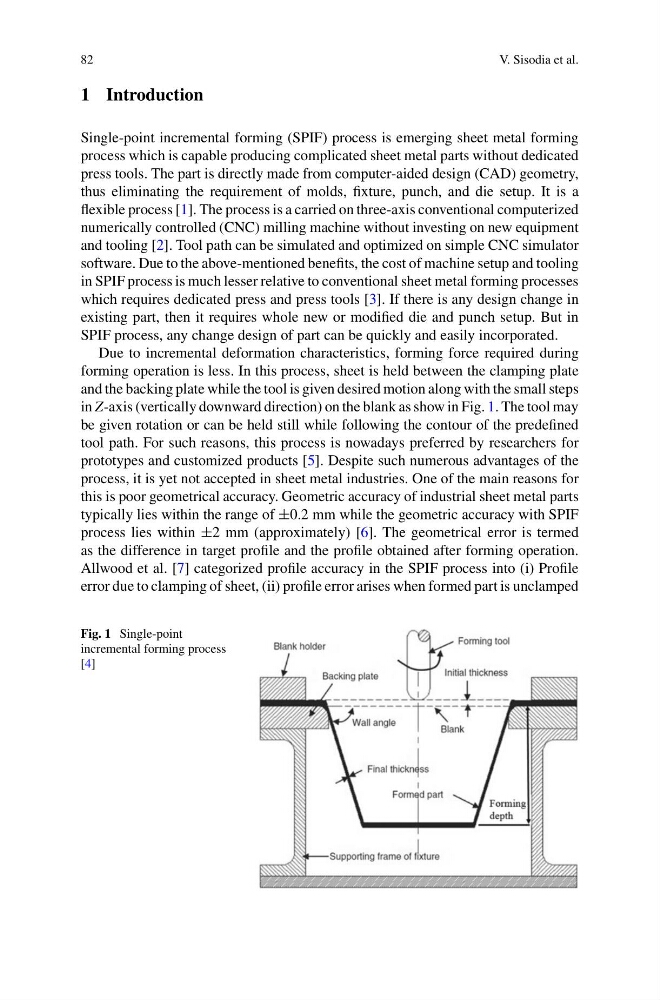
forming operation is less. In this process, sheet is held between the clamping plate
and the backing plate while the tool is given desired motion along with the small steps
in Z-axis (vertically downward direction) on the blank as show in Fig. 1. The tool may
be given rotation or can be held still while following the contour of the predefined
tool path. For such reasons, this process is nowadays preferred by researchers for
prototypes and customized products [5]. Despite such numerous advantages of the
process, it is yet not accepted in sheet metal industries. One of the main reasons for
this is poor geometrical accuracy. Geometric accuracy of industrial sheet metal parts
typically lies within the range of ±0.2 mm while the geometric accuracy with SPIF
process lies within ±2 mm (approximately) [6]. The geometrical error is termed
as the difference in target profile and the profile obtained after forming operation.
Allwood et al. [7] categorized profile accuracy in the SPIF process into (i) Profile
error due to clamping of sheet, (ii) profile error arises when formed part is unclamped
Fig. 1 Single-point
incremental forming process
[4]
V. Sisodia et al.
1 Introduction
Single-point incremental forming (SPIF) process is emerging sheet metal forming
process which is capable producing complicated sheet metal parts without dedicated
press tools. The part is directly made from computer-aided design (CAD) geometry,
thus eliminating the requirement of molds, fixture, punch, and die setup. It is a
flexible process [1]. The process is a carried on three-axis conventional computerized
numerically controlled (CNC) milling machine without investing on new equipment
and tooling [2]. Tool path can be simulated and optimized on simple CNC simulator
software. Due to the above-mentioned benefits, the cost of machine setup and tooling
in SPIF process is much lesser relative to conventional sheet metal forming processes
which requires dedicated press and press tools [3]. If there is any design change in
existing part, then it requires whole new or modified die and punch setup. But in
SPIF process, any change design of part can be quickly and easily incorporated.
Due to incremental deformation characteristics, forming force required during
forming operation is less. In this process, sheet is held between the clamping plate
and the backing plate while the tool is given desired motion along with the small steps
in Z-axis (vertically downward direction) on the blank as show in Fig. 1. The tool may
be given rotation or can be held still while following the contour of the predefined
tool path. For such reasons, this process is nowadays preferred by researchers for
prototypes and customized products [5]. Despite such numerous advantages of the
process, it is yet not accepted in sheet metal industries. One of the main reasons for
this is poor geometrical accuracy. Geometric accuracy of industrial sheet metal parts
typically lies within the range of ±0.2 mm while the geometric accuracy with SPIF
process lies within ±2 mm (approximately) [6]. The geometrical error is termed
as the difference in target profile and the profile obtained after forming operation.
Allwood et al. [7] categorized profile accuracy in the SPIF process into (i) Profile
error due to clamping of sheet, (ii) profile error arises when formed part is unclamped
Fig. 1 Single-point
incremental forming process
[4]