

Experimental and Numerical Study on Temperature Distribution …
77
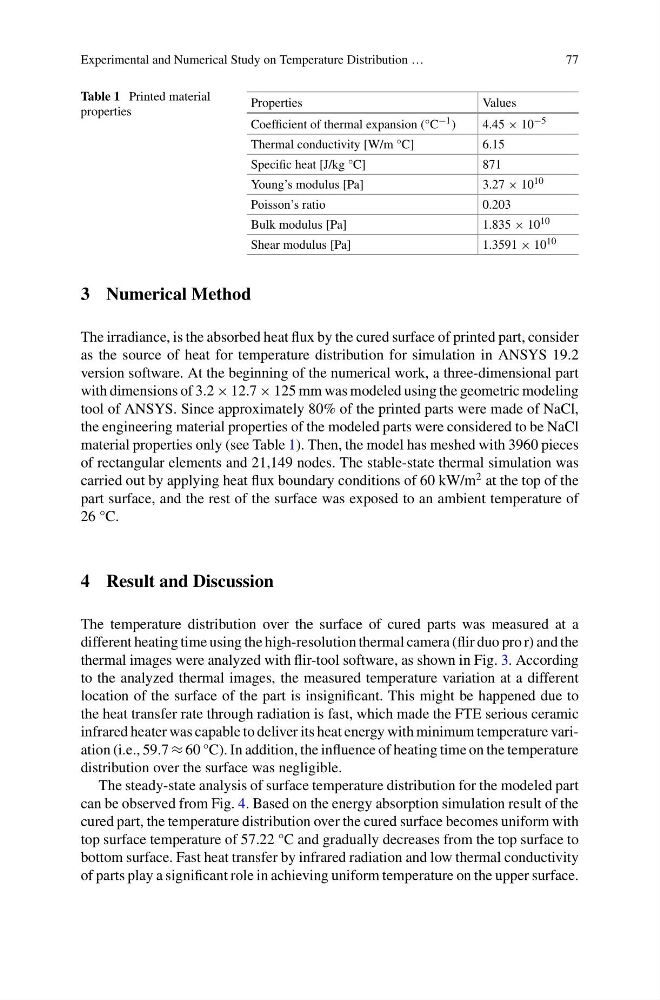
Table 1 Printed material
properties
Properties
Values
Coefficient of thermal expansion (°C −1 )
4.45 × 10 −5
Thermal conductivity [W/m °C]
6.15
Specific heat [J/kg °C]
871
Young’s modulus [Pa]
3.27 × 10 10
Poisson’s ratio
0.203
Bulk modulus [Pa]
1.835 × 10 10
Shear modulus [Pa]
1.3591 × 10 10
3 Numerical Method
The irradiance, is the absorbed heat flux by the cured surface of printed part, consider
as the source of heat for temperature distribution for simulation in ANSYS 19.2
version software. At the beginning of the numerical work, a three-dimensional part
with dimensions of 3.2 × 12.7 × 125 mm was modeled using the geometric modeling
tool of ANSYS. Since approximately 80% of the printed parts were made of NaCl,
the engineering material properties of the modeled parts were considered to be NaCl
material properties only (see Table 1). Then, the model has meshed with 3960 pieces
of rectangular elements and 21,149 nodes. The stable-state thermal simulation was
carried out by applying heat flux boundary conditions of 60 kW/m
2 at the top of the
part surface, and the rest of the surface was exposed to an ambient temperature of
26 °C.
4 Result and Discussion
The temperature distribution over the surface of cured parts was measured at a
different heating time using the high-resolution thermal camera (flir duo pro r) and the
thermal images were analyzed with flir-tool software, as shown in Fig. 3. According
to the analyzed thermal images, the measured temperature variation at a different
location of the surface of the part is insignificant. This might be happened due to
the heat transfer rate through radiation is fast, which made the FTE serious ceramic
infrared heater was capable to deliver its heat energy with minimum temperature variation (i.e., 59.7 ≈ 60 °C). In addition, the influence of heating time on the temperature
distribution over the surface was negligible.
The steady-state analysis of surface temperature distribution for the modeled part
can be observed from Fig. 4. Based on the energy absorption simulation result of the
cured part, the temperature distribution over the cured surface becomes uniform with
top surface temperature of 57.22 °C and gradually decreases from the top surface to
bottom surface. Fast heat transfer by infrared radiation and low thermal conductivity
of parts play a significant role in achieving uniform temperature on the upper surface.
77
Table 1 Printed material
properties
Properties
Values
Coefficient of thermal expansion (°C −1 )
4.45 × 10 −5
Thermal conductivity [W/m °C]
6.15
Specific heat [J/kg °C]
871
Young’s modulus [Pa]
3.27 × 10 10
Poisson’s ratio
0.203
Bulk modulus [Pa]
1.835 × 10 10
Shear modulus [Pa]
1.3591 × 10 10
3 Numerical Method
The irradiance, is the absorbed heat flux by the cured surface of printed part, consider
as the source of heat for temperature distribution for simulation in ANSYS 19.2
version software. At the beginning of the numerical work, a three-dimensional part
with dimensions of 3.2 × 12.7 × 125 mm was modeled using the geometric modeling
tool of ANSYS. Since approximately 80% of the printed parts were made of NaCl,
the engineering material properties of the modeled parts were considered to be NaCl
material properties only (see Table 1). Then, the model has meshed with 3960 pieces
of rectangular elements and 21,149 nodes. The stable-state thermal simulation was
carried out by applying heat flux boundary conditions of 60 kW/m
2 at the top of the
part surface, and the rest of the surface was exposed to an ambient temperature of
26 °C.
4 Result and Discussion
The temperature distribution over the surface of cured parts was measured at a
different heating time using the high-resolution thermal camera (flir duo pro r) and the
thermal images were analyzed with flir-tool software, as shown in Fig. 3. According
to the analyzed thermal images, the measured temperature variation at a different
location of the surface of the part is insignificant. This might be happened due to
the heat transfer rate through radiation is fast, which made the FTE serious ceramic
infrared heater was capable to deliver its heat energy with minimum temperature variation (i.e., 59.7 ≈ 60 °C). In addition, the influence of heating time on the temperature
distribution over the surface was negligible.
The steady-state analysis of surface temperature distribution for the modeled part
can be observed from Fig. 4. Based on the energy absorption simulation result of the
cured part, the temperature distribution over the cured surface becomes uniform with
top surface temperature of 57.22 °C and gradually decreases from the top surface to
bottom surface. Fast heat transfer by infrared radiation and low thermal conductivity
of parts play a significant role in achieving uniform temperature on the upper surface.