

524
M. Abhay et al.
dt =
mean free path
Thermal Velocity
=
λ
c
(2)
where
c
=
√
3kT /
√ ¯
m
(3)
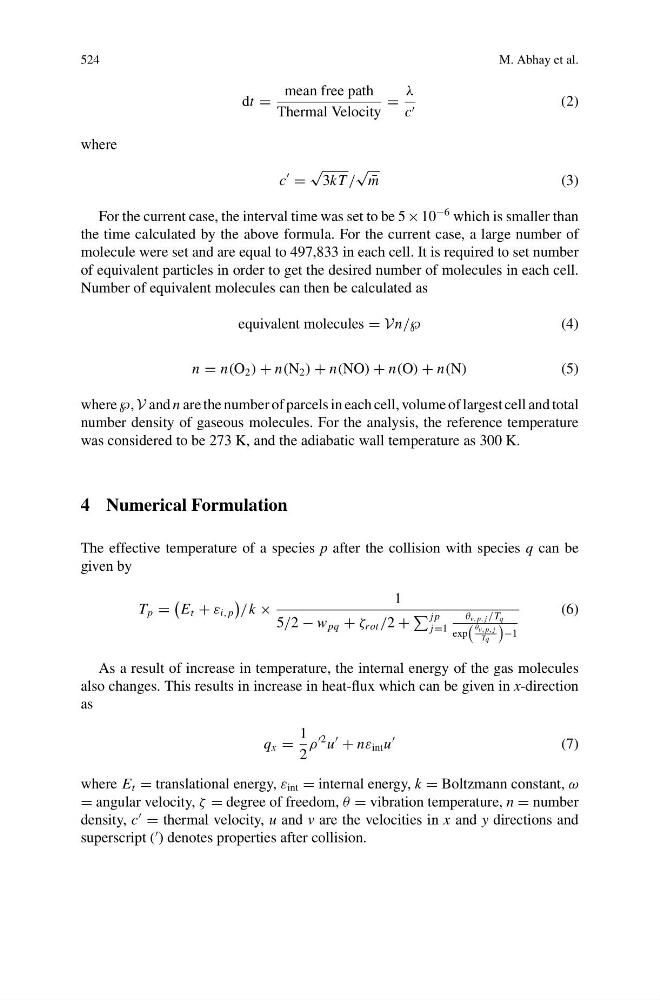
For the current case, the interval time was set to be 5 × 10
−6 which is smaller than
the time calculated by the above formula. For the current case, a large number of
molecule were set and are equal to 497,833 in each cell. It is required to set number
of equivalent particles in order to get the desired number of molecules in each cell.
Number of equivalent molecules can then be calculated as
equivalent molecules = Vn/℘
(4)
n = n(O 2 ) + n(N 2 ) + n(NO) + n(O) + n(N)
(5)
where ℘, V and n are the number of parcels in each cell, volume of largest cell and total
number density of gaseous molecules. For the analysis, the reference temperature
was considered to be 273 K, and the adiabatic wall temperature as 300 K.
4 Numerical Formulation
The effective temperature of a species p after the collision with species q can be
given by
T p =
E t + ε i, p
/k ×
1
5/2 − w pq + ζ rot /2 +
j p
j=1
θ v, p, j /T q
exp
θ v, p, j
Tq
−1
(6)
As a result of increase in temperature, the internal energy of the gas molecules
also changes. This results in increase in heat-flux which can be given in x-direction
as
q x =
1
2
ρ
2 u
+ nε int u
(7)
where E t = translational energy, ε int = internal energy, k = Boltzmann constant, ω
= angular velocity, ζ = degree of freedom, θ = vibration temperature, n = number
density, c
= thermal velocity, u and v are the velocities in x and y directions and
superscript (
) denotes properties after collision.
M. Abhay et al.
dt =
mean free path
Thermal Velocity
=
λ
c
(2)
where
c
=
√
3kT /
√ ¯
m
(3)
For the current case, the interval time was set to be 5 × 10
−6 which is smaller than
the time calculated by the above formula. For the current case, a large number of
molecule were set and are equal to 497,833 in each cell. It is required to set number
of equivalent particles in order to get the desired number of molecules in each cell.
Number of equivalent molecules can then be calculated as
equivalent molecules = Vn/℘
(4)
n = n(O 2 ) + n(N 2 ) + n(NO) + n(O) + n(N)
(5)
where ℘, V and n are the number of parcels in each cell, volume of largest cell and total
number density of gaseous molecules. For the analysis, the reference temperature
was considered to be 273 K, and the adiabatic wall temperature as 300 K.
4 Numerical Formulation
The effective temperature of a species p after the collision with species q can be
given by
T p =
E t + ε i, p
/k ×
1
5/2 − w pq + ζ rot /2 +
j p
j=1
θ v, p, j /T q
exp
θ v, p, j
Tq
−1
(6)
As a result of increase in temperature, the internal energy of the gas molecules
also changes. This results in increase in heat-flux which can be given in x-direction
as
q x =
1
2
ρ
2 u
+ nε int u
(7)
where E t = translational energy, ε int = internal energy, k = Boltzmann constant, ω
= angular velocity, ζ = degree of freedom, θ = vibration temperature, n = number
density, c
= thermal velocity, u and v are the velocities in x and y directions and
superscript (
) denotes properties after collision.