

Influence of Different Abrasives Mixtures on Abrasive Water …
513
cost. Change in the abrasives also brings about changes in the features of the hole.
From the literature survey, it is observed that the mixing of two abrasives and their
respective output responses have never been attempted.
2 Materials and Methods
In this study, AISI D2 steel was chosen as work material due to its toughness and
hardness properties. It has high wear and abrasion-resistant properties. D2 steel has
the following mechanical properties namely, hardness 260 HV, poor toughness, and
machinability [6]. The size of the work material is 290 mm × 190 mm × 39 mm.
In this study, three types of abrasives were used for drilling operations. First, Garnet
is the most widely used abrasive. It has a significant hardness, cost-effective abrasive, Options for recycling, environmentally friendly cutting, and cleaning. Second,
Silicon Carbide (SiC) has higher hardness and sharp crystal edges. The reason behind
the selection of SiC and Garnet abrasives are suitable for AWJM of hard materials.
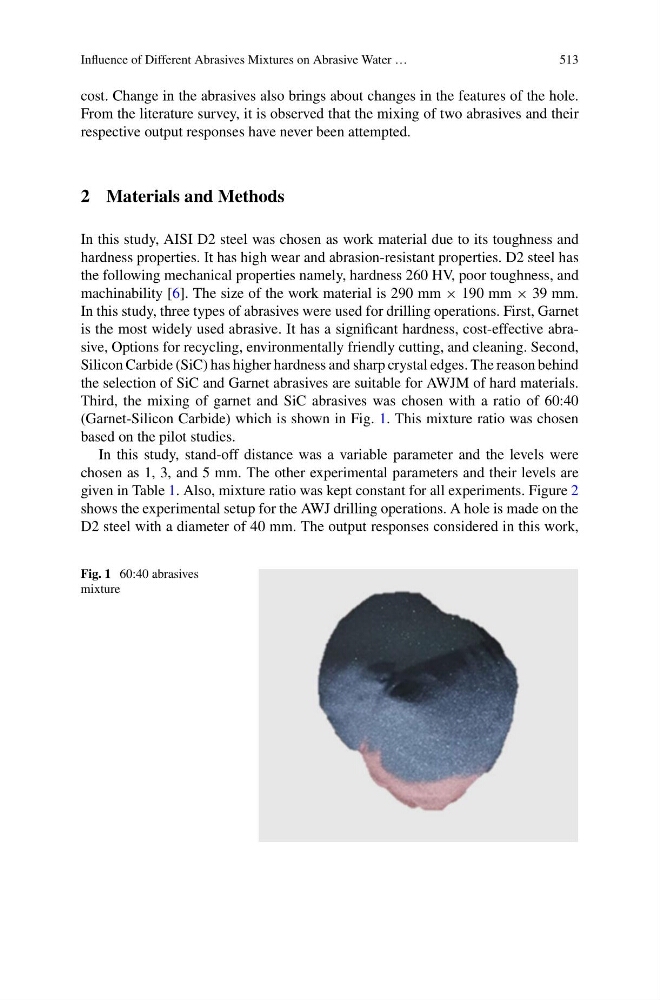
Third, the mixing of garnet and SiC abrasives was chosen with a ratio of 60:40
(Garnet-Silicon Carbide) which is shown in Fig. 1. This mixture ratio was chosen
based on the pilot studies.
In this study, stand-off distance was a variable parameter and the levels were
chosen as 1, 3, and 5 mm. The other experimental parameters and their levels are
given in Table 1. Also, mixture ratio was kept constant for all experiments. Figure 2
shows the experimental setup for the AWJ drilling operations. A hole is made on the
D2 steel with a diameter of 40 mm. The output responses considered in this work,
Fig. 1 60:40 abrasives
mixture
513
cost. Change in the abrasives also brings about changes in the features of the hole.
From the literature survey, it is observed that the mixing of two abrasives and their
respective output responses have never been attempted.
2 Materials and Methods
In this study, AISI D2 steel was chosen as work material due to its toughness and
hardness properties. It has high wear and abrasion-resistant properties. D2 steel has
the following mechanical properties namely, hardness 260 HV, poor toughness, and
machinability [6]. The size of the work material is 290 mm × 190 mm × 39 mm.
In this study, three types of abrasives were used for drilling operations. First, Garnet
is the most widely used abrasive. It has a significant hardness, cost-effective abrasive, Options for recycling, environmentally friendly cutting, and cleaning. Second,
Silicon Carbide (SiC) has higher hardness and sharp crystal edges. The reason behind
the selection of SiC and Garnet abrasives are suitable for AWJM of hard materials.
Third, the mixing of garnet and SiC abrasives was chosen with a ratio of 60:40
(Garnet-Silicon Carbide) which is shown in Fig. 1. This mixture ratio was chosen
based on the pilot studies.
In this study, stand-off distance was a variable parameter and the levels were
chosen as 1, 3, and 5 mm. The other experimental parameters and their levels are
given in Table 1. Also, mixture ratio was kept constant for all experiments. Figure 2
shows the experimental setup for the AWJ drilling operations. A hole is made on the
D2 steel with a diameter of 40 mm. The output responses considered in this work,
Fig. 1 60:40 abrasives
mixture