

428
T. Sundararajan et al.
1 Introduction
To induce compressive residual stress, there are various methods such as cold
working, deep rolling, shot peening and so on. But one such recent and advance
method is Laser Peening (LP) or Laser shot peening.
Laser peening is a surface engineering technique, which strengthens the component surface, where it is structurally vulnerable, without adding any material. Laser
peening is a mechanical process that uses a high energy pulse laser beam to produce
a plasma, that creates a shock wave where the surface that plastically deforms and
improves the surface hardness. This process has a wide range of applications such
as aerospace, defence, medical equipment, automobiles and so on.
1.1 Working Principle of Laser Peening
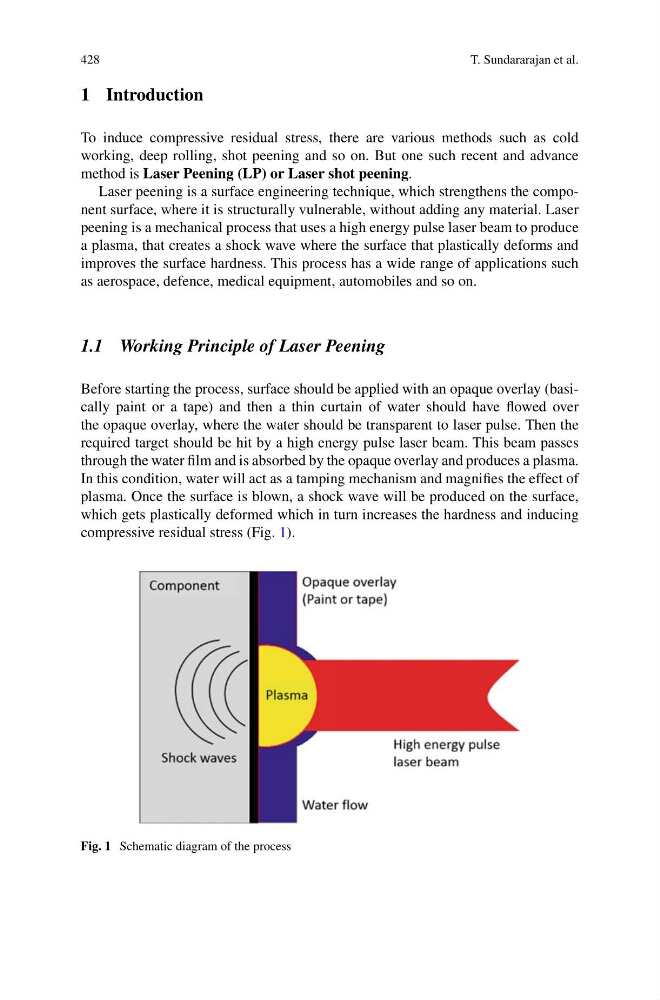
Before starting the process, surface should be applied with an opaque overlay (basically paint or a tape) and then a thin curtain of water should have flowed over
the opaque overlay, where the water should be transparent to laser pulse. Then the
required target should be hit by a high energy pulse laser beam. This beam passes
through the water film and is absorbed by the opaque overlay and produces a plasma.
In this condition, water will act as a tamping mechanism and magnifies the effect of
plasma. Once the surface is blown, a shock wave will be produced on the surface,
which gets plastically deformed which in turn increases the hardness and inducing
compressive residual stress (Fig. 1).
Fig. 1 Schematic diagram of the process
T. Sundararajan et al.
1 Introduction
To induce compressive residual stress, there are various methods such as cold
working, deep rolling, shot peening and so on. But one such recent and advance
method is Laser Peening (LP) or Laser shot peening.
Laser peening is a surface engineering technique, which strengthens the component surface, where it is structurally vulnerable, without adding any material. Laser
peening is a mechanical process that uses a high energy pulse laser beam to produce
a plasma, that creates a shock wave where the surface that plastically deforms and
improves the surface hardness. This process has a wide range of applications such
as aerospace, defence, medical equipment, automobiles and so on.
1.1 Working Principle of Laser Peening
Before starting the process, surface should be applied with an opaque overlay (basically paint or a tape) and then a thin curtain of water should have flowed over
the opaque overlay, where the water should be transparent to laser pulse. Then the
required target should be hit by a high energy pulse laser beam. This beam passes
through the water film and is absorbed by the opaque overlay and produces a plasma.
In this condition, water will act as a tamping mechanism and magnifies the effect of
plasma. Once the surface is blown, a shock wave will be produced on the surface,
which gets plastically deformed which in turn increases the hardness and inducing
compressive residual stress (Fig. 1).
Fig. 1 Schematic diagram of the process