

426
T. Sundararajan et al.
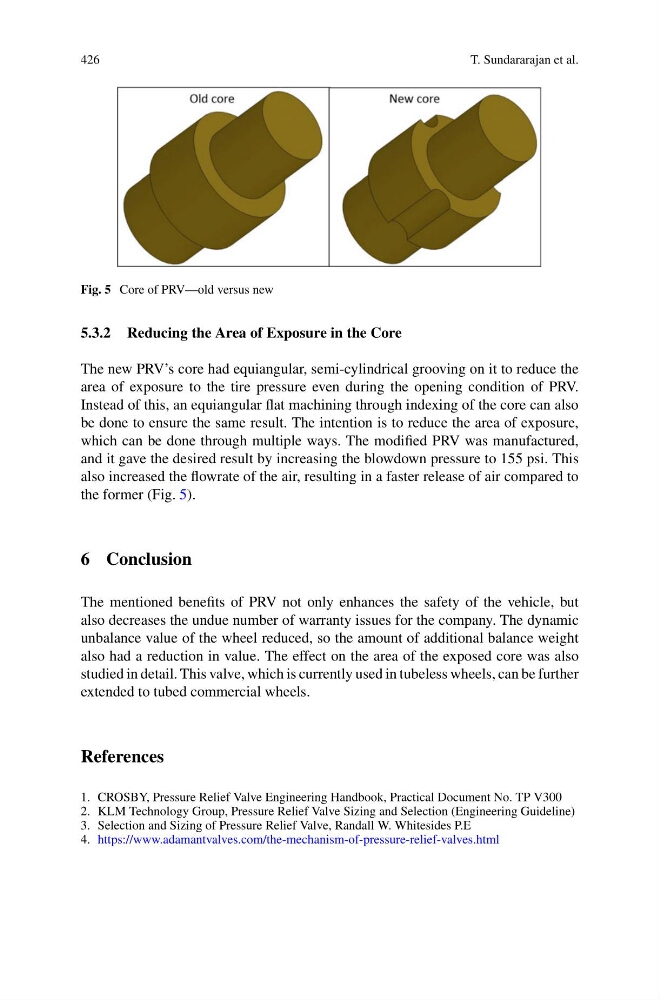
Fig. 5 Core of PRV—old versus new
5.3.2 Reducing the Area of Exposure in the Core
The new PRV’s core had equiangular, semi-cylindrical grooving on it to reduce the
area of exposure to the tire pressure even during the opening condition of PRV.
Instead of this, an equiangular flat machining through indexing of the core can also
be done to ensure the same result. The intention is to reduce the area of exposure,
which can be done through multiple ways. The modified PRV was manufactured,
and it gave the desired result by increasing the blowdown pressure to 155 psi. This
also increased the flowrate of the air, resulting in a faster release of air compared to
the former (Fig. 5).
6 Conclusion
The mentioned benefits of PRV not only enhances the safety of the vehicle, but
also decreases the undue number of warranty issues for the company. The dynamic
unbalance value of the wheel reduced, so the amount of additional balance weight
also had a reduction in value. The effect on the area of the exposed core was also
studied in detail. This valve, which is currently used in tubeless wheels, can be further
extended to tubed commercial wheels.
References
1. CROSBY, Pressure Relief Valve Engineering Handbook, Practical Document No. TP V300
2. KLM Technology Group, Pressure Relief Valve Sizing and Selection (Engineering Guideline)
3. Selection and Sizing of Pressure Relief Valve, Randall W. Whitesides P.E
4. https://www.adamantvalves.com/the-mechanism-of-pressure-relief-valves.html
T. Sundararajan et al.
Fig. 5 Core of PRV—old versus new
5.3.2 Reducing the Area of Exposure in the Core
The new PRV’s core had equiangular, semi-cylindrical grooving on it to reduce the
area of exposure to the tire pressure even during the opening condition of PRV.
Instead of this, an equiangular flat machining through indexing of the core can also
be done to ensure the same result. The intention is to reduce the area of exposure,
which can be done through multiple ways. The modified PRV was manufactured,
and it gave the desired result by increasing the blowdown pressure to 155 psi. This
also increased the flowrate of the air, resulting in a faster release of air compared to
the former (Fig. 5).
6 Conclusion
The mentioned benefits of PRV not only enhances the safety of the vehicle, but
also decreases the undue number of warranty issues for the company. The dynamic
unbalance value of the wheel reduced, so the amount of additional balance weight
also had a reduction in value. The effect on the area of the exposed core was also
studied in detail. This valve, which is currently used in tubeless wheels, can be further
extended to tubed commercial wheels.
References
1. CROSBY, Pressure Relief Valve Engineering Handbook, Practical Document No. TP V300
2. KLM Technology Group, Pressure Relief Valve Sizing and Selection (Engineering Guideline)
3. Selection and Sizing of Pressure Relief Valve, Randall W. Whitesides P.E
4. https://www.adamantvalves.com/the-mechanism-of-pressure-relief-valves.html