

Numerical Study on Sonic Underexpanded Co-flowing Jet …
361
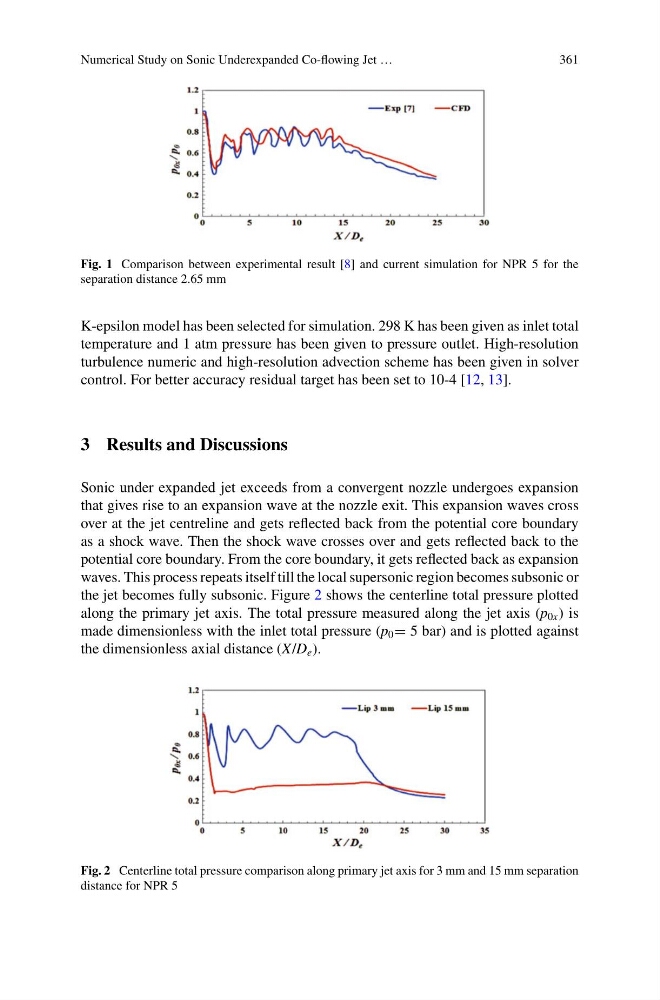
Fig. 1 Comparison between experimental result [8] and current simulation for NPR 5 for the
separation distance 2.65 mm
K-epsilon model has been selected for simulation. 298 K has been given as inlet total
temperature and 1 atm pressure has been given to pressure outlet. High-resolution
turbulence numeric and high-resolution advection scheme has been given in solver
control. For better accuracy residual target has been set to 10-4 [12, 13].
3 Results and Discussions
Sonic under expanded jet exceeds from a convergent nozzle undergoes expansion
that gives rise to an expansion wave at the nozzle exit. This expansion waves cross
over at the jet centreline and gets reflected back from the potential core boundary
as a shock wave. Then the shock wave crosses over and gets reflected back to the
potential core boundary. From the core boundary, it gets reflected back as expansion
waves. This process repeats itself till the local supersonic region becomes subsonic or
the jet becomes fully subsonic. Figure 2 shows the centerline total pressure plotted
along the primary jet axis. The total pressure measured along the jet axis (p 0x ) is
made dimensionless with the inlet total pressure (p 0 = 5 bar) and is plotted against
the dimensionless axial distance (X/D e ).
Fig. 2 Centerline total pressure comparison along primary jet axis for 3 mm and 15 mm separation
distance for NPR 5
361
Fig. 1 Comparison between experimental result [8] and current simulation for NPR 5 for the
separation distance 2.65 mm
K-epsilon model has been selected for simulation. 298 K has been given as inlet total
temperature and 1 atm pressure has been given to pressure outlet. High-resolution
turbulence numeric and high-resolution advection scheme has been given in solver
control. For better accuracy residual target has been set to 10-4 [12, 13].
3 Results and Discussions
Sonic under expanded jet exceeds from a convergent nozzle undergoes expansion
that gives rise to an expansion wave at the nozzle exit. This expansion waves cross
over at the jet centreline and gets reflected back from the potential core boundary
as a shock wave. Then the shock wave crosses over and gets reflected back to the
potential core boundary. From the core boundary, it gets reflected back as expansion
waves. This process repeats itself till the local supersonic region becomes subsonic or
the jet becomes fully subsonic. Figure 2 shows the centerline total pressure plotted
along the primary jet axis. The total pressure measured along the jet axis (p 0x ) is
made dimensionless with the inlet total pressure (p 0 = 5 bar) and is plotted against
the dimensionless axial distance (X/D e ).
Fig. 2 Centerline total pressure comparison along primary jet axis for 3 mm and 15 mm separation
distance for NPR 5