

Cell Arrangement Measurement—A Perfect Usage of Cell …
13
• To think about the presentation of the cell format with the customary design as far
as profitability improvement, decrease in material taking care of separation and
decrease in floor space prerequisites.
1.1 Evaluation Parameter
The four main parameters were used to evaluate the cells formed are
1. Exceptional elements (PE)
PE = e 0
(1)
2. Voids (v)
Voids shows that all components assigned to the cell will not require any machine
assigned to a cell. Leads to huge, ineffective cells and will potentially supports
to low utilizations.
3. Efficiency (η)
η = wη 1 + (1 − w)η 2
(2)
η 1 =
o − e
o − e + v
(4)
η 2 =
MP − o − v
MP − o + e − v
(5)
4. Efficacy (τ)
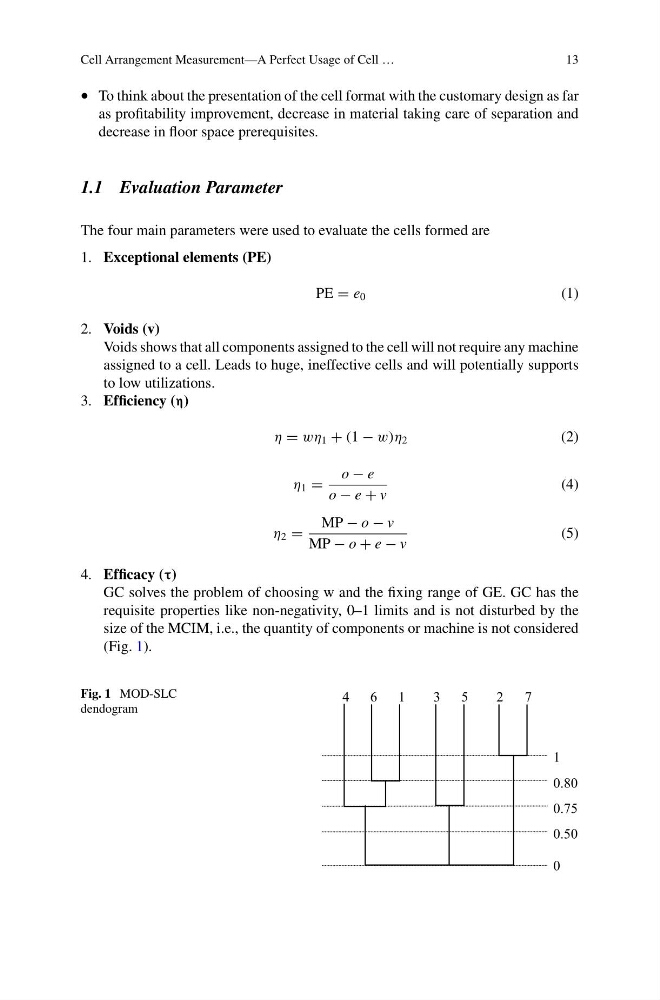
GC solves the problem of choosing w and the fixing range of GE. GC has the
requisite properties like non-negativity, 0–1 limits and is not disturbed by the
size of the MCIM, i.e., the quantity of components or machine is not considered
(Fig. 1).
Fig. 1 MOD-SLC
dendogram
4 6
0.50
0.75
0.80
1
2
5
3
1
0
7
13
• To think about the presentation of the cell format with the customary design as far
as profitability improvement, decrease in material taking care of separation and
decrease in floor space prerequisites.
1.1 Evaluation Parameter
The four main parameters were used to evaluate the cells formed are
1. Exceptional elements (PE)
PE = e 0
(1)
2. Voids (v)
Voids shows that all components assigned to the cell will not require any machine
assigned to a cell. Leads to huge, ineffective cells and will potentially supports
to low utilizations.
3. Efficiency (η)
η = wη 1 + (1 − w)η 2
(2)
η 1 =
o − e
o − e + v
(4)
η 2 =
MP − o − v
MP − o + e − v
(5)
4. Efficacy (τ)
GC solves the problem of choosing w and the fixing range of GE. GC has the
requisite properties like non-negativity, 0–1 limits and is not disturbed by the
size of the MCIM, i.e., the quantity of components or machine is not considered
(Fig. 1).
Fig. 1 MOD-SLC
dendogram
4 6
0.50
0.75
0.80
1
2
5
3
1
0
7