

Comparative Study of Response of Vibrations for Circular …
193
π 1 =
¨
x
R c N 2
(6)
Using the similar procedure, Table 2 gives the remaining twenty (20) dimensionless groups,
3.2 Deducing of Dimensionless Groups
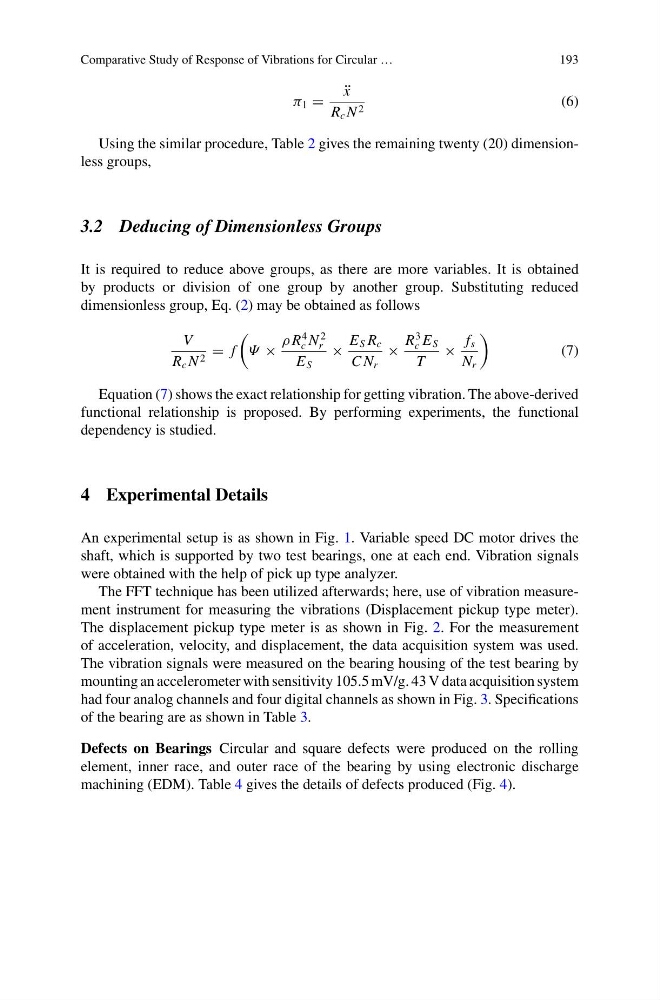
It is required to reduce above groups, as there are more variables. It is obtained
by products or division of one group by another group. Substituting reduced
dimensionless group, Eq. (2) may be obtained as follows
V
R c N 2 = f
Ψ ×
ρ R
4
c N
2
r
E S
×
E S R c
C N r
×
R
3
c E S
T
×
f s
N r
(7)
Equation (7) shows the exact relationship for getting vibration. The above-derived
functional relationship is proposed. By performing experiments, the functional
dependency is studied.
4 Experimental Details
An experimental setup is as shown in Fig. 1. Variable speed DC motor drives the
shaft, which is supported by two test bearings, one at each end. Vibration signals
were obtained with the help of pick up type analyzer.
The FFT technique has been utilized afterwards; here, use of vibration measurement instrument for measuring the vibrations (Displacement pickup type meter).
The displacement pickup type meter is as shown in Fig. 2. For the measurement
of acceleration, velocity, and displacement, the data acquisition system was used.
The vibration signals were measured on the bearing housing of the test bearing by
mounting an accelerometer with sensitivity 105.5 mV/g. 43 V data acquisition system
had four analog channels and four digital channels as shown in Fig. 3. Specifications
of the bearing are as shown in Table 3.
Defects on Bearings Circular and square defects were produced on the rolling
element, inner race, and outer race of the bearing by using electronic discharge
machining (EDM). Table 4 gives the details of defects produced (Fig. 4).
193
π 1 =
¨
x
R c N 2
(6)
Using the similar procedure, Table 2 gives the remaining twenty (20) dimensionless groups,
3.2 Deducing of Dimensionless Groups
It is required to reduce above groups, as there are more variables. It is obtained
by products or division of one group by another group. Substituting reduced
dimensionless group, Eq. (2) may be obtained as follows
V
R c N 2 = f
Ψ ×
ρ R
4
c N
2
r
E S
×
E S R c
C N r
×
R
3
c E S
T
×
f s
N r
(7)
Equation (7) shows the exact relationship for getting vibration. The above-derived
functional relationship is proposed. By performing experiments, the functional
dependency is studied.
4 Experimental Details
An experimental setup is as shown in Fig. 1. Variable speed DC motor drives the
shaft, which is supported by two test bearings, one at each end. Vibration signals
were obtained with the help of pick up type analyzer.
The FFT technique has been utilized afterwards; here, use of vibration measurement instrument for measuring the vibrations (Displacement pickup type meter).
The displacement pickup type meter is as shown in Fig. 2. For the measurement
of acceleration, velocity, and displacement, the data acquisition system was used.
The vibration signals were measured on the bearing housing of the test bearing by
mounting an accelerometer with sensitivity 105.5 mV/g. 43 V data acquisition system
had four analog channels and four digital channels as shown in Fig. 3. Specifications
of the bearing are as shown in Table 3.
Defects on Bearings Circular and square defects were produced on the rolling
element, inner race, and outer race of the bearing by using electronic discharge
machining (EDM). Table 4 gives the details of defects produced (Fig. 4).