

Comparative Study of Response of Vibrations for Circular …
191
early stage. Desavale [8–10] developed different models by using dimensional analysis approach to study different faults in rotor-bearing system, namely looseness,
misalignment, defect of various component of bearing, etc.
3 Formulations of Mathematical Model
The dimensional analysis approach is used to develop mathematical model for
complex systems containing more number of variables. This paper presents a model
proposed by using dimensional analysis to estimate vibration amplitude.
The dimensional groups are obtained in terms of three basic dimensions—L
length, T time and either M mass or F force. The mathematical model expressed to
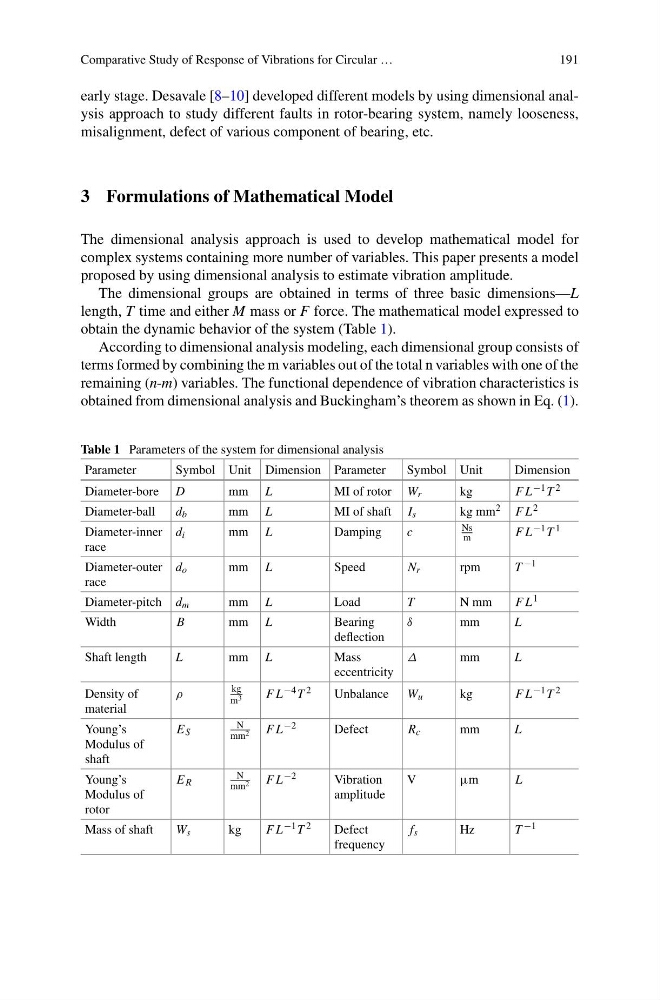
obtain the dynamic behavior of the system (Table 1).
According to dimensional analysis modeling, each dimensional group consists of
terms formed by combining the m variables out of the total n variables with one of the
remaining (n-m) variables. The functional dependence of vibration characteristics is
obtained from dimensional analysis and Buckingham’s theorem as shown in Eq. (1).
Table 1 Parameters of the system for dimensional analysis
Parameter
Symbol Unit Dimension Parameter
Symbol Unit
Dimension
Diameter-bore D
mm L
MI of rotor W r
kg
F L −1 T 2
Diameter-ball
d b
mm L
MI of shaft I s
kg mm 2 F L 2
Diameter-inner
race
d i
mm L
Damping
c
Ns
m
F L −1 T 1
Diameter-outer
race
d o
mm L
Speed
N r
rpm
T −1
Diameter-pitch d m
mm L
Load
T
N mm
F L 1
Width
B
mm L
Bearing
deflection
δ
mm
L
Shaft length
L
mm L
Mass
eccentricity
Δ
mm
L
Density of
material
ρ
kg
m 3
F L −4 T 2
Unbalance W u
kg
F L −1 T 2
Young’s
Modulus of
shaft
E S
N
mm 2
F L −2
Defect
R c
mm
L
Young’s
Modulus of
rotor
E R
N
mm 2
F L −2
Vibration
amplitude
V
µm
L
Mass of shaft
W s
kg
F L −1 T 2
Defect
frequency
f s
Hz
T −1
191
early stage. Desavale [8–10] developed different models by using dimensional analysis approach to study different faults in rotor-bearing system, namely looseness,
misalignment, defect of various component of bearing, etc.
3 Formulations of Mathematical Model
The dimensional analysis approach is used to develop mathematical model for
complex systems containing more number of variables. This paper presents a model
proposed by using dimensional analysis to estimate vibration amplitude.
The dimensional groups are obtained in terms of three basic dimensions—L
length, T time and either M mass or F force. The mathematical model expressed to
obtain the dynamic behavior of the system (Table 1).
According to dimensional analysis modeling, each dimensional group consists of
terms formed by combining the m variables out of the total n variables with one of the
remaining (n-m) variables. The functional dependence of vibration characteristics is
obtained from dimensional analysis and Buckingham’s theorem as shown in Eq. (1).
Table 1 Parameters of the system for dimensional analysis
Parameter
Symbol Unit Dimension Parameter
Symbol Unit
Dimension
Diameter-bore D
mm L
MI of rotor W r
kg
F L −1 T 2
Diameter-ball
d b
mm L
MI of shaft I s
kg mm 2 F L 2
Diameter-inner
race
d i
mm L
Damping
c
Ns
m
F L −1 T 1
Diameter-outer
race
d o
mm L
Speed
N r
rpm
T −1
Diameter-pitch d m
mm L
Load
T
N mm
F L 1
Width
B
mm L
Bearing
deflection
δ
mm
L
Shaft length
L
mm L
Mass
eccentricity
Δ
mm
L
Density of
material
ρ
kg
m 3
F L −4 T 2
Unbalance W u
kg
F L −1 T 2
Young’s
Modulus of
shaft
E S
N
mm 2
F L −2
Defect
R c
mm
L
Young’s
Modulus of
rotor
E R
N
mm 2
F L −2
Vibration
amplitude
V
µm
L
Mass of shaft
W s
kg
F L −1 T 2
Defect
frequency
f s
Hz
T −1