

Multistage Mass Optimization of a Quadcopter Frame
183
2 Design and Modelling of Quadcopter Structure
The conceptual model considered for the analysis is an off-the-shelf quadcopter
frame. DoE requires input variables that define the frame size and shape. Hence,
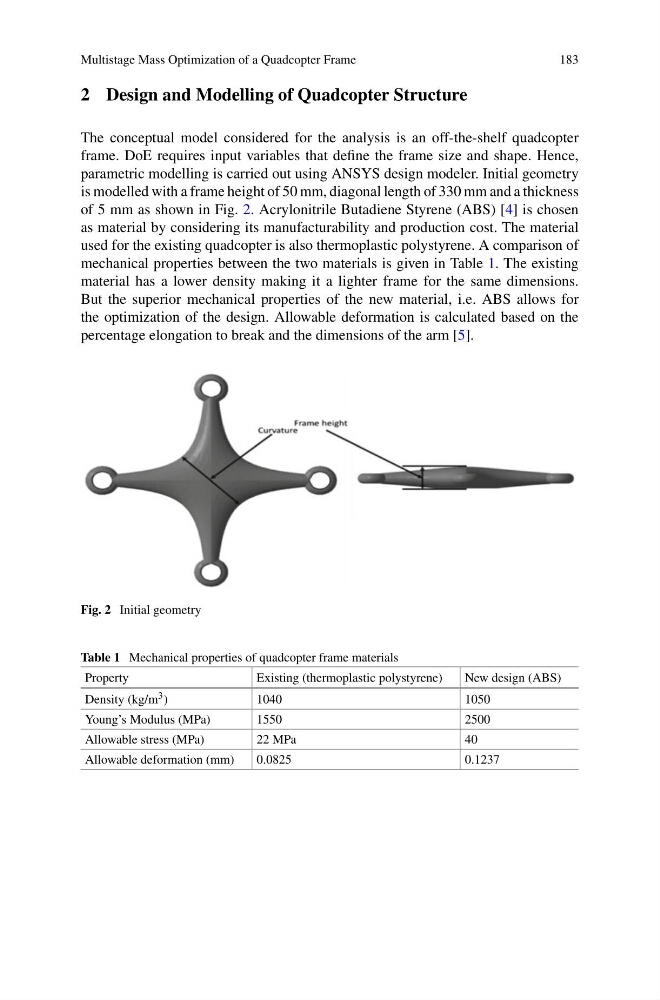
parametric modelling is carried out using ANSYS design modeler. Initial geometry
is modelled with a frame height of 50 mm, diagonal length of 330 mm and a thickness
of 5 mm as shown in Fig. 2. Acrylonitrile Butadiene Styrene (ABS) [4] is chosen
as material by considering its manufacturability and production cost. The material
used for the existing quadcopter is also thermoplastic polystyrene. A comparison of
mechanical properties between the two materials is given in Table 1. The existing
material has a lower density making it a lighter frame for the same dimensions.
But the superior mechanical properties of the new material, i.e. ABS allows for
the optimization of the design. Allowable deformation is calculated based on the
percentage elongation to break and the dimensions of the arm [5].
Fig. 2 Initial geometry
Table 1 Mechanical properties of quadcopter frame materials
Property
Existing (thermoplastic polystyrene)
New design (ABS)
Density (kg/m 3 )
1040
1050
Young’s Modulus (MPa)
1550
2500
Allowable stress (MPa)
22 MPa
40
Allowable deformation (mm)
0.0825
0.1237
183
2 Design and Modelling of Quadcopter Structure
The conceptual model considered for the analysis is an off-the-shelf quadcopter
frame. DoE requires input variables that define the frame size and shape. Hence,
parametric modelling is carried out using ANSYS design modeler. Initial geometry
is modelled with a frame height of 50 mm, diagonal length of 330 mm and a thickness
of 5 mm as shown in Fig. 2. Acrylonitrile Butadiene Styrene (ABS) [4] is chosen
as material by considering its manufacturability and production cost. The material
used for the existing quadcopter is also thermoplastic polystyrene. A comparison of
mechanical properties between the two materials is given in Table 1. The existing
material has a lower density making it a lighter frame for the same dimensions.
But the superior mechanical properties of the new material, i.e. ABS allows for
the optimization of the design. Allowable deformation is calculated based on the
percentage elongation to break and the dimensions of the arm [5].
Fig. 2 Initial geometry
Table 1 Mechanical properties of quadcopter frame materials
Property
Existing (thermoplastic polystyrene)
New design (ABS)
Density (kg/m 3 )
1040
1050
Young’s Modulus (MPa)
1550
2500
Allowable stress (MPa)
22 MPa
40
Allowable deformation (mm)
0.0825
0.1237