

146
S. N. Mahottamananda et al.
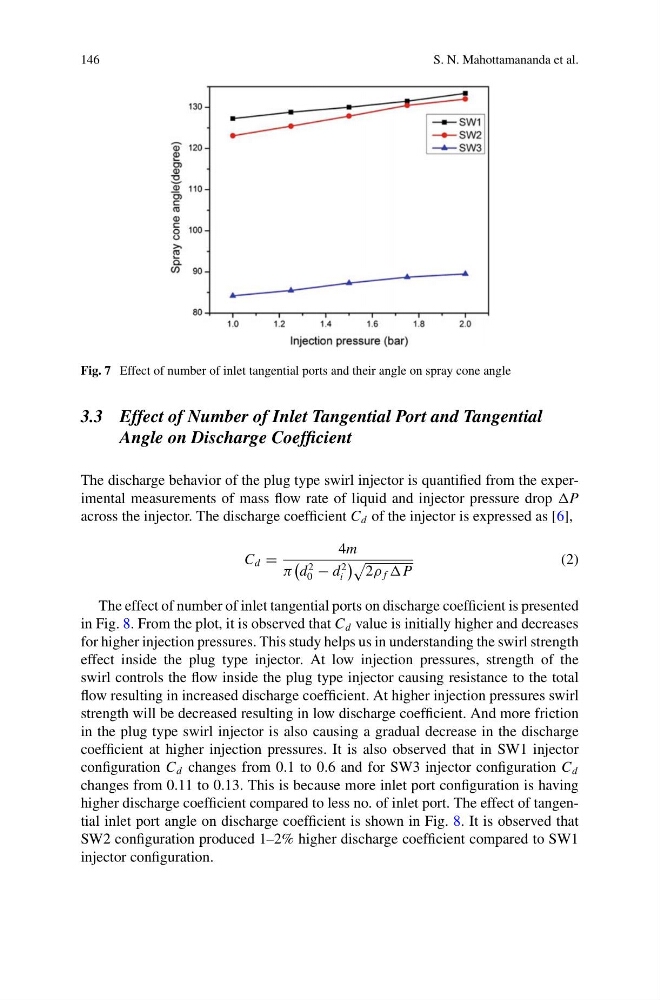
Fig. 7 Effect of number of inlet tangential ports and their angle on spray cone angle
3.3 Effect of Number of Inlet Tangential Port and Tangential
Angle on Discharge Coefficient
The discharge behavior of the plug type swirl injector is quantified from the experimental measurements of mass flow rate of liquid and injector pressure drop P
across the injector. The discharge coefficient C d of the injector is expressed as [6],
C d =
4m
π
d
2
0 − d
2
i
2ρ f P
(2)
The effect of number of inlet tangential ports on discharge coefficient is presented
in Fig. 8. From the plot, it is observed that C d value is initially higher and decreases
for higher injection pressures. This study helps us in understanding the swirl strength
effect inside the plug type injector. At low injection pressures, strength of the
swirl controls the flow inside the plug type injector causing resistance to the total
flow resulting in increased discharge coefficient. At higher injection pressures swirl
strength will be decreased resulting in low discharge coefficient. And more friction
in the plug type swirl injector is also causing a gradual decrease in the discharge
coefficient at higher injection pressures. It is also observed that in SW1 injector
configuration C d changes from 0.1 to 0.6 and for SW3 injector configuration C d
changes from 0.11 to 0.13. This is because more inlet port configuration is having
higher discharge coefficient compared to less no. of inlet port. The effect of tangential inlet port angle on discharge coefficient is shown in Fig. 8. It is observed that
SW2 configuration produced 1–2% higher discharge coefficient compared to SW1
injector configuration.
S. N. Mahottamananda et al.
Fig. 7 Effect of number of inlet tangential ports and their angle on spray cone angle
3.3 Effect of Number of Inlet Tangential Port and Tangential
Angle on Discharge Coefficient
The discharge behavior of the plug type swirl injector is quantified from the experimental measurements of mass flow rate of liquid and injector pressure drop P
across the injector. The discharge coefficient C d of the injector is expressed as [6],
C d =
4m
π
d
2
0 − d
2
i
2ρ f P
(2)
The effect of number of inlet tangential ports on discharge coefficient is presented
in Fig. 8. From the plot, it is observed that C d value is initially higher and decreases
for higher injection pressures. This study helps us in understanding the swirl strength
effect inside the plug type injector. At low injection pressures, strength of the
swirl controls the flow inside the plug type injector causing resistance to the total
flow resulting in increased discharge coefficient. At higher injection pressures swirl
strength will be decreased resulting in low discharge coefficient. And more friction
in the plug type swirl injector is also causing a gradual decrease in the discharge
coefficient at higher injection pressures. It is also observed that in SW1 injector
configuration C d changes from 0.1 to 0.6 and for SW3 injector configuration C d
changes from 0.11 to 0.13. This is because more inlet port configuration is having
higher discharge coefficient compared to less no. of inlet port. The effect of tangential inlet port angle on discharge coefficient is shown in Fig. 8. It is observed that
SW2 configuration produced 1–2% higher discharge coefficient compared to SW1
injector configuration.