

5.1 Higher Order Moment Robust Filter Design for Multi-model Jumping System
81
Define
P 1 = S
−1
11 , P 2 = P 11 , A F = ˆ
Z P 1 , C F = ˜
Z P 1 ,
then, inequality (5.29) can be deduced. After matrix Operations, the filter parameters
are calculated by
A f = (P 1 − P 2 )
−1 A F , B f = (P 1 − P 2 )
−1 B F , C f = C F , D f = D F
Overall, inequality (5.29) is equivalent to inequality (5.20). Then the condition of
Theorem 5.1 holds, which completes the proof.
Remark 5.3 The computational complexity of the proposed method is increased
due to the translation of the original stochastic system into a deterministic system
with the high-order moment component expression. The conservativeness is reduced
by taking the transition rate information.
5.2 High-Order Moment Filtering for Multi-model
Jumping System in Finite Frequency Domain
5.2.1 System Description
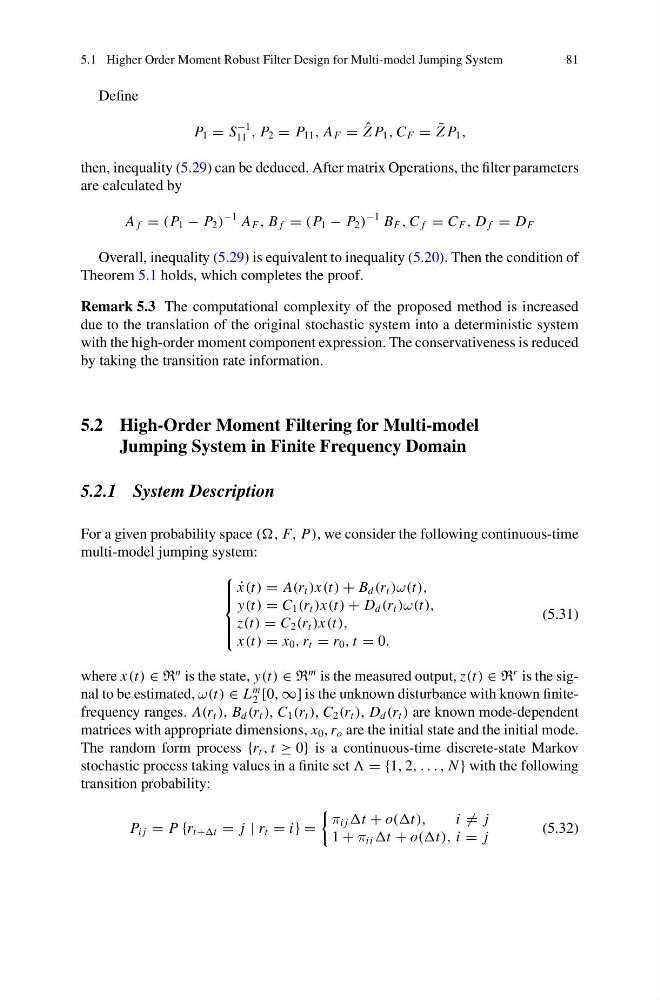
For a given probability space ((, F, P), we consider the following continuous-time
multi-model jumping system:
⎧
⎪ ⎪ ⎨
⎪ ⎪ ⎩
˙
x(t) = A(r t )x(t) + B d (r t )ω(t),
y(t) = C 1 (r t )x(t) + D d (r t )ω(t),
z(t) = C 2 (r t )x(t),
x(t) = x 0 , r t = r 0 , t = 0.
(5.31)
where x(t) ∈ R
n is the state, y(t) ∈ R
m is the measured output, z(t) ∈ R
r is the signal to be estimated, ω(t) ∈ L
m
2 [0, ∞] is the unknown disturbance with known finitefrequency ranges. A(r t ), B d (r t ), C 1 (r t ), C 2 (r t ), D d (r t ) are known mode-dependent
matrices with appropriate dimensions, x 0 , r o are the initial state and the initial mode.
The random form process {r t , t ≥ 0} is a continuous-time discrete-state Markov
stochastic process taking values in a finite set = {1, 2, . . . , N } with the following
transition probability:
P i j = P {r t+t = j | r t = i} =
π i j t + o((t),
i = j
1 + π ii t + o((t), i = j
(5.32)
81
Define
P 1 = S
−1
11 , P 2 = P 11 , A F = ˆ
Z P 1 , C F = ˜
Z P 1 ,
then, inequality (5.29) can be deduced. After matrix Operations, the filter parameters
are calculated by
A f = (P 1 − P 2 )
−1 A F , B f = (P 1 − P 2 )
−1 B F , C f = C F , D f = D F
Overall, inequality (5.29) is equivalent to inequality (5.20). Then the condition of
Theorem 5.1 holds, which completes the proof.
Remark 5.3 The computational complexity of the proposed method is increased
due to the translation of the original stochastic system into a deterministic system
with the high-order moment component expression. The conservativeness is reduced
by taking the transition rate information.
5.2 High-Order Moment Filtering for Multi-model
Jumping System in Finite Frequency Domain
5.2.1 System Description
For a given probability space ((, F, P), we consider the following continuous-time
multi-model jumping system:
⎧
⎪ ⎪ ⎨
⎪ ⎪ ⎩
˙
x(t) = A(r t )x(t) + B d (r t )ω(t),
y(t) = C 1 (r t )x(t) + D d (r t )ω(t),
z(t) = C 2 (r t )x(t),
x(t) = x 0 , r t = r 0 , t = 0.
(5.31)
where x(t) ∈ R
n is the state, y(t) ∈ R
m is the measured output, z(t) ∈ R
r is the signal to be estimated, ω(t) ∈ L
m
2 [0, ∞] is the unknown disturbance with known finitefrequency ranges. A(r t ), B d (r t ), C 1 (r t ), C 2 (r t ), D d (r t ) are known mode-dependent
matrices with appropriate dimensions, x 0 , r o are the initial state and the initial mode.
The random form process {r t , t ≥ 0} is a continuous-time discrete-state Markov
stochastic process taking values in a finite set = {1, 2, . . . , N } with the following
transition probability:
P i j = P {r t+t = j | r t = i} =
π i j t + o((t),
i = j
1 + π ii t + o((t), i = j
(5.32)