

4.2 Multiple Frequency Robust Filtering for Multi-model Jumping System
61
˜
ω(t) =
ω
T
(t) · · · ω
T
(t)
T ,
˜
z(t) =
z
T
(t) · · · z
T
(t)
T .
A = diag{A 1 , A 2 , . . . , A N } +
T
⊗ I n ,
B d = diag{B d1 , B d2 , . . . , B d N },
C 1 = diag{C 11 , C 12 , . . . , C 1N },
C 2 = diag{C 21 , C 22 , . . . , C 2N },
D d = diag{D d1 , D d2 , . . . , D d N }.
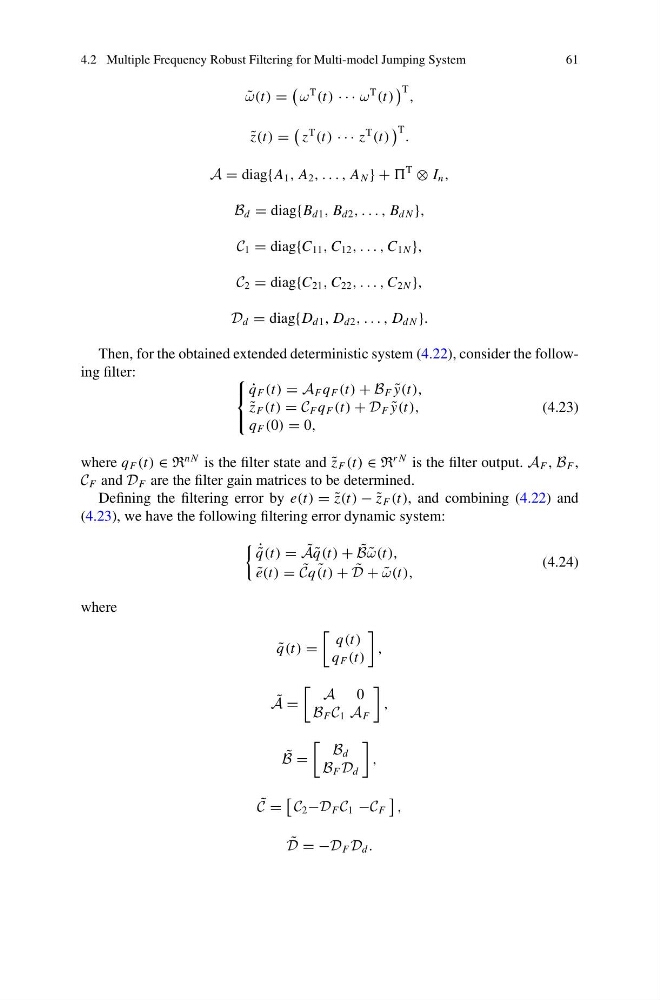
Then, for the obtained extended deterministic system (4.22), consider the following filter:
⎧
⎨
⎩
˙
q F (t) = A F q F (t) + B F ˜
y(t),
˜
z F (t) = C F q F (t) + D F ˜
y(t),
q F (0) = 0,
(4.23)
where q F (t) ∈ R
nN is the filter state and ˜
z F (t) ∈ R
r N is the filter output. A F , B F ,
C F and D F are the filter gain matrices to be determined.
Defining the filtering error by e(t) = ˜
z(t) − ˜
z F (t), and combining (4.22) and
(4.23), we have the following filtering error dynamic system:
˙ ˜
q(t) = ˜
A ˜
q(t) + ˜
B ˜
ω(t),
˜
e(t) = ˜
C ˜
q(t) + ˜
D + ˜
ω(t),
(4.24)
where
˜
q(t) =
q(t)
q F (t)
,
˜
A =
A 0
B F C 1 A F
,
˜
B =
B d
B F D d
,
˜
C =
C 2 −D F C 1 −C F
,
˜
D = −D F D d .
61
˜
ω(t) =
ω
T
(t) · · · ω
T
(t)
T ,
˜
z(t) =
z
T
(t) · · · z
T
(t)
T .
A = diag{A 1 , A 2 , . . . , A N } +
T
⊗ I n ,
B d = diag{B d1 , B d2 , . . . , B d N },
C 1 = diag{C 11 , C 12 , . . . , C 1N },
C 2 = diag{C 21 , C 22 , . . . , C 2N },
D d = diag{D d1 , D d2 , . . . , D d N }.
Then, for the obtained extended deterministic system (4.22), consider the following filter:
⎧
⎨
⎩
˙
q F (t) = A F q F (t) + B F ˜
y(t),
˜
z F (t) = C F q F (t) + D F ˜
y(t),
q F (0) = 0,
(4.23)
where q F (t) ∈ R
nN is the filter state and ˜
z F (t) ∈ R
r N is the filter output. A F , B F ,
C F and D F are the filter gain matrices to be determined.
Defining the filtering error by e(t) = ˜
z(t) − ˜
z F (t), and combining (4.22) and
(4.23), we have the following filtering error dynamic system:
˙ ˜
q(t) = ˜
A ˜
q(t) + ˜
B ˜
ω(t),
˜
e(t) = ˜
C ˜
q(t) + ˜
D + ˜
ω(t),
(4.24)
where
˜
q(t) =
q(t)
q F (t)
,
˜
A =
A 0
B F C 1 A F
,
˜
B =
B d
B F D d
,
˜
C =
C 2 −D F C 1 −C F
,
˜
D = −D F D d .