

72
4 Layout of a Single Floor
h ik
A i
−
h jk
A j
− max
h max
i
A i
,
h min
j
A j
(2 − z ik − z j k ) ≤ 0, 1 ≤ i < j ≤ n,
h ik
A i
−
h jk
A j
+ max
h max
i
A i
,
h min
j
A j
(2 − z ik − z j k ) ≥ 0, 1 ≤ i < j ≤ n,
(4.39)
n
i=1
h ik = h F δ k , k ∈ K,
(4.40)
h
min
i z ik ≤ h ik ≤ h
max
i z ik , 1 ≤ i ≤ n, k ∈ K,
(4.41)
k∈K
h ik = h i , 1 ≤ i ≤ n,
(4.42)
y i −
1
2
h i ≥ y j +
1
2
h j − w H (1 − r ij ), 1 ≤ i = j ≤ n,
(4.43)
α ij + α j i ≤ 1, 1 ≤ i < j ≤ n,
(4.44)
α ij + α j i ≥ z ik + z j k − 1, 1 ≤ i < j ≤ n, k ∈ K,
(4.45)
1
2
h i ≤ y i ≤ w H −
1
2
h i , 1 ≤ i ≤ n.
(4.46)
Constraints (4.35) ensure that each department is assigned to a single bay. Constraints (4.36) calculate the width of each bay as the total area of the departments
assigned to that bay divided by the facility height. This ensures that the bay width w k
is determined so that w k ×h F has enough space to accommodate all the departments
assigned to bay k. Note that under the assumption that
i∈N
A i ≤ w F h F , we have
k∈K
w k ≤ w F . Constraints (4.37) impose bounds on the bay widths, based on the
width bounds of the departments assigned to each bay.
Constraints (4.38) determine the horizontal locations of the department centres.
In this model, the origin for the x coordinate is located in the middle of the bays.
Therefore, if department i is assigned to bay k, x i is calculated as x i =
k
j =1 w j −
1
2 w k . This is consistent with constraints (4.38) when z ik = 1.
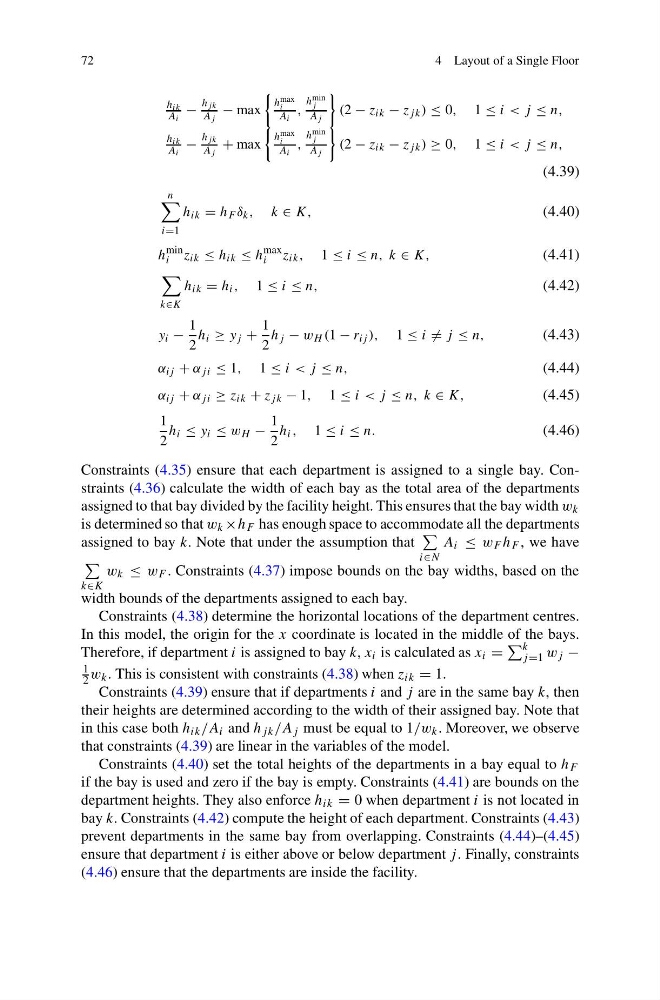
Constraints (4.39) ensure that if departments i and j are in the same bay k, then
their heights are determined according to the width of their assigned bay. Note that
in this case both h ik /A i and h jk /A j must be equal to 1/w k . Moreover, we observe
that constraints (4.39) are linear in the variables of the model.
Constraints (4.40) set the total heights of the departments in a bay equal to h F
if the bay is used and zero if the bay is empty. Constraints (4.41) are bounds on the
department heights. They also enforce h ik = 0 when department i is not located in
bay k. Constraints (4.42) compute the height of each department. Constraints (4.43)
prevent departments in the same bay from overlapping. Constraints (4.44)–(4.45)
ensure that department i is either above or below department j . Finally, constraints
(4.46) ensure that the departments are inside the facility.
4 Layout of a Single Floor
h ik
A i
−
h jk
A j
− max
h max
i
A i
,
h min
j
A j
(2 − z ik − z j k ) ≤ 0, 1 ≤ i < j ≤ n,
h ik
A i
−
h jk
A j
+ max
h max
i
A i
,
h min
j
A j
(2 − z ik − z j k ) ≥ 0, 1 ≤ i < j ≤ n,
(4.39)
n
i=1
h ik = h F δ k , k ∈ K,
(4.40)
h
min
i z ik ≤ h ik ≤ h
max
i z ik , 1 ≤ i ≤ n, k ∈ K,
(4.41)
k∈K
h ik = h i , 1 ≤ i ≤ n,
(4.42)
y i −
1
2
h i ≥ y j +
1
2
h j − w H (1 − r ij ), 1 ≤ i = j ≤ n,
(4.43)
α ij + α j i ≤ 1, 1 ≤ i < j ≤ n,
(4.44)
α ij + α j i ≥ z ik + z j k − 1, 1 ≤ i < j ≤ n, k ∈ K,
(4.45)
1
2
h i ≤ y i ≤ w H −
1
2
h i , 1 ≤ i ≤ n.
(4.46)
Constraints (4.35) ensure that each department is assigned to a single bay. Constraints (4.36) calculate the width of each bay as the total area of the departments
assigned to that bay divided by the facility height. This ensures that the bay width w k
is determined so that w k ×h F has enough space to accommodate all the departments
assigned to bay k. Note that under the assumption that
i∈N
A i ≤ w F h F , we have
k∈K
w k ≤ w F . Constraints (4.37) impose bounds on the bay widths, based on the
width bounds of the departments assigned to each bay.
Constraints (4.38) determine the horizontal locations of the department centres.
In this model, the origin for the x coordinate is located in the middle of the bays.
Therefore, if department i is assigned to bay k, x i is calculated as x i =
k
j =1 w j −
1
2 w k . This is consistent with constraints (4.38) when z ik = 1.
Constraints (4.39) ensure that if departments i and j are in the same bay k, then
their heights are determined according to the width of their assigned bay. Note that
in this case both h ik /A i and h jk /A j must be equal to 1/w k . Moreover, we observe
that constraints (4.39) are linear in the variables of the model.
Constraints (4.40) set the total heights of the departments in a bay equal to h F
if the bay is used and zero if the bay is empty. Constraints (4.41) are bounds on the
department heights. They also enforce h ik = 0 when department i is not located in
bay k. Constraints (4.42) compute the height of each department. Constraints (4.43)
prevent departments in the same bay from overlapping. Constraints (4.44)–(4.45)
ensure that department i is either above or below department j . Finally, constraints
(4.46) ensure that the departments are inside the facility.