

They collected 1,230,604 records from 46,241 patients. Falls occurred in 0.16%
of the records. The authors selected electronic medical record data to use this dataset
for model construction and verification. That is, half of the data was used for model
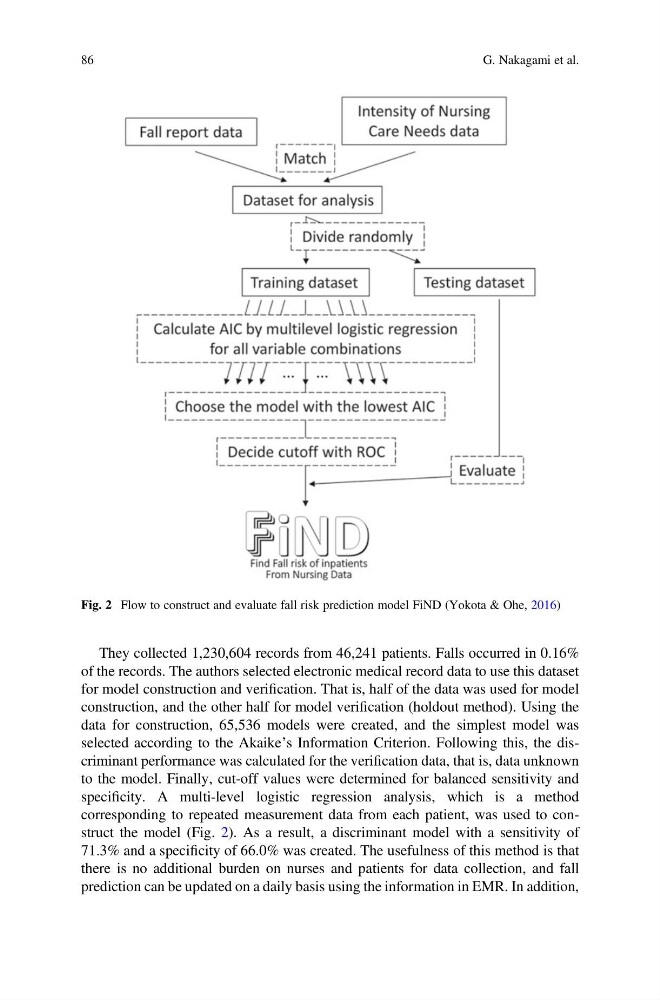
construction, and the other half for model verification (holdout method). Using the
data for construction, 65,536 models were created, and the simplest model was
selected according to the Akaike’s Information Criterion. Following this, the discriminant performance was calculated for the verification data, that is, data unknown
to the model. Finally, cut-off values were determined for balanced sensitivity and
specificity. A multi-level logistic regression analysis, which is a method
corresponding to repeated measurement data from each patient, was used to construct the model (Fig. 2). As a result, a discriminant model with a sensitivity of
71.3% and a specificity of 66.0% was created. The usefulness of this method is that
there is no additional burden on nurses and patients for data collection, and fall
prediction can be updated on a daily basis using the information in EMR. In addition,
Fig. 2 Flow to construct and evaluate fall risk prediction model FiND (Yokota & Ohe, 2016)
86
G. Nakagami et al.
of the records. The authors selected electronic medical record data to use this dataset
for model construction and verification. That is, half of the data was used for model
construction, and the other half for model verification (holdout method). Using the
data for construction, 65,536 models were created, and the simplest model was
selected according to the Akaike’s Information Criterion. Following this, the discriminant performance was calculated for the verification data, that is, data unknown
to the model. Finally, cut-off values were determined for balanced sensitivity and
specificity. A multi-level logistic regression analysis, which is a method
corresponding to repeated measurement data from each patient, was used to construct the model (Fig. 2). As a result, a discriminant model with a sensitivity of
71.3% and a specificity of 66.0% was created. The usefulness of this method is that
there is no additional burden on nurses and patients for data collection, and fall
prediction can be updated on a daily basis using the information in EMR. In addition,
Fig. 2 Flow to construct and evaluate fall risk prediction model FiND (Yokota & Ohe, 2016)
86
G. Nakagami et al.