

of effects. Consequently, the Japan Agency for Medical Research and Development
conducted an empirical study from a quantitative perspective in 2016.
5 A Theoretical Framework for Realizing Better QOL
Through IT/AI Innovations
As seen above, empirical research to reveal effective usage methods for robots and
their practical implementation are ongoing. These are examples of innovation in the
field of healthcare. It is important to improve healthcare activities while considering
how to do so and using which resources with the goals of increasing efficiency and
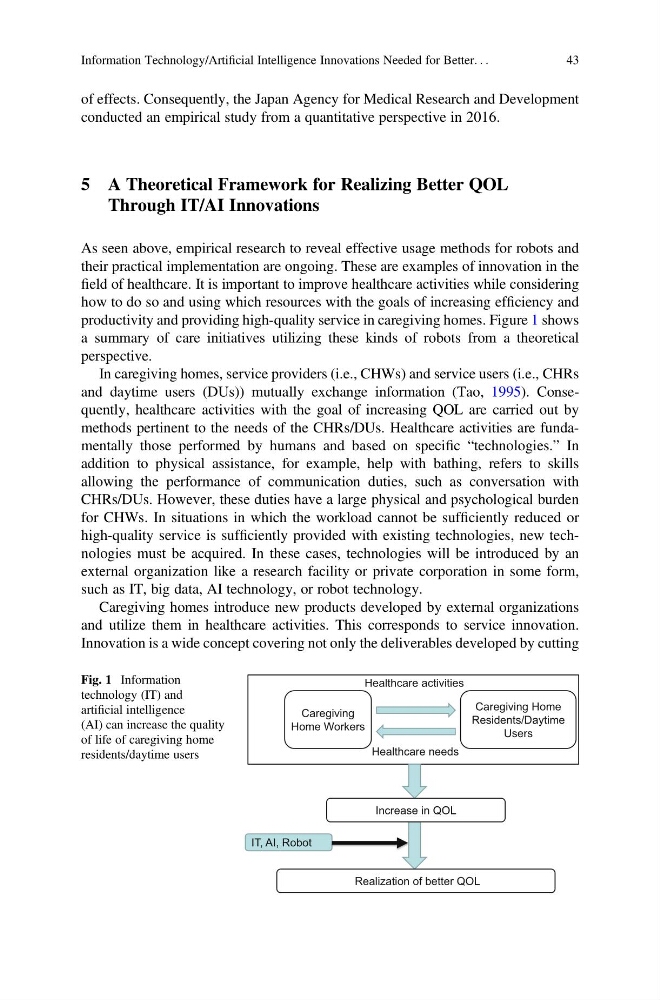
productivity and providing high-quality service in caregiving homes. Figure 1 shows
a summary of care initiatives utilizing these kinds of robots from a theoretical
perspective.
In caregiving homes, service providers (i.e., CHWs) and service users (i.e., CHRs
and daytime users (DUs)) mutually exchange information (Tao, 1995). Consequently, healthcare activities with the goal of increasing QOL are carried out by
methods pertinent to the needs of the CHRs/DUs. Healthcare activities are fundamentally those performed by humans and based on specific “technologies.” In
addition to physical assistance, for example, help with bathing, refers to skills
allowing the performance of communication duties, such as conversation with
CHRs/DUs. However, these duties have a large physical and psychological burden
for CHWs. In situations in which the workload cannot be sufficiently reduced or
high-quality service is sufficiently provided with existing technologies, new technologies must be acquired. In these cases, technologies will be introduced by an
external organization like a research facility or private corporation in some form,
such as IT, big data, AI technology, or robot technology.
Caregiving homes introduce new products developed by external organizations
and utilize them in healthcare activities. This corresponds to service innovation.
Innovation is a wide concept covering not only the deliverables developed by cutting
Caregiving
Home Workers
Caregiving Home
Residents/Daytime
Users
Increase in QOL
Healthcare activities
Healthcare needs
Realization of better QOL
IT, AI, Robot
Fig. 1 Information
technology (IT) and
artificial intelligence
(AI) can increase the quality
of life of caregiving home
residents/daytime users
Information Technology/Artificial Intelligence Innovations Needed for Better. . .
43
conducted an empirical study from a quantitative perspective in 2016.
5 A Theoretical Framework for Realizing Better QOL
Through IT/AI Innovations
As seen above, empirical research to reveal effective usage methods for robots and
their practical implementation are ongoing. These are examples of innovation in the
field of healthcare. It is important to improve healthcare activities while considering
how to do so and using which resources with the goals of increasing efficiency and
productivity and providing high-quality service in caregiving homes. Figure 1 shows
a summary of care initiatives utilizing these kinds of robots from a theoretical
perspective.
In caregiving homes, service providers (i.e., CHWs) and service users (i.e., CHRs
and daytime users (DUs)) mutually exchange information (Tao, 1995). Consequently, healthcare activities with the goal of increasing QOL are carried out by
methods pertinent to the needs of the CHRs/DUs. Healthcare activities are fundamentally those performed by humans and based on specific “technologies.” In
addition to physical assistance, for example, help with bathing, refers to skills
allowing the performance of communication duties, such as conversation with
CHRs/DUs. However, these duties have a large physical and psychological burden
for CHWs. In situations in which the workload cannot be sufficiently reduced or
high-quality service is sufficiently provided with existing technologies, new technologies must be acquired. In these cases, technologies will be introduced by an
external organization like a research facility or private corporation in some form,
such as IT, big data, AI technology, or robot technology.
Caregiving homes introduce new products developed by external organizations
and utilize them in healthcare activities. This corresponds to service innovation.
Innovation is a wide concept covering not only the deliverables developed by cutting
Caregiving
Home Workers
Caregiving Home
Residents/Daytime
Users
Increase in QOL
Healthcare activities
Healthcare needs
Realization of better QOL
IT, AI, Robot
Fig. 1 Information
technology (IT) and
artificial intelligence
(AI) can increase the quality
of life of caregiving home
residents/daytime users
Information Technology/Artificial Intelligence Innovations Needed for Better. . .
43