

5 Diagnostic Imaging and Deep Learning
Progress in technologies such as AI and ICT is remarkable, with the wave spreading
in the medical field as well. Changes have already begun in both regional and
advanced medicine, but how will AI and ICT further evolve and influence the future?
Research on AI began around 60 years ago. Currently, machine learning and deep
learning are positioned as the third AI boom. Recently, technologies such as image
recognition by deep learning have been developed and are considered to bring
innovation to the field of health care. In pathological image analysis such as for
blood cancer, chronic shortage of pathologists continues. Currently, one pathologist
is responsible for nearly 3000 diagnoses a year, which makes it impossible to arrive
at accurate diagnosis. With Japan’s declining birthrate and aging population, labor
shortage is accelerating. Therefore, in Japan’s medical industry, collaboration with
AI is essential to eliminate labor shortage and maintain economic growth.
There is a pattern of innovation in this area. The innovators combine a variety of
devices, including X-rays, computed tomography (CT), magnetic resonance imaging
(MRI), and cytology with computer-assisted diagnosis or detection software that
implements machine learning and deep learning. The new combination analyzes
image and video data and information. To promote the development and clinical
application of Computer-Aided Design (CAD) software, it is critical to achieve
algorithm development, software implementation, clinical use, feedback of knowledge, improvement of algorithm and software, and circulation of additional
clinical use.
In addition to the detection of tumors, outliers can be found from numerous test
results. AI can perform inspection that takes 10 days in case of manual inspection.
Although humans obtain immense information with their eyes, AI’s image recognition ability and pattern recognition competencies have improved over those of
humans. Doctor’s competency is greatly expanded by acquiring AI’s image recognition ability. The amount of work done by physicians performing diagnostic
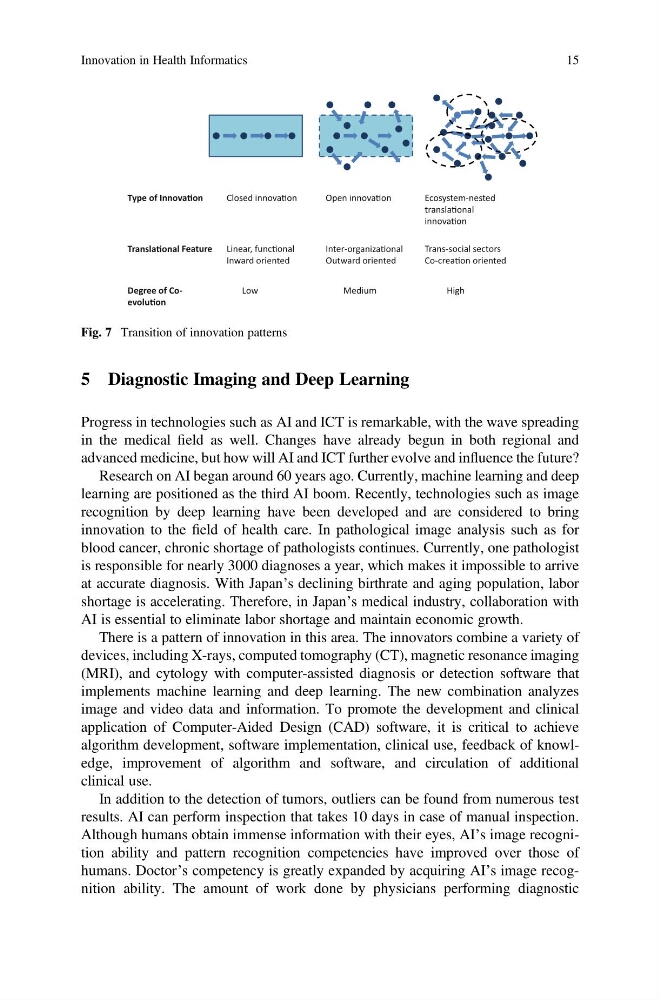
Type of InnovaƟon
Closed innovaƟon
Open innovaƟon
Ecosystem-nested
translaƟonal
innovaƟon
TranslaƟonal Feature Linear, funcƟonal
Inward oriented
Inter-organizaƟonal
Outward oriented
Trans-social sectors
Co-creaƟon oriented
Degree of CoevoluƟon
Low
Medium
High
Fig. 7 Transition of innovation patterns
Innovation in Health Informatics
15
Progress in technologies such as AI and ICT is remarkable, with the wave spreading
in the medical field as well. Changes have already begun in both regional and
advanced medicine, but how will AI and ICT further evolve and influence the future?
Research on AI began around 60 years ago. Currently, machine learning and deep
learning are positioned as the third AI boom. Recently, technologies such as image
recognition by deep learning have been developed and are considered to bring
innovation to the field of health care. In pathological image analysis such as for
blood cancer, chronic shortage of pathologists continues. Currently, one pathologist
is responsible for nearly 3000 diagnoses a year, which makes it impossible to arrive
at accurate diagnosis. With Japan’s declining birthrate and aging population, labor
shortage is accelerating. Therefore, in Japan’s medical industry, collaboration with
AI is essential to eliminate labor shortage and maintain economic growth.
There is a pattern of innovation in this area. The innovators combine a variety of
devices, including X-rays, computed tomography (CT), magnetic resonance imaging
(MRI), and cytology with computer-assisted diagnosis or detection software that
implements machine learning and deep learning. The new combination analyzes
image and video data and information. To promote the development and clinical
application of Computer-Aided Design (CAD) software, it is critical to achieve
algorithm development, software implementation, clinical use, feedback of knowledge, improvement of algorithm and software, and circulation of additional
clinical use.
In addition to the detection of tumors, outliers can be found from numerous test
results. AI can perform inspection that takes 10 days in case of manual inspection.
Although humans obtain immense information with their eyes, AI’s image recognition ability and pattern recognition competencies have improved over those of
humans. Doctor’s competency is greatly expanded by acquiring AI’s image recognition ability. The amount of work done by physicians performing diagnostic
Type of InnovaƟon
Closed innovaƟon
Open innovaƟon
Ecosystem-nested
translaƟonal
innovaƟon
TranslaƟonal Feature Linear, funcƟonal
Inward oriented
Inter-organizaƟonal
Outward oriented
Trans-social sectors
Co-creaƟon oriented
Degree of CoevoluƟon
Low
Medium
High
Fig. 7 Transition of innovation patterns
Innovation in Health Informatics
15