

backgrounds, lives, specialties, values, and behavior patterns interact freely; the
context in which close friends meet again after a long time and are shared; and a
shared context when discussing given ideologies. Context sharing is a very human
act.
As described above, “Ba” is a very human act, and without “human interaction,”
“Ba” should be difficult to establish. This raises a big question. Can AI produce
“Ba”? Can the subtleties of “Ba” interwoven by humans be able to create AI? At
present, there are many advantages of humans over AI. One of them would be the
creation and sharing of “Ba.”
However, using the findings of Talcott Parsons’s social action theory, the mechanism of “Ba” which appears as a very human-based act at the first glance, is
decomposed into four functional prerequisites, namely, adaptation, goal accommodation, integration, and pattern maintenance (Parsons, 1937). If we can make AI
learn these functional prerequisites, which may be possible, then “Ba” can be
released from the human activity system. This will be one of the challenges of the
new era of informatics.
3.8 Value-in-Context Emerges Through Translational
Phases Such as Contextualization (Participation),
Re-Contextualization (Interpretation),
Co-Contextualization (Socialization),
De-Contextualization (Objectification),
and Trans-Contextualization (Translation)
Data, information, knowledge, and wisdom can only create value when embedded in
a specific context. What is valued by context is called value-in-context. How is
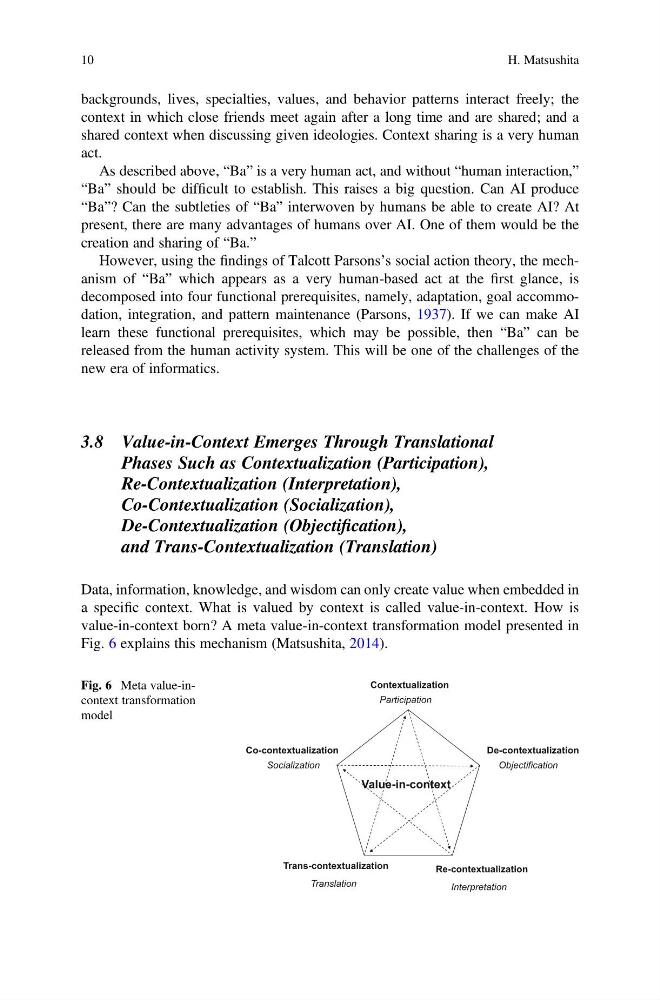
value-in-context born? A meta value-in-context transformation model presented in
Fig. 6 explains this mechanism (Matsushita, 2014).
Contextualization
Participation
Re-contextualization
Interpretation
De-contextualization
Objectification
Co-contextualization
Socialization
Trans-contextualization
Translation
Value-in-context
Fig. 6 Meta value-incontext transformation
model
10
H. Matsushita
context in which close friends meet again after a long time and are shared; and a
shared context when discussing given ideologies. Context sharing is a very human
act.
As described above, “Ba” is a very human act, and without “human interaction,”
“Ba” should be difficult to establish. This raises a big question. Can AI produce
“Ba”? Can the subtleties of “Ba” interwoven by humans be able to create AI? At
present, there are many advantages of humans over AI. One of them would be the
creation and sharing of “Ba.”
However, using the findings of Talcott Parsons’s social action theory, the mechanism of “Ba” which appears as a very human-based act at the first glance, is
decomposed into four functional prerequisites, namely, adaptation, goal accommodation, integration, and pattern maintenance (Parsons, 1937). If we can make AI
learn these functional prerequisites, which may be possible, then “Ba” can be
released from the human activity system. This will be one of the challenges of the
new era of informatics.
3.8 Value-in-Context Emerges Through Translational
Phases Such as Contextualization (Participation),
Re-Contextualization (Interpretation),
Co-Contextualization (Socialization),
De-Contextualization (Objectification),
and Trans-Contextualization (Translation)
Data, information, knowledge, and wisdom can only create value when embedded in
a specific context. What is valued by context is called value-in-context. How is
value-in-context born? A meta value-in-context transformation model presented in
Fig. 6 explains this mechanism (Matsushita, 2014).
Contextualization
Participation
Re-contextualization
Interpretation
De-contextualization
Objectification
Co-contextualization
Socialization
Trans-contextualization
Translation
Value-in-context
Fig. 6 Meta value-incontext transformation
model
10
H. Matsushita