

Livelihood support/ preventing long-term care
So that seniors can continue active,healthy living
Home
* The Community-based Integrated Care System is
conceived in units of every-day living areas
(specifically equivalent to district divisions for
junior high-schools) in which necessary services
can be provided within approximately 30 minutes.
In-homeservices:
Home-Vi si tLong-TermCare,Home-Vi si tNursi ng,
Outpati entDayLong-TermCare
Mul ti functi onal(Long-TermCarei na)Smal lGroupHome
Short-TermAdmi ssi onforDai l yLi feLong-TermCare
Equi pment forLong-TermCarecoveredbyPubl i cAi d
24-hourHome-Vi si tServi ce
Combi nedMul ti pl eServi ce(Mul ti functi onalLong-Term
Carei naSmal lGroupHomeHome-Vi si tNursi ng)
One’sownresidence
Seniorresidencesofferingservices,etc.
Handlesconsultationandservice
coordination.
Faci l i ty/Resi denceservi ces:
Nursi ngcarehomes
Geri atri cheal thservi ces
faci l i ti es
Communal -l i vi ngcare
fordementi apati ents
Li vi ngcareforpersonsat
government-desi gnated
faci l i ti es
etc.
Regul arheal thcare:
PCP, clinics with in-patient facilities
Regional affiliate hospitals
Dental care, pharmacies
Senior clubs, residents’associations, volunteer groups, NPOs, etc.
CommunityGeneral
Support Center
Care manager
Outpatient/in-patient
care
Visits / Moving in
Hospi tal s:
Acutephase,recoveryphase,chroni cphase
Health Care
Nursing Care
Preventi veLong-TermCareServi ces
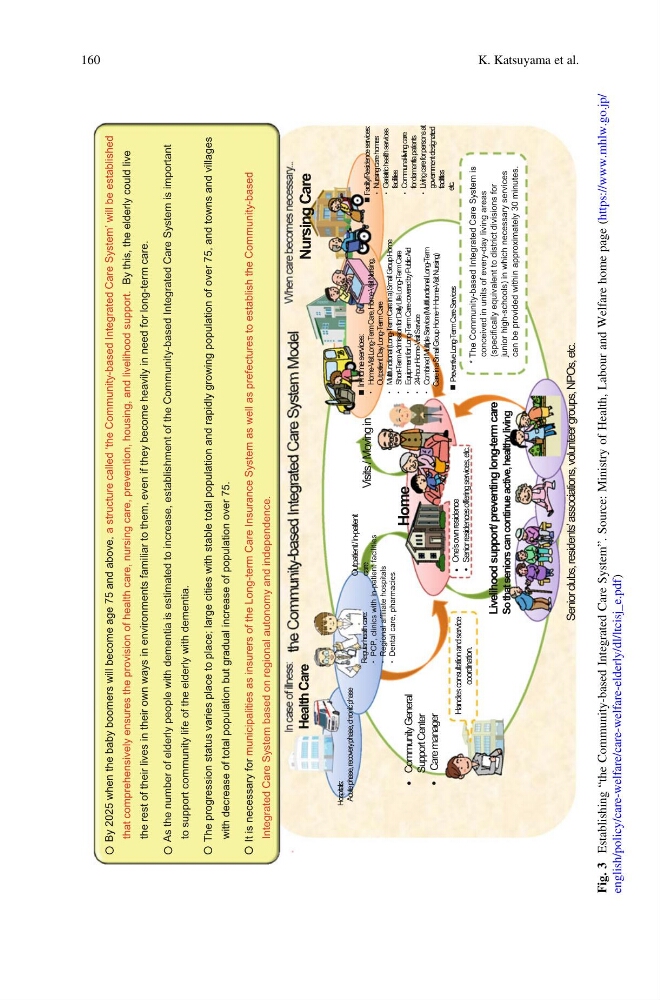
By 2025 when the baby boomers will become age 75 and above, a structure called ‘the Community-based Integrated Care System’ will be established
that comprehensively ensures the provision of health care, nursing care, prevention, housing, and livelihood support. By this, the elderly could live
the rest of their lives in their own ways in environments familiar to them, even if they become heavily in need for long-term care.
As the number of elderly people with dementia is estimated to increase, establishment of the Community-based Integrated Care System is important
to support community life of the elderly with dementia.
The progression status varies place to place; large cities with stable total population and rapidly growing population of over 75, and towns and villages
with decrease of total population but gradual increase of population over 75.
It is necessary for municipalities as insurers of the Long-term Care Insurance System as well as prefectures to establish the Community-based
Integrated Care System based on regional autonomy and independence.
.
.
.
.
Fig. 3
Establishing
“the Community-based Integrated Care System”. Source: Ministry of Health, Labour and Welfare home page (https://www.mhlw.go.jp/
english/policy/care-welfare/care-welfare-elderly/dl/ltcisj_e.pdf)
160
K. Katsuyama et al.
So that seniors can continue active,healthy living
Home
* The Community-based Integrated Care System is
conceived in units of every-day living areas
(specifically equivalent to district divisions for
junior high-schools) in which necessary services
can be provided within approximately 30 minutes.
In-homeservices:
Home-Vi si tLong-TermCare,Home-Vi si tNursi ng,
Outpati entDayLong-TermCare
Mul ti functi onal(Long-TermCarei na)Smal lGroupHome
Short-TermAdmi ssi onforDai l yLi feLong-TermCare
Equi pment forLong-TermCarecoveredbyPubl i cAi d
24-hourHome-Vi si tServi ce
Combi nedMul ti pl eServi ce(Mul ti functi onalLong-Term
Carei naSmal lGroupHomeHome-Vi si tNursi ng)
One’sownresidence
Seniorresidencesofferingservices,etc.
Handlesconsultationandservice
coordination.
Faci l i ty/Resi denceservi ces:
Nursi ngcarehomes
Geri atri cheal thservi ces
faci l i ti es
Communal -l i vi ngcare
fordementi apati ents
Li vi ngcareforpersonsat
government-desi gnated
faci l i ti es
etc.
Regul arheal thcare:
PCP, clinics with in-patient facilities
Regional affiliate hospitals
Dental care, pharmacies
Senior clubs, residents’associations, volunteer groups, NPOs, etc.
CommunityGeneral
Support Center
Care manager
Outpatient/in-patient
care
Visits / Moving in
Hospi tal s:
Acutephase,recoveryphase,chroni cphase
Health Care
Nursing Care
Preventi veLong-TermCareServi ces
By 2025 when the baby boomers will become age 75 and above, a structure called ‘the Community-based Integrated Care System’ will be established
that comprehensively ensures the provision of health care, nursing care, prevention, housing, and livelihood support. By this, the elderly could live
the rest of their lives in their own ways in environments familiar to them, even if they become heavily in need for long-term care.
As the number of elderly people with dementia is estimated to increase, establishment of the Community-based Integrated Care System is important
to support community life of the elderly with dementia.
The progression status varies place to place; large cities with stable total population and rapidly growing population of over 75, and towns and villages
with decrease of total population but gradual increase of population over 75.
It is necessary for municipalities as insurers of the Long-term Care Insurance System as well as prefectures to establish the Community-based
Integrated Care System based on regional autonomy and independence.
.
.
.
.
Fig. 3
Establishing
“the Community-based Integrated Care System”. Source: Ministry of Health, Labour and Welfare home page (https://www.mhlw.go.jp/
english/policy/care-welfare/care-welfare-elderly/dl/ltcisj_e.pdf)
160
K. Katsuyama et al.