

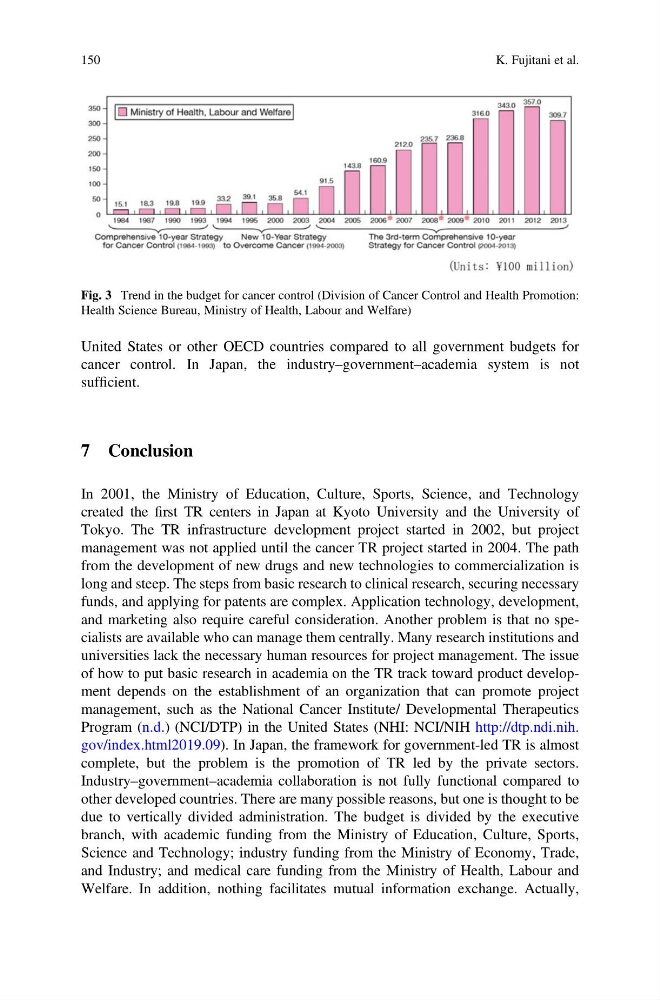
United States or other OECD countries compared to all government budgets for
cancer control. In Japan, the industry–government–academia system is not
sufficient.
7 Conclusion
In 2001, the Ministry of Education, Culture, Sports, Science, and Technology
created the first TR centers in Japan at Kyoto University and the University of
Tokyo. The TR infrastructure development project started in 2002, but project
management was not applied until the cancer TR project started in 2004. The path
from the development of new drugs and new technologies to commercialization is
long and steep. The steps from basic research to clinical research, securing necessary
funds, and applying for patents are complex. Application technology, development,
and marketing also require careful consideration. Another problem is that no specialists are available who can manage them centrally. Many research institutions and
universities lack the necessary human resources for project management. The issue
of how to put basic research in academia on the TR track toward product development depends on the establishment of an organization that can promote project
management, such as the National Cancer Institute/ Developmental Therapeutics
Program (n.d.) (NCI/DTP) in the United States (NHI: NCI/NIH http://dtp.ndi.nih.
gov/index.html2019.09). In Japan, the framework for government-led TR is almost
complete, but the problem is the promotion of TR led by the private sectors.
Industry–government–academia collaboration is not fully functional compared to
other developed countries. There are many possible reasons, but one is thought to be
due to vertically divided administration. The budget is divided by the executive
branch, with academic funding from the Ministry of Education, Culture, Sports,
Science and Technology; industry funding from the Ministry of Economy, Trade,
and Industry; and medical care funding from the Ministry of Health, Labour and
Welfare. In addition, nothing facilitates mutual information exchange. Actually,
Fig. 3 Trend in the budget for cancer control (Division of Cancer Control and Health Promotion:
Health Science Bureau, Ministry of Health, Labour and Welfare)
150
K. Fujitani et al.
cancer control. In Japan, the industry–government–academia system is not
sufficient.
7 Conclusion
In 2001, the Ministry of Education, Culture, Sports, Science, and Technology
created the first TR centers in Japan at Kyoto University and the University of
Tokyo. The TR infrastructure development project started in 2002, but project
management was not applied until the cancer TR project started in 2004. The path
from the development of new drugs and new technologies to commercialization is
long and steep. The steps from basic research to clinical research, securing necessary
funds, and applying for patents are complex. Application technology, development,
and marketing also require careful consideration. Another problem is that no specialists are available who can manage them centrally. Many research institutions and
universities lack the necessary human resources for project management. The issue
of how to put basic research in academia on the TR track toward product development depends on the establishment of an organization that can promote project
management, such as the National Cancer Institute/ Developmental Therapeutics
Program (n.d.) (NCI/DTP) in the United States (NHI: NCI/NIH http://dtp.ndi.nih.
gov/index.html2019.09). In Japan, the framework for government-led TR is almost
complete, but the problem is the promotion of TR led by the private sectors.
Industry–government–academia collaboration is not fully functional compared to
other developed countries. There are many possible reasons, but one is thought to be
due to vertically divided administration. The budget is divided by the executive
branch, with academic funding from the Ministry of Education, Culture, Sports,
Science and Technology; industry funding from the Ministry of Economy, Trade,
and Industry; and medical care funding from the Ministry of Health, Labour and
Welfare. In addition, nothing facilitates mutual information exchange. Actually,
Fig. 3 Trend in the budget for cancer control (Division of Cancer Control and Health Promotion:
Health Science Bureau, Ministry of Health, Labour and Welfare)
150
K. Fujitani et al.