

of Things (IoT), are central issues in health informatics. Research and development
in this field have been promoted in the past with the focus on the construction of an
environment for collecting, storing, and integrally managing various data, such as
devices, storage, and Internet technologies. However, in the future, the development
of “translational systemization” technology based on transfer learning is strongly
demanded. Specifically, it includes individual estimation/prediction of health status
by the analysis and mathematical modeling of large-scale health and medical-related
data and development of adaptive treatment/intervention methods.
In the future, the health field will evolve in seven directions in line with the
evolution of ICT/IoT and AI. (1) Healthcare management will be increasingly
dependent on data. (2) Health management and healthcare systems will be systematized for risk control. (3) Health management and healthcare systems will be
predictive and immediate. (4) Health policies will be transformed to evidencebased policies. (5) A health information infrastructure will be constructed through
standardization of various kinds of health information. (6) Management of
healthcare organizations will be redesigned with information as the core in conjunction with policies. (7) Health support will emerge as a strategy for differentiating
human resource development in business management. These seven directions are
all inextricably related to information and translationality.
It is important to view the vast and infinite world of information in a holistic
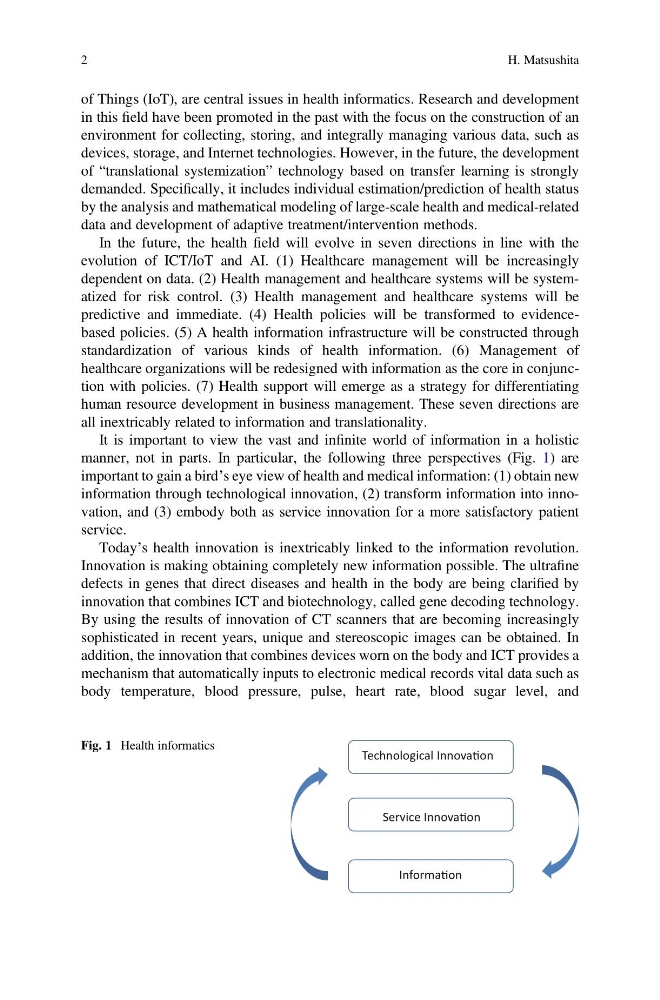
manner, not in parts. In particular, the following three perspectives (Fig. 1) are
important to gain a bird’s eye view of health and medical information: (1) obtain new
information through technological innovation, (2) transform information into innovation, and (3) embody both as service innovation for a more satisfactory patient
service.
Today’s health innovation is inextricably linked to the information revolution.
Innovation is making obtaining completely new information possible. The ultrafine
defects in genes that direct diseases and health in the body are being clarified by
innovation that combines ICT and biotechnology, called gene decoding technology.
By using the results of innovation of CT scanners that are becoming increasingly
sophisticated in recent years, unique and stereoscopic images can be obtained. In
addition, the innovation that combines devices worn on the body and ICT provides a
mechanism that automatically inputs to electronic medical records vital data such as
body temperature, blood pressure, pulse, heart rate, blood sugar level, and
InformaƟon
Technological InnovaƟon
Service InnovaƟon
Fig. 1 Health informatics
2
H. Matsushita
in this field have been promoted in the past with the focus on the construction of an
environment for collecting, storing, and integrally managing various data, such as
devices, storage, and Internet technologies. However, in the future, the development
of “translational systemization” technology based on transfer learning is strongly
demanded. Specifically, it includes individual estimation/prediction of health status
by the analysis and mathematical modeling of large-scale health and medical-related
data and development of adaptive treatment/intervention methods.
In the future, the health field will evolve in seven directions in line with the
evolution of ICT/IoT and AI. (1) Healthcare management will be increasingly
dependent on data. (2) Health management and healthcare systems will be systematized for risk control. (3) Health management and healthcare systems will be
predictive and immediate. (4) Health policies will be transformed to evidencebased policies. (5) A health information infrastructure will be constructed through
standardization of various kinds of health information. (6) Management of
healthcare organizations will be redesigned with information as the core in conjunction with policies. (7) Health support will emerge as a strategy for differentiating
human resource development in business management. These seven directions are
all inextricably related to information and translationality.
It is important to view the vast and infinite world of information in a holistic
manner, not in parts. In particular, the following three perspectives (Fig. 1) are
important to gain a bird’s eye view of health and medical information: (1) obtain new
information through technological innovation, (2) transform information into innovation, and (3) embody both as service innovation for a more satisfactory patient
service.
Today’s health innovation is inextricably linked to the information revolution.
Innovation is making obtaining completely new information possible. The ultrafine
defects in genes that direct diseases and health in the body are being clarified by
innovation that combines ICT and biotechnology, called gene decoding technology.
By using the results of innovation of CT scanners that are becoming increasingly
sophisticated in recent years, unique and stereoscopic images can be obtained. In
addition, the innovation that combines devices worn on the body and ICT provides a
mechanism that automatically inputs to electronic medical records vital data such as
body temperature, blood pressure, pulse, heart rate, blood sugar level, and
InformaƟon
Technological InnovaƟon
Service InnovaƟon
Fig. 1 Health informatics
2
H. Matsushita