

• Institutions.
Localized institutions understood as common rules, norms, laws, and established
practices (Edquist, 1997) play a pivotal role to fully appreciate the complexities of
medical innovation. Medical innovative solutions are anchored in distinct
national healthcare systems that contingent health research and delivery, shaping
some diversity from national socialized to private fee-based healthcare systems.
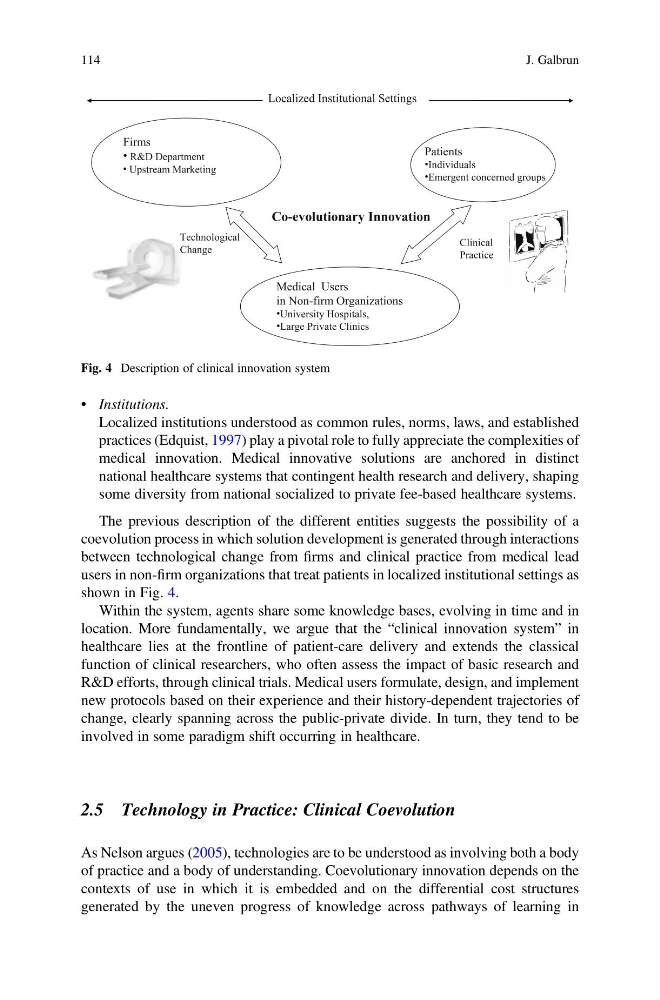
The previous description of the different entities suggests the possibility of a
coevolution process in which solution development is generated through interactions
between technological change from firms and clinical practice from medical lead
users in non-firm organizations that treat patients in localized institutional settings as
shown in Fig. 4.
Within the system, agents share some knowledge bases, evolving in time and in
location. More fundamentally, we argue that the “clinical innovation system” in
healthcare lies at the frontline of patient-care delivery and extends the classical
function of clinical researchers, who often assess the impact of basic research and
R&D efforts, through clinical trials. Medical users formulate, design, and implement
new protocols based on their experience and their history-dependent trajectories of
change, clearly spanning across the public-private divide. In turn, they tend to be
involved in some paradigm shift occurring in healthcare.
2.5 Technology in Practice: Clinical Coevolution
As Nelson argues (2005), technologies are to be understood as involving both a body
of practice and a body of understanding. Coevolutionary innovation depends on the
contexts of use in which it is embedded and on the differential cost structures
generated by the uneven progress of knowledge across pathways of learning in
Fig. 4 Description of clinical innovation system
114
J. Galbrun
Localized institutions understood as common rules, norms, laws, and established
practices (Edquist, 1997) play a pivotal role to fully appreciate the complexities of
medical innovation. Medical innovative solutions are anchored in distinct
national healthcare systems that contingent health research and delivery, shaping
some diversity from national socialized to private fee-based healthcare systems.
The previous description of the different entities suggests the possibility of a
coevolution process in which solution development is generated through interactions
between technological change from firms and clinical practice from medical lead
users in non-firm organizations that treat patients in localized institutional settings as
shown in Fig. 4.
Within the system, agents share some knowledge bases, evolving in time and in
location. More fundamentally, we argue that the “clinical innovation system” in
healthcare lies at the frontline of patient-care delivery and extends the classical
function of clinical researchers, who often assess the impact of basic research and
R&D efforts, through clinical trials. Medical users formulate, design, and implement
new protocols based on their experience and their history-dependent trajectories of
change, clearly spanning across the public-private divide. In turn, they tend to be
involved in some paradigm shift occurring in healthcare.
2.5 Technology in Practice: Clinical Coevolution
As Nelson argues (2005), technologies are to be understood as involving both a body
of practice and a body of understanding. Coevolutionary innovation depends on the
contexts of use in which it is embedded and on the differential cost structures
generated by the uneven progress of knowledge across pathways of learning in
Fig. 4 Description of clinical innovation system
114
J. Galbrun