

provides clinicians and patients with timely relevant clinical information.
13 Multirow scanners (16 submillimeter slices in one 0.5-s rotation of the tube) made it
possible to obtain 2D and 3D images of all cardiac structures and the coronary
arteries in one single 20-s ECG-gated volume acquisition with injection of iodinebased contrast medium. This noninvasive imaging procedure did emerge as a
solution for early CAD diagnosis. Some pioneers in hospitals did compare these
new techniques to current examinations (coronography, myocardial scintigraphy,
echocardiography) by intensively exchanging results within their medical organizations and sometimes outside through publications and conferences in medical
congresses (Nieman et al., 2001).
In the north of Paris, the “Centre Cardiologique du Nord” (CCN) has been among
the early inventers of this new technique in the radiology world since 2000, leading
to achieve the challenge of replacing invasive diagnostic coronary angiography by a
noninvasive innovation, the CT cardiac imaging (Sablayrolles, 2002). Dr. J.L. Sablayrolles and his team have developed this technique in the context of close
collaboration between internal actors of CCN (radiologists, technicians, cardiologist,
and heart surgeons) and external actors (CT device research engineers of the CT
manufacturer and contrast media producer). This private clinic did not only validate
the performance of new scanners by providing CT manufacturer with clinical cases
but also improved acquisition technology and post-processing to validate new
cardiac CT applications, so-called clinical applications. This set of innovation is a
combination of new acquisition techniques: patient preparation (including oxygen
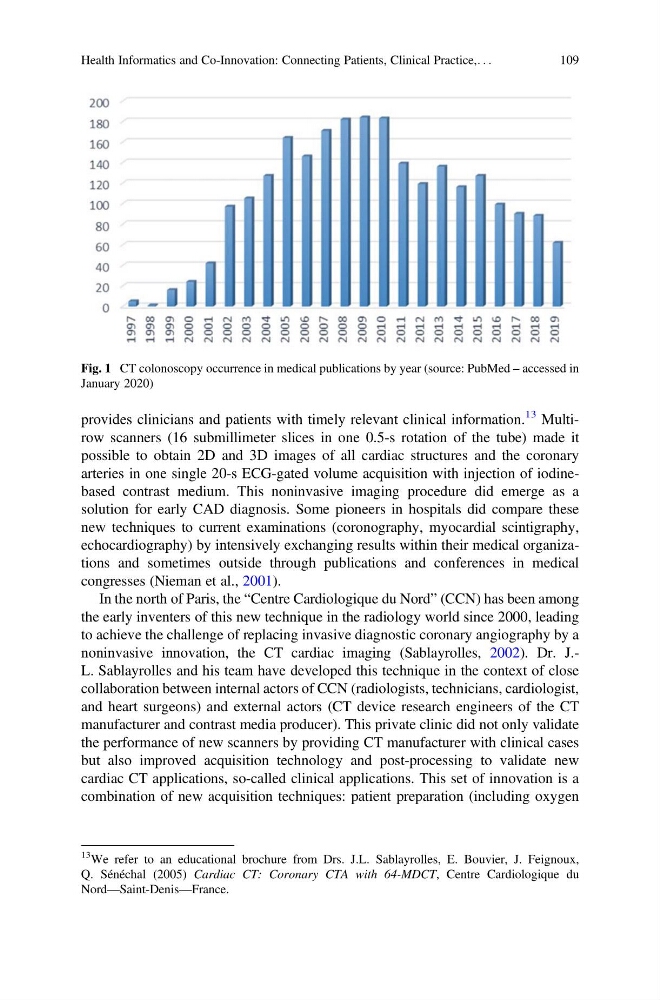
Fig. 1 CT colonoscopy occurrence in medical publications by year (source: PubMed – accessed in
January 2020)
13 We refer to an educational brochure from Drs. J.L. Sablayrolles, E. Bouvier, J. Feignoux,
Q. Sénéchal (2005) Cardiac CT: Coronary CTA with 64-MDCT, Centre Cardiologique du
Nord—Saint-Denis—France.
Health Informatics and Co-Innovation: Connecting Patients, Clinical Practice,. . .
109
13 Multirow scanners (16 submillimeter slices in one 0.5-s rotation of the tube) made it
possible to obtain 2D and 3D images of all cardiac structures and the coronary
arteries in one single 20-s ECG-gated volume acquisition with injection of iodinebased contrast medium. This noninvasive imaging procedure did emerge as a
solution for early CAD diagnosis. Some pioneers in hospitals did compare these
new techniques to current examinations (coronography, myocardial scintigraphy,
echocardiography) by intensively exchanging results within their medical organizations and sometimes outside through publications and conferences in medical
congresses (Nieman et al., 2001).
In the north of Paris, the “Centre Cardiologique du Nord” (CCN) has been among
the early inventers of this new technique in the radiology world since 2000, leading
to achieve the challenge of replacing invasive diagnostic coronary angiography by a
noninvasive innovation, the CT cardiac imaging (Sablayrolles, 2002). Dr. J.L. Sablayrolles and his team have developed this technique in the context of close
collaboration between internal actors of CCN (radiologists, technicians, cardiologist,
and heart surgeons) and external actors (CT device research engineers of the CT
manufacturer and contrast media producer). This private clinic did not only validate
the performance of new scanners by providing CT manufacturer with clinical cases
but also improved acquisition technology and post-processing to validate new
cardiac CT applications, so-called clinical applications. This set of innovation is a
combination of new acquisition techniques: patient preparation (including oxygen
Fig. 1 CT colonoscopy occurrence in medical publications by year (source: PubMed – accessed in
January 2020)
13 We refer to an educational brochure from Drs. J.L. Sablayrolles, E. Bouvier, J. Feignoux,
Q. Sénéchal (2005) Cardiac CT: Coronary CTA with 64-MDCT, Centre Cardiologique du
Nord—Saint-Denis—France.
Health Informatics and Co-Innovation: Connecting Patients, Clinical Practice,. . .
109