

Websites abound at which patients or potentially patients can learn about all manner
of treatments, procedures, both established and experimental.
Advances in medical technology, involving both diagnostics and treatment, have
been, at least arguably, a driving force behind the rapid growth of healthcare
expenditures (Aaron & Schwartz, 1984; Weisbrod, 1991). One mechanism through
which technological change could foster increased expenditures on healthcare would
be through its effect on the healthcare insurance system. If a previously untreatable
condition becomes treatable, a possible outcome is that an individual patient could
encounter a larger medical care expense than was previously the case. In addition to
the increased expected demand from individual patients, collective demand is also
likely to increase; improving health care, particularly when it has a major effect on
life expectancy or quality of life, results in public pressure on government to ensure
that the care is available to whomever needs it medically.
Empirical evidence has shown the significant influence of economic pressures on
both the rate and direction of medical innovation. This variety of both technologies
and techniques tends to limit the promotion of “global standards” in healthcare, some
healthcare procedures being refrained in some countries while more rapidly adopted
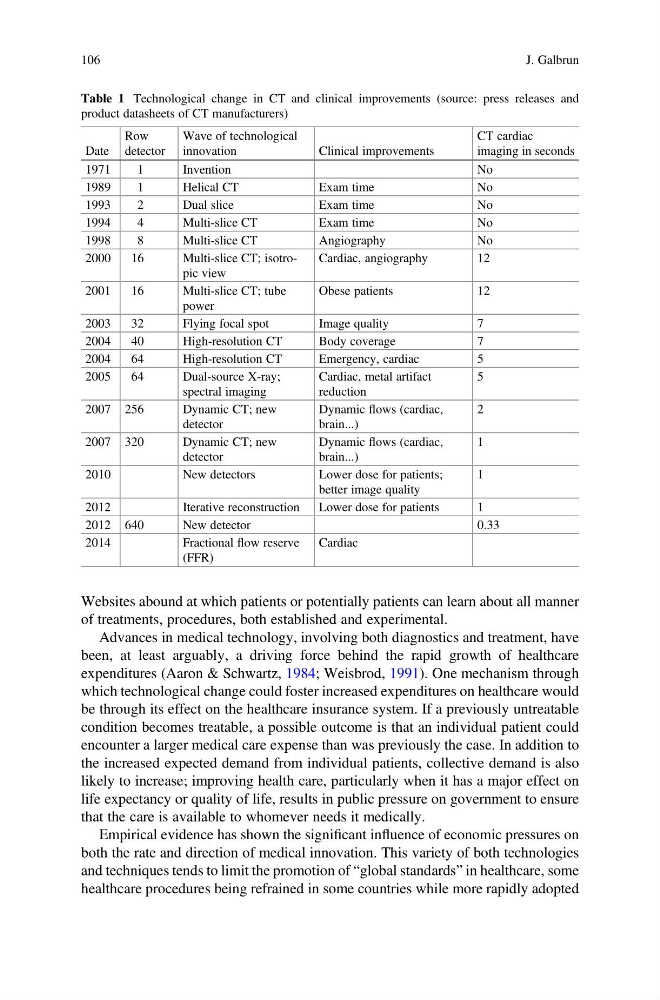
Table 1 Technological change in CT and clinical improvements (source: press releases and
product datasheets of CT manufacturers)
Date
Row
detector
Wave of technological
innovation
Clinical improvements
CT cardiac
imaging in seconds
1971
1
Invention
No
1989
1
Helical CT
Exam time
No
1993
2
Dual slice
Exam time
No
1994
4
Multi-slice CT
Exam time
No
1998
8
Multi-slice CT
Angiography
No
2000
16
Multi-slice CT; isotropic view
Cardiac, angiography
12
2001
16
Multi-slice CT; tube
power
Obese patients
12
2003
32
Flying focal spot
Image quality
7
2004
40
High-resolution CT
Body coverage
7
2004
64
High-resolution CT
Emergency, cardiac
5
2005
64
Dual-source X-ray;
spectral imaging
Cardiac, metal artifact
reduction
5
2007 256
Dynamic CT; new
detector
Dynamic flows (cardiac,
brain...)
2
2007 320
Dynamic CT; new
detector
Dynamic flows (cardiac,
brain...)
1
2010
New detectors
Lower dose for patients;
better image quality
1
2012
Iterative reconstruction
Lower dose for patients
1
2012 640
New detector
0.33
2014
Fractional flow reserve
(FFR)
Cardiac
106
J. Galbrun
of treatments, procedures, both established and experimental.
Advances in medical technology, involving both diagnostics and treatment, have
been, at least arguably, a driving force behind the rapid growth of healthcare
expenditures (Aaron & Schwartz, 1984; Weisbrod, 1991). One mechanism through
which technological change could foster increased expenditures on healthcare would
be through its effect on the healthcare insurance system. If a previously untreatable
condition becomes treatable, a possible outcome is that an individual patient could
encounter a larger medical care expense than was previously the case. In addition to
the increased expected demand from individual patients, collective demand is also
likely to increase; improving health care, particularly when it has a major effect on
life expectancy or quality of life, results in public pressure on government to ensure
that the care is available to whomever needs it medically.
Empirical evidence has shown the significant influence of economic pressures on
both the rate and direction of medical innovation. This variety of both technologies
and techniques tends to limit the promotion of “global standards” in healthcare, some
healthcare procedures being refrained in some countries while more rapidly adopted
Table 1 Technological change in CT and clinical improvements (source: press releases and
product datasheets of CT manufacturers)
Date
Row
detector
Wave of technological
innovation
Clinical improvements
CT cardiac
imaging in seconds
1971
1
Invention
No
1989
1
Helical CT
Exam time
No
1993
2
Dual slice
Exam time
No
1994
4
Multi-slice CT
Exam time
No
1998
8
Multi-slice CT
Angiography
No
2000
16
Multi-slice CT; isotropic view
Cardiac, angiography
12
2001
16
Multi-slice CT; tube
power
Obese patients
12
2003
32
Flying focal spot
Image quality
7
2004
40
High-resolution CT
Body coverage
7
2004
64
High-resolution CT
Emergency, cardiac
5
2005
64
Dual-source X-ray;
spectral imaging
Cardiac, metal artifact
reduction
5
2007 256
Dynamic CT; new
detector
Dynamic flows (cardiac,
brain...)
2
2007 320
Dynamic CT; new
detector
Dynamic flows (cardiac,
brain...)
1
2010
New detectors
Lower dose for patients;
better image quality
1
2012
Iterative reconstruction
Lower dose for patients
1
2012 640
New detector
0.33
2014
Fractional flow reserve
(FFR)
Cardiac
106
J. Galbrun